

How self-publishing, social media and algorithms are aiding far-right novelists
- Written by: Helen Young, Lecturer, Deakin University
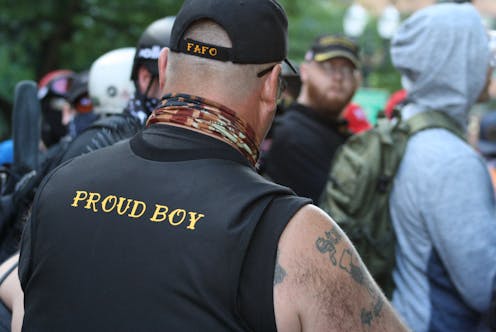
Far-right extremists pose an increasing risk in Australia and around the world. In 2020, ASIO revealed that about 40% of its counter-terrorism work involved the far right.
The recent mass murder in Buffalo, USA, and the attack in Christchurch, New Zealand, in 2019 are just two examples of many far-right extremist acts of terror.
Far-right extremists have complex and diverse methods for spreading their messages of hate. These can include through social media, video games, wellness culture, interest in medieval European history, and fiction. Novels by both extremist and non-extremist authors feature on far-right “reading lists” designed to draw people into their beliefs and normalise hate.
As literary studies scholars, our research grew out of exploring these reading lists and investigating why extremists write fiction. In 2020, we began looking at how someone who casually encountered a reading list online might access the books and pursue the ideas they contain.
We found a group of about 15 novels by self-identified neo-Nazis and other white supremacists that were known to counter-terrorism experts. Others were not. These books were disturbingly easy to get, because they were sold on sites including Amazon, Google Play, and Book Depository.
Publishing houses once refused to print such books, but changes in technology have made traditional publishers less important. With self-publishing and e-books, it is easy for extremists to produce and distribute their fiction.
In this article, we have only given the titles and authors of those books that are already notorious, to avoid publicising other dangerous hate-filled fictions.
A literature of hate
Far-right extremists have a long and successful history of spreading their ideas and helping inspire violence by writing and publishing novels. “The Great Replacement Theory”, which allegedly motivated the mass-murderer in Buffalo, and which the Christchurch attacker embraced in his manifesto, was articulated in 1973 in a French novel, Le Camp des Saints by Jean Raspail.
A few years later, the American neo-Nazi William L. Pierce published The Turner Diaries (1978). The novel is now known as “the bible” of the far-right. In 2021, the Australian Classification Board classed it as Category 1: Not Available to Persons Under 18 Years. Australian Border Force have reportedly seized copies, as they have with other known extremist books, including Le Camp des Saints.
Pierce claimed to have sold 185,000 copies of The Turner Diaries in the 20 years after it was published. Exact sales figures for the book and others like it are impossible to obtain. Some we identified as having far-right extremist narratives, written by authors with ties to militias in the USA, have appeared on New York Times bestseller lists.
The Turner Diaries has been directly linked to more than 15 acts of violence, including the deadly Oklahoma City bombing in 1995. The Christchurch terrorist used phrases from The Turner Diaries in his manifesto.
White supremacists from the USA, the UK and elsewhere have written novels to help spread their violent ideas since. Some write under pen-names and are impossible for us to identify, but the settings of some books suggest the authors may be Australian. Many imitate The Turner Diaries, in that they are “blueprints” and “fantasies” of terrorist acts leading to race war. Others are in popular fiction genres, including crime and historical fiction.

Read more: To shut down far-right extremism in Australia, we must confront the ecosystem of hate
Why would far-right extremists write novels?
Reading fiction is different to reading non-fiction. Fiction offers readers imaginative scenarios that can seem to be truthful, even though they are not fact-based. It can encourage readers to empathise with the emotions, thoughts and ethics of characters, particularly when they recognise those characters as being “like” them. A novel featuring characters who become radicalised to far-right extremism, or who undertake violent terrorist acts, can help make those things seem justified and normal.
Novels that promote political violence, such as The Turner Diaries, are also ways for extremists to share plans and give readers who hold extreme views ideas about how to commit terrorist acts. Authors can make suggestions through fictional narratives that might otherwise be censored, for example that politicians should be assassinated or buildings bombed.
Some known violent extremists have tried to make money from selling their books, but their main purpose is to spread hate-filled ideologies.
One author wrote that his books, which include crime and romance novels, all have “a political and racial message”. These books, he added, “make great gifts for that politically incorrect friend or significant other in your life”.
Publishing extremist fiction
50 years ago, Pierce had to start his own neo-Nazi press, as no publisher would print The Turner Diaries. The novel circulated mainly among white extremists, until it came to wider public knowledge following the Oklahoma City bombing. After that, a mainstream publishing house began to circulate the book, ostensibly to warn Americans about its violent ideology.
In the late 20th century, far-right extremists without Pierce’s notoriety found it impossible to get their books published. One complained about this on his blog in 1999, blaming feminists and Jewish people. Just a few years later, print-on-demand and digital self-publishing made it possible to circumvent this difficulty.
The same neo-Nazi self-published what he termed “a lifetime of writing” in the space of a few years in the early 2000s. The company he paid to produce his books – iUniverse.com – helped get them onto the sales lists of major booksellers Barnes and Noble and Amazon in the early 2000s, making a huge difference to how easily they circulated outside extremist circles. It still produces print-on-demand hard copies, even though the author has died. The same author’s books also circulate in digital versions, including on Google Play and Kindle, making them easily accessible
 A man reads scripture at a memorial for the victims of the attack on 15 May 2022 in Buffalo, NY.
Joshua Bessex/AP
A man reads scripture at a memorial for the victims of the attack on 15 May 2022 in Buffalo, NY.
Joshua Bessex/AP
Distributing extremist novels digitally
Far-right extremists use social media to spread their beliefs, but other digital platforms are also useful for them. Seemingly innocent sites that host a wide range of mainstream material, such as Google Books, Project Gutenberg, and the Internet Archive, are open to exploitation. Extremists use them to share, for example, material denying the Holocaust alongside historical Nazi newspapers.
Far-right novels are also shared easily online through social media platforms such as Gab and Telegram, alongside other extremist material, as well as on dedicated websites.
Amazon’s Kindle self-publishing service has been called “a haven for white supremacists” because of how easy it is for them to circulate political tracts there. The far-right extremist who committed the Oslo terrorist attacks in 2011 recommended in his manifesto that his followers use Kindle to to spread his message.
Our research has shown that novels by known far-right extremists have been published and circulated through Kindle as well as other digital self-publishing services.
When we began our research in 2020, The Turner Diaries was sold through Amazon, though it has now been taken down. Novels by less notorious neo-Nazis and other violent extremists are still sold there, and by other major e-book distributors, such as Google Play.
Read more: Not all polarization is bad, but the US could be in trouble
Radicalising recommendations
As we researched how novels by known violent extremists circulate, we noticed that the sales algorithms of mainstream platforms were suggesting others that we might also be interested in. Sales algorithms work by recommending items that customers who purchased one book have also viewed or bought.
Those recommendations directed us to an array of novels that, when we investigated them, proved to resonate with far-right ideologies.
A significant number of them were by authors with far-right political views. Some had ties to US militia movements and the gun-obsessed “prepper” subculture. Almost all of the books were self-published as e-books and print-on-demand editions.
Without the marketing and distribution channels of established publishing houses, these books rely on digital circulation for sales, including sale recommendation algorithms.
The trail of sales recommendations led us, with just two clicks, to the novels of mainstream authors. They also led us back again, from mainstream authors’ books to extremist novels. This is deeply troubling. It risks unsuspecting readers being introduced to the ideologies, world-views and sometimes powerful emotional narratives of far-right extremist novels designed to radicalise.
Banning and removing books by known violent extremists from sale can help limit how easily they are found, and whether money can be made from them. New novels can be quickly and easily written and published under pseudonyms, however, so we think it is more useful to help readers recognise and understand what far-right fiction is like and what it is trying to do.
 Abdul Aziz delivers his victim impact statement in the Christchurch High Court, 26 August 2020.
John Kirk-Anderson/AP
Abdul Aziz delivers his victim impact statement in the Christchurch High Court, 26 August 2020.
John Kirk-Anderson/AP
Read more: Can radicalisation be defeated? Yes, if we understand that it happens when people's bonds are broken
Recognising far-right messages
Some extremist novels follow the lead of The Turner Diaries and represent the start of a racist, openly genocidal war alongside a call to bring one about. Others are less obvious about their violent messages.
Some are not easily distinguished from mainstream novels – for example, from political thrillers and dystopian adventure stories like those of Tom Clancy or Matthew Reilly – so what is different about them? Openly neo-Nazi authors, like Pierce, often use racist, homophobic and misogynist slurs, but many do not. This may be to help make their books more palatable to general readers, or to avoid digital moderation based on specific words.
Knowing more about far-right extremism can help. Researchers generally say that there are three main things that connect the spectrum of far-right extremist politics: acceptance of social inequality, authoritarianism, and embracing violence as a tool for political change. Willingness to commit or endorse violence is a key factor separating extremism from other radical politics.
These positions emerge in fiction in some noticeable ways that are quite consistent across different genres.
Often, the story is set in an imaginary near future where everything from natural disasters to terror attacks, open war and citizen rebellion against an oppressive (always left-wing) government have caused society to fall into violent anarchy. Historical novels are usually set during times of social upheaval, such as the American Civil War.
Social inequality is written into the worlds of these novels. The protagonist is almost without exception a white heterosexual cisgendered male with military experience. Marginalised groups, including LGBTQI+ people, migrants, and people of colour, are almost always present in the story. They are often blamed for social collapse through a conspiracy theory that is typically also anti-Semitic. They are always enemies of the protagonist and are violently killed.
White women are spared only if they follow the orders of the protagonist and support his violence. Feminists, if they appear, are his enemies. The protagonist’s violence (and that of others like him) keeps him and his family safe and ultimately leads to a new society being established. That new society is always authoritarian and led by a white male.
These storylines depict white male violence as necessary and appropriate for solving whatever problems the protagonist, his family and society face. The violence is often graphic, and typically includes details of weapons and tactics used to inflict it.
Some books that feature these sorts of characters and storylines are not by authors with known radical or extreme politics. Those books could still reinforce a hateful message, especially if they are part of a digital “recommendations” trail that leads readers from one similar book to another.
It is very unlikely that anyone would become radicalised to violent extremism just by reading novels. Novels can, however, reinforce political messages heard elsewhere (such as on social media) and help make those messages and acts of hate feel justified. With the growing threat of far-right extremism and deliberate recruitment strategies of extremists targeting unexpected places, it is well worth being informed enough to recognise the hate-filled stories they tell.
Authors: Helen Young, Lecturer, Deakin University


















