

The Greens' election wins are not so surprising when you look at Queensland's political history
- Written by: Jon Piccini, Lecturer in History, Australian Catholic University
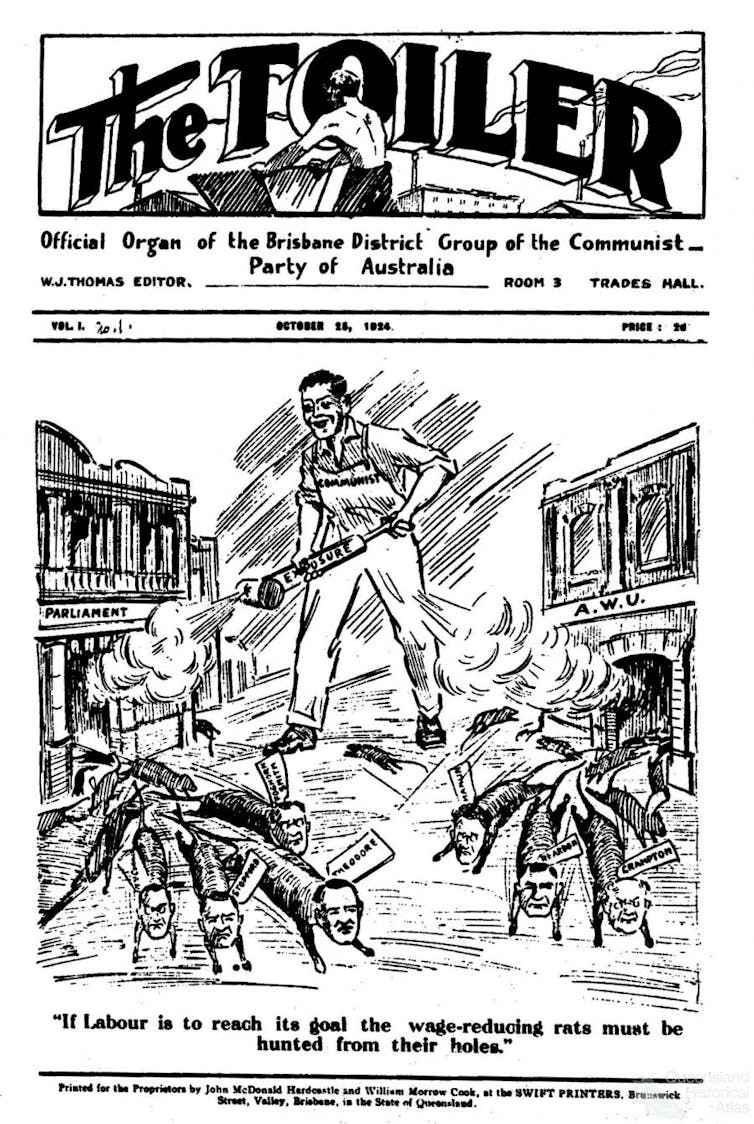
Aboriginal and Torres Strait Islander readers are advised this article contains names and an image of deceased people.
Victories of three Greens candidates in the federal election have thrown political certainties into doubt.
While the “teal wave” in Sydney and Melbourne blue-blood electorates resulted from the Liberal Party’s rightward drift, Green wins in inner-city, youthful seats of Griffith, Brisbane and Ryan defy simple explanation. After all, isn’t Queensland the “deep north”, a bulwark that secures conservative hegemony?
Read more: Good timing and hard work: behind the election's 'Greenslide'
While there is of course some truth here, Queensland historian Humphrey McQueen long ago diagnosed this perspective as a “state of mind”. Queensland’s “hillbilly dictatorship” excuses Southern critics, in McQueen’s interpretation, “from doing much about what is wrong in their own states”.
It also conveniently ignores the long history of Queensland left-wing radicalism, obscuring the continuities that underlay last Saturday’s result.
The Red North
Queensland was, of course, the birthplace of the Australian Labor Party. The Australian Workers Union (AWU) that emerged from a wave of shearers’ strikes in the 1890s was the party’s backbone in Queensland, ensuring it stayed in office for 40 almost uninterrupted years (1915-57).
Racism was the AWU’s modus operandi. It worked diligently to expel South Sea Island labourers in the 1900s and then treated the southern European – and primarily Italian – migrants who replaced them with contempt. As historian Diane Menghetti explained, this racism was fertile ground for the Communist Party, which established one of its strongest branches in the nation among the multicultural sugar cane workers of the far north, many of whom were refugees from fascism.
Their struggle, particularly for decent conditions in that dangerous industry, was depicted in Jean Devanny’s 1936 novel Sugar Heaven. It also saw Australia’s only Communist member of parliament – Fred Paterson – elected to the Queensland Legislative Assembly. Elected twice (in 1944 and 1947), Queensland Labor employed the gerrymander that premier Joh Bjelke-Peterson would later exercise with such aplomb to redistribute Paterson’s electorate.
‘A community of the left’
Seen as a millstone by the left today, Queensland’s resources sector has long been host to radicalism.
In 1964, an unprecedented 32-week strike and lockout at the Mt Isa Mines was led by anarchist Pat Mackie. Soon expelled from the AWU and fired from his job at the mines, Mackie’s militant challenge saw a state of emergency declared in the regional town. Mackay’s leadership garnered national infamy, and an attempted deportation to his native New Zealand.
At the same time, Indigenous activists were forging links with white unionists that would fundamentally shape Australian history. The Cairns Aboriginal and Torres Strait Islander Advancement League, an Indigenous-led rights organisation, was founded in 1960 – a time when such organisations were led by well-meaning whites. The league flourished amid what historian Sue Taffe calls a “community of the left” in that small Queensland town.
The Communist Party’s local branch, although much depleted since the 1930s, was still a substantial player in the local trade unions – particularly on the wharves. It also favoured self-determination for Indigenous peoples in line with decolonisation struggles in Asia and Africa.
Led by Joe McGuiness and Gladys O’Shane, the Cairns league forged a close working relationship with the Communists on the basis that, as O’Shane put it:
Stirring up prejudices between the coloured people and the whites…cause[s] divisions among the workers thereby […] break[ing] down hard-won conditions.
Many activists, including Eddie Koiki Mabo – a member of the Communist-controlled Waterside Workers Federation – first became politically active in the Cairns League. It is also worth noting that in the 2022 election, O'Shane’s daughter Pat outpolled the United Australia Party in the far north seat of Leichhardt, as candidate for the tiny Socialist Alliance.
Radical Brisbane?
To understand the Greens’ successes in southeast Queensland, then, it is insufficient to say Brisbane is a city that has outgrown its state. If anything, Brisbane has long mirrored the broader state’s rebellious streak.
This is evident in the right to march campaigns of the 1960s and 1970s, anti-uranium and nuclear weapons actions in the 1980s, as well as climate marches and Indigenous rights protests today.
It is instead fruitful to pull out some continuities between then and now. The campaign waged by the Queensland Greens reflects two vital traditions. One was pointed out by Greens councillor Jonathon Sri:
Queensland is not a conservative state. It is an anti-establishment state where voters have a healthy scepticism of authority and of whoever they perceive as being ‘in charge’.
Furthermore, the campaigns in inner Brisbane were based not on speaking over people, but to them about the material issues that affect their lives. Rental prices, the unaffordability of dental care, and of course climate change, were these campaigns’ key talking points.
By seeking to mobilise as many people as possible around unifying, radical demands, these campaigns show the “Red North’s” continued legacy today.
Authors: Jon Piccini, Lecturer in History, Australian Catholic University


















