

Google AI


Modern Australian

the enterprise bargaining system is broken, and in terminal decline

  • Written by: Anthony Forsyth, Distinguished Professor of Workplace Law, RMIT University
the enterprise bargaining system is broken, and in terminal decline

Real wages in Australia have been stagnating for the better part of a decade. Now, with higher inflation, they’re declining. So what can the new Albanese government, having campaigned hard on the previous government’s failures, do about it?

Making a submission to Australia’s industrial relations umpire, the Fair Work Commission, to lift the minimum hourly wage from A$20.33 to A$21.36, is one thing. If that push is successful, it would help the 2% of workers paid the minimum wage, as well as the 23% (about 2.2 million workers) on awards, whose rates would also lift.

Read more: Lifting the minimum wage is anything but reckless – it's what low earners need

But there’s a bigger systemic problem the Albanese government needs to address – a flaw designed and implemented by a previous Labor government. Enterprise bargaining, the mechanism introduced 30 years ago for workers to collectively negotiate better wages and conditions, is broken.

It’s failing low-paid workers lacking bargaining power in particular, and is a big part of the reason for such poor wages in female-dominated professions such as aged care and child care.

Origin of enterprise bargaining agreements

Enterprise bargaining was introduced during the Hawke-Keating Labor era in the early 1990s, in partnership with the Australian Council of Trade Unions and the support of employer groups.

The Business Council of Australia had lobbied strongly for an enterprise focus for negotiating employment conditions, on the basis it`was the best way to tie wage claims to gains in productivity.

Prime Minister Paul Keating extols enterprise bargaining in parliament on June 24 1992.

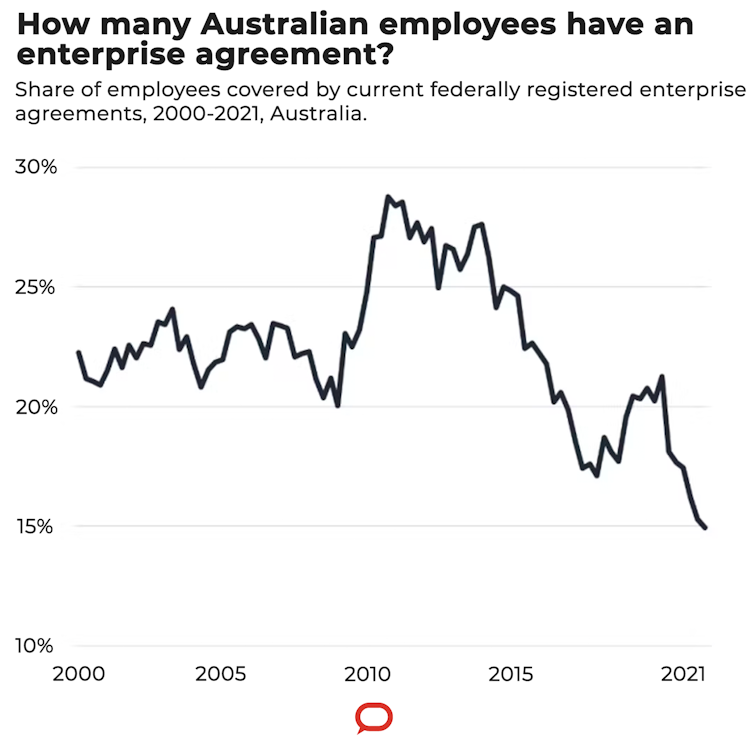
After 30 years, though, enterprise bargaining is in terminal decline, with ten years of shrinking agreement coverage in line with stagnant wages growth.

Research by labour law and policy experts Andrew Stewart, Jim Stanford and Tess Hardy published in May shows the total number of enterprise agreements fell by more than half between 2013 and 2021 (from 23,500 agreements to 10,000).

Worse, the share of employees covered by a current enterprise agreement declined from an average of 27% in 2012 to just 15% by late 2021. This is shown in the following graph.

Australia Institute, The Wages Crisis Revisited, CC BY-ND The Australian Industry Group and other business representatives blame this on the Fair Work Commission’s strict approach to the “better off overall test” and other statutory protections of employees’ interests in agreement-making. Unions see it differently. In their view, the reason enterprise bargaining is in free-fall is because of design flaws in the current laws, meaning workers have very limited negotiating power and employers can “game” the system to avoid their obligation to bargain. The main problem: enterprise bargaining was designed for an economy that no longer exists. Read more: Cabinet papers 1992-93: the rise and fall of enterprise bargaining agreements Workplaces have changed Allowing employees and unions to only bargain and take industrial action for an agreement with a single business, or part of a business, works fine with large worksites, such as factories, with hundreds or thousands of workers with the same employer. But these types of workplaces are increasingly rare. Now, many employers in sectors such as food production, logistics, warehousing, building management and “big box” retail stores have hived off large parts of their operations, and workers, to other entities. They’ve used labour hire, independent contracting and outsourcing to distance themselves from responsibility for minimum employment standards – and collective bargaining. To lift wages, workers need the boost to bargaining power that comes from being able to negotiate – and strike – across entire industries. Labour hire workers must be able to bargain not just with the agency that technically employs them, but with the business for whom they are working – such as Amazon, which has relied heavily on outsourced labour in its Australian operations. Workers who clean and provide security services in commercial buildings need to have the capacity to pursue pay increases from the lead firms that ultimately control labour’s share of profits. What Labor has promised to do Federal Labor’s 2021 national policy platform contains a commitment to “improve access to collective bargaining, including where appropriate through multi-employer collective bargaining”. It notes this access is a particular issue for low-paid employees lacking industrial power, and that the Fair Work Act does not adequately facilitate it. These points, however, were not mentioned in the run-up to the election. Nor did the Australian Council of Trade Unions make an issue of it, in contrast to its “Change the Rules” campaign between 2017 and 2019. ACTU general secretary Sally McManus addresses a 'Change the Rules' rally in Brisbane, November 20 2018.
ACTU general secretary Sally McManus addresses a ‘Change the Rules’ rally in Brisbane, November 20 2018. Glenn Hunt/AAP

Instead, Labor pledged to address other problems in the enterprise bargaining system: the weak requirements for employers to negotiate in “good faith”, and the ease with which employers can have agreements terminated.

However, the Albanese government may well be pushed to “go bolder” – not just by unions but also the Australian Greens, whose 2022 election policy states:

Workers should be free to collectively bargain at whatever level they consider appropriate and with whoever has real control over their work, whether at a workplace, industry, sector or other level.

The Greens’ platform also states:

Workers should have the right to engage in industrial action, including the right to strike, consistent with international law and not limited to artificially restricted bargaining periods.

The government may not need Greens’ support to pass legislation in the House of Representatives, but it will need it in the Senate.

So expect the future of enterprise bargaining, along with properly tackling insecure work, to be a hot topic for the government’s planned jobs summit.

With employers already talking up the need for productivity gains to underpin any changes, we’ll have to wait and see how serious the new government is about fixing a broken bargaining system.

Authors: Anthony Forsyth, Distinguished Professor of Workplace Law, RMIT University

Read more https://theconversation.com/theres-one-big-reason-wages-are-stagnating-the-enterprise-bargaining-system-is-broken-and-in-terminal-decline-183818

The Best Overseas Adventure Holidays for Australians Who Love the Outdoors

Australia offers no shortage of incredible outdoor experiences, but sometimes the best way to satisfy your sense of adventure is to head overseas. A...

Cape Town Wine Shuttle: Winelands Tasting & Tours

Embark on an unforgettable journey through the picturesque Cape Winelands, where world-class wines and breathtaking scenery await. Our Cape Town Win...

Why Giant Rats Tail Grass Keeps Coming Back After Spraying

Giant Rats Tail Grass (GRT) is one of the most frustrating pasture weeds for farmers and lifestyle property owners. You spray an infested area, see th...

When Custom Cardboard Boxes Make Sense for Your Business

Custom cardboard boxes can be useful when a standard carton does not fit a product, packing method or presentation requirement particularly well. A ...

Virtual Livestock Fencing and GPS Tracking: Improving Visibility Across Cattle Properties

What Virtual Livestock Fencing Means for Modern Cattle Management Managing cattle across extensive properties requires more than knowing where anim...

Sydney Pawnbrokers Explained: How Hocking Your Car Actually Works

Sometimes you need cash, and you need it soon. If you own a car, you may already have a way to get it. That's what people mean when they say they've...

Moving Interstate from the Gold Coast to Brisbane (or Back)? What Removalists Wish You Knew First

Have you talked to anyone who’s done the move? They say the same thing: the drive up the M1 is the easy part. It's everything around it that catches...

Why the Spring School Holidays Are a Great Time to Visit Coffs Harbour

The spring school holidays are a good time to spend a few days on the Coffs Coast. The weather is starting to warm up, there is plenty to do outdoor...

What to Do When an Older Car Is No Longer Worth Keeping in Melbourne

Ever looked at another repair quote and wondered whether your old car is still worth the trouble? It is a common turning point for Melbourne motoris...

Your Baby's First Year: A Local Guide to Feeding, Sleep, and When to Get Extra Support

Ask ten parents in a Brisbane mothers' group how their baby is feeding or sleeping, and expect ten different answers.  Someone's baby sleeps throug...

Kitchen and Laundry Makeover Ideas That Don't Require a Full Renovation

Full kitchen renos are expensive — and most people don't actually need one.  They need the kitchen to stop looking like it's stuck in 2009, or they...

How Technology Is Reshaping the Modern Australian Commercial Kitchen

The commercial kitchen has always been shaped by technology. Refrigeration changed how ingredients could be stored, modern ventilation transformed k...

The Number on a Roller Blind Fabric That Nobody Explains

Somewhere in the fabric book, next to the colour name, there is a percentage. Three per cent. Five per cent. Ten per cent. Nobody explains it, most c...

What’s Trending in Men’s Jewellery This Father’s Day!

Finding a Father’s Day gift that feels personal, stylish and genuinely wearable is not always easy. While socks and novelty mugs have traditionally ...

Road Signs: Understanding Their Role in Clear and Effective Signage

Effective signage and display hardware can help businesses communicate information, promote products and organise customer or visitor movement. Road...

Bottle Label Printing: Key Factors to Consider Before Your Next Packaging Run

Effective packaging begins with understanding the product, bottle material, artwork and production requirements when planning bottle label printing. H...

Planning a Long-Distance Move With Interstate Movers Melbourne

Moving between states involves more planning than a typical local relocation. Along with packing and transporting household belongings, you need to...

Understanding the Role of an I/O Controller in Industrial Automation

Modern industrial systems depend on accurate communication between sensors, machines and control systems. An I/O controller can help manage this commu...
















