

Louisa Lim's 'outstanding' portrait of a dispossessed, defiant Hong Kong is the activist journalism we need
- Written by: Kevin Carrico, Senior Lecturer, Chinese Studies, Monash University
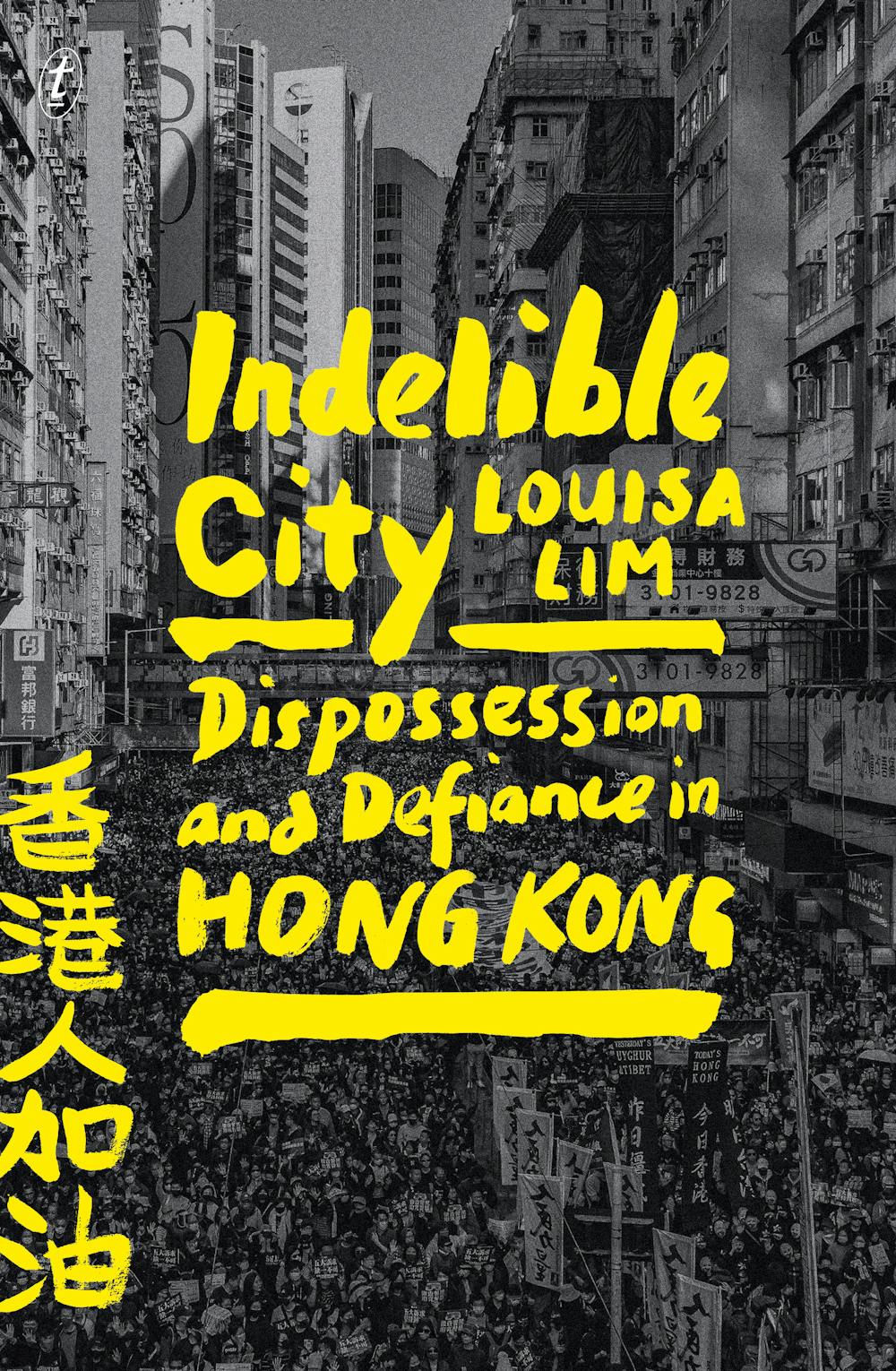
Indelible City is more than a book: it is a haunting testimonial to the intertwined vitality, tragedy and hope of Hong Kong.
Review: Indelible City: Dispossession and Defiance in Hong Kong by Louisa Lim (Text Publishing)
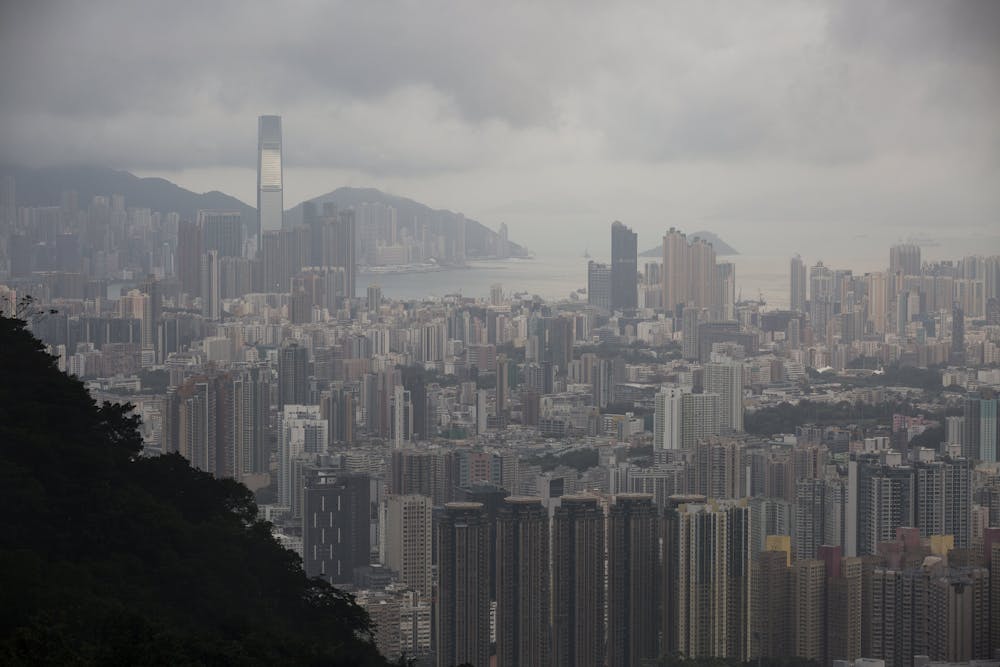 Hong Kong cityscape.
Jerome Favre/AP
From British to Chinese colonisation
Lim’s overview of the colonial era shows how British rule fostered the diverse, dynamic and mature society that we see today – but was structured around unforgivable exclusion and marginalisation. The latter, characteristic of the colonial experience, continued for Hong Kong in its process of supposed decolonisation.
Faced with the expiration of the 99-year lease on the New Territories in 1997, Great Britain pursued negotiations with China on the city’s future.
Lim brings us inside these negotiations and their often painful twists and turns, as the fate of millions was determined behind closed doors – with often quite inexplicable conclusions. Foremost among these was the diligent drafting of a supposedly legally binding agreement with China, a state that refuses to be bound by any law.
Read more:
'We fear Hong Kong will become just another Chinese city': an interview with Martin Lee, grandfather of democracy
Tellingly, there was no seat at the negotiating table for a representative from Hong Kong. Lim shows how the concerns of excluded locals turned out to be prophetic.
One local official, excluded from the talks, expressed his worries that Hong Kong would not be genuinely autonomous, but rather controlled by Beijing; that Chinese officials charged with implementing policy would be unable to accept Hong Kong’s culture; and that future Chinese leaders might change their mind about promises made to Hong Kong. Few predictions of Hong Kong’s future could be more accurate.
The result of this deeply flawed process, as we can all see today, is a dynamic society muzzled under the so-called National Security Law. Although marketed as a law, the National Security Law is effectively the end of all law in Hong Kong. It strips away legally protected rights and due process, giving the government free rein to imprison anyone it pleases indefinitely for speech crimes.
The fate of Hong Kong today is a stain on Britain’s legacy and a reminder of the fundamental duplicity of the Chinese Communist Party leadership. Yet most importantly, for the people of Hong Kong, none of whom have remained untouched by this debacle, it is a genuine tragedy: recolonisation masquerading as decolonisation.
Read more:
Hong Kong activists now face a choice: stay silent, or flee the city. The world must give them a path to safety
‘Guerrilla street calligrapher’ the King of Kowloon
Woven into this rich history is a parallel micro-history of the King of Kowloon: Tsang Tsou-Choi, a trash collector with some fairly obvious mental issues who made a name for himself as a guerrilla street calligrapher. Lim’s narrative of Tsang, his life, and his rise to the status of media icon makes for unforgettable reading.
Hong Kong cityscape.
Jerome Favre/AP
From British to Chinese colonisation
Lim’s overview of the colonial era shows how British rule fostered the diverse, dynamic and mature society that we see today – but was structured around unforgivable exclusion and marginalisation. The latter, characteristic of the colonial experience, continued for Hong Kong in its process of supposed decolonisation.
Faced with the expiration of the 99-year lease on the New Territories in 1997, Great Britain pursued negotiations with China on the city’s future.
Lim brings us inside these negotiations and their often painful twists and turns, as the fate of millions was determined behind closed doors – with often quite inexplicable conclusions. Foremost among these was the diligent drafting of a supposedly legally binding agreement with China, a state that refuses to be bound by any law.
Read more:
'We fear Hong Kong will become just another Chinese city': an interview with Martin Lee, grandfather of democracy
Tellingly, there was no seat at the negotiating table for a representative from Hong Kong. Lim shows how the concerns of excluded locals turned out to be prophetic.
One local official, excluded from the talks, expressed his worries that Hong Kong would not be genuinely autonomous, but rather controlled by Beijing; that Chinese officials charged with implementing policy would be unable to accept Hong Kong’s culture; and that future Chinese leaders might change their mind about promises made to Hong Kong. Few predictions of Hong Kong’s future could be more accurate.
The result of this deeply flawed process, as we can all see today, is a dynamic society muzzled under the so-called National Security Law. Although marketed as a law, the National Security Law is effectively the end of all law in Hong Kong. It strips away legally protected rights and due process, giving the government free rein to imprison anyone it pleases indefinitely for speech crimes.
The fate of Hong Kong today is a stain on Britain’s legacy and a reminder of the fundamental duplicity of the Chinese Communist Party leadership. Yet most importantly, for the people of Hong Kong, none of whom have remained untouched by this debacle, it is a genuine tragedy: recolonisation masquerading as decolonisation.
Read more:
Hong Kong activists now face a choice: stay silent, or flee the city. The world must give them a path to safety
‘Guerrilla street calligrapher’ the King of Kowloon
Woven into this rich history is a parallel micro-history of the King of Kowloon: Tsang Tsou-Choi, a trash collector with some fairly obvious mental issues who made a name for himself as a guerrilla street calligrapher. Lim’s narrative of Tsang, his life, and his rise to the status of media icon makes for unforgettable reading.
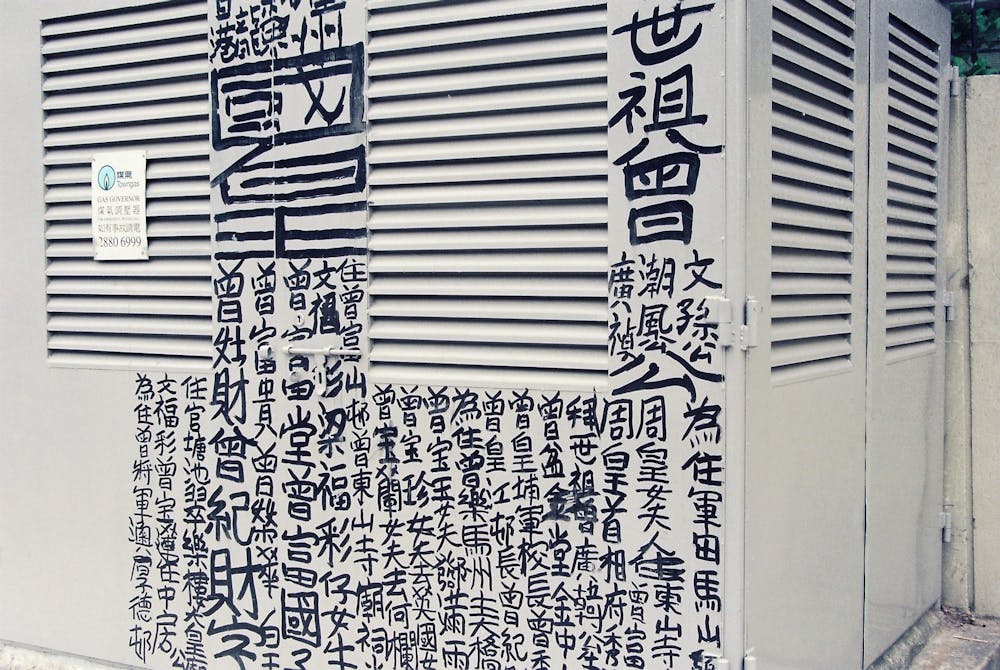 King of Kowloon street graffiti.
longzijun/Flickr
At some point in his life, Tsang came to the admittedly unlikely but symbolically telling conclusion that his family had once owned the Kowloon Penninsula and that this land had been taken from them illegally. Rather than seeking redress in the courts – long the preferred avenue for settling disputes in the city – Tsang opted to decorate the cityscape with calligraphic declarations of his family’s ownership of the penninsula and his own self-declared royal status.
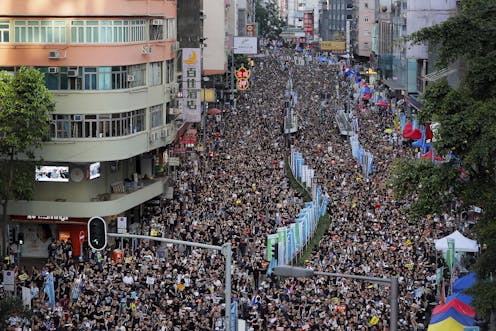
Tsang’s choice here anticipated a broader shift from working within the system to resolve issues, to seeking new paths outside the system: a driving ethos of the protest movement of 2019. Here again, the streets of Hong Kong were covered in calligraphic declarations of dispossession and defiance, seeking redress (that would never arrive) beyond the stifling confines of the conventional.
Neutrality a ‘corrupt compromise’
The third narrative thread in the book is Lim’s own personal experiences, from growing up Eurasian in Hong Kong to observing the defining moments of the 2019 protests.
I particularly appreciated Lim’s frequently witty casual observations and offhand comments, which incorporate a touch of humour into the narrative: much needed, considering the gravity of its subject.
King of Kowloon street graffiti.
longzijun/Flickr
At some point in his life, Tsang came to the admittedly unlikely but symbolically telling conclusion that his family had once owned the Kowloon Penninsula and that this land had been taken from them illegally. Rather than seeking redress in the courts – long the preferred avenue for settling disputes in the city – Tsang opted to decorate the cityscape with calligraphic declarations of his family’s ownership of the penninsula and his own self-declared royal status.
Tsang’s choice here anticipated a broader shift from working within the system to resolve issues, to seeking new paths outside the system: a driving ethos of the protest movement of 2019. Here again, the streets of Hong Kong were covered in calligraphic declarations of dispossession and defiance, seeking redress (that would never arrive) beyond the stifling confines of the conventional.
Neutrality a ‘corrupt compromise’
The third narrative thread in the book is Lim’s own personal experiences, from growing up Eurasian in Hong Kong to observing the defining moments of the 2019 protests.
I particularly appreciated Lim’s frequently witty casual observations and offhand comments, which incorporate a touch of humour into the narrative: much needed, considering the gravity of its subject.
 Louisa Lim’s book is an ‘outstanding example’ of activist journalism. Photo Laura Du Vé.
In her reflections on the events of 2019, Lim narrates a number of moments at which she crossed over from an observer of political developments to become a participant. This poses a pressing question for our time: how does one balance the ideal of journalistic or academic neutrality with activist participation?
The answer to this question is, in my reading, extremely clear. As the horrifying nature of Chinese Communist Party rule over its colonies – from Hong Kong to Tibet to Xinjiang – becomes increasingly apparent, the ideal of neutrality becomes a corrupt compromise with the fundamentally unjustifiable.
If academic or journalistic work on China in the age of the National Security Law, concentration camps and genocide is to have any meaning at all beyond its own vapid self-reproduction, it must embrace an activist ethos – of which Indelible City is an outstanding example.
Lim’s book concludes with details of a fascinating exchange with a curator and friend of the King of Kowloon, Joel Chung Yin-chai. Chung has ironically spent years carefully painting over the King’s calligraphy in public spaces, to preserve and protect these works from state-enforced erasure.
The King’s defiance thus lives on under a thin veneer of paint, unnoticed by tens of thousands of passersby every day, awaiting a moment when it can again see the light of day. This image is deeply evocative in the context of Hong Kong today.
Similarly, if we peer beneath the surface of the National Security Law’s unrelenting reign of terror, we can still see a politically engaged and dynamic civil society – as captured so memorably in Lim’s book. Hopefully awaiting the day when the thin, fragile and always fundamentally unsustainable veneer of repression can finally be chipped away, as history shows it always will be.
This will be the day when the people of Hong Kong will finally have a say in determining their own future, once and for all.
Authors: Kevin Carrico, Senior Lecturer, Chinese Studies, Monash University
Louisa Lim’s book is an ‘outstanding example’ of activist journalism. Photo Laura Du Vé.
In her reflections on the events of 2019, Lim narrates a number of moments at which she crossed over from an observer of political developments to become a participant. This poses a pressing question for our time: how does one balance the ideal of journalistic or academic neutrality with activist participation?
The answer to this question is, in my reading, extremely clear. As the horrifying nature of Chinese Communist Party rule over its colonies – from Hong Kong to Tibet to Xinjiang – becomes increasingly apparent, the ideal of neutrality becomes a corrupt compromise with the fundamentally unjustifiable.
If academic or journalistic work on China in the age of the National Security Law, concentration camps and genocide is to have any meaning at all beyond its own vapid self-reproduction, it must embrace an activist ethos – of which Indelible City is an outstanding example.
Lim’s book concludes with details of a fascinating exchange with a curator and friend of the King of Kowloon, Joel Chung Yin-chai. Chung has ironically spent years carefully painting over the King’s calligraphy in public spaces, to preserve and protect these works from state-enforced erasure.
The King’s defiance thus lives on under a thin veneer of paint, unnoticed by tens of thousands of passersby every day, awaiting a moment when it can again see the light of day. This image is deeply evocative in the context of Hong Kong today.
Similarly, if we peer beneath the surface of the National Security Law’s unrelenting reign of terror, we can still see a politically engaged and dynamic civil society – as captured so memorably in Lim’s book. Hopefully awaiting the day when the thin, fragile and always fundamentally unsustainable veneer of repression can finally be chipped away, as history shows it always will be.
This will be the day when the people of Hong Kong will finally have a say in determining their own future, once and for all.
Authors: Kevin Carrico, Senior Lecturer, Chinese Studies, Monash University 

















