

what ex-automotive workers told us about job loss, shutdowns, and communities on the edge
- Written by: Helen Dinmore, Research Fellow, University of South Australia
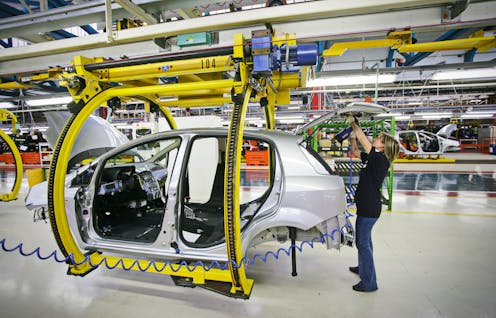
Economies are forever changing and the loss of some industries or businesses is part of that transformation. But change often comes at great cost for workers, many of whom are already vulnerable.
The stories of retrenched workers give us important insights into the often complex effects of job loss. To find out more about these experiences, we interviewed 28 workers made redundant from the auto sector around South Australia and Victoria over the past five years, as part of a larger research project about disadvantaged communities.
Our paper, published in the journal Regional Studies, Regional Science, reveals how economic change interrupts careers and life plans, casting people into new worlds of precarious work and long, indefinite journeys in search of security.
The stories of these automotive workers are not unique; they reflect the experiences of many workers in Australia who have faced retrenchment and redundancy as industries and businesses have closed.
Read more: What the departure of Toyota, Holden and Ford really means for workers
Bad jobs are easy to find
Since being retrenched, many of our interviewees have struggled to find a job that is secure, safe and pays a decent wage.
Bad jobs – with undesirable hours and low pay – are easy to find, and many are forced to take them. Many are also shocked by what they find at their new workplaces – poor safety standards, toxic cultures and boring or “disgusting” work. These included jobs as diverse as food processing, cleaning, warehousing, chicken killing and grout manufacturing.
As one worker who’d been made redundant three years before told us:
I got a job as a prefabrication supervisor […] And that was absolutely horrible, horrible, horrible […] just the safety stuff, you know, like they talked a lot of safety, but there was never much action […] just a bullying culture.
Another left a processing job with a food company after just two days, saying:
I couldn’t do that job. It was absolutely disgusting. It was hot. They were arrogant towards you.
Workers often left jobs quickly, or struggled through while looking for something else. The result was a high level of employment instability, as people cycled through multiple jobs searching for one they could tolerate long term.
‘It really, really scarred me’
Workers at the bottom of the labour market often experience demanding or demoralising recruitment processes for casual positions through labour hire agencies. These workers are made to feel feel they can’t afford to be choosy:
So labour hire, I just pretty much I just said yes to everything. And that’s the way, that’s the work in labour hire. If you start saying no, then you go to the back of the list.
Casual jobs often serve as a kind of probation, but there are no guarantees:
I couldn’t see a future. Yeah. So I would just continue to look around […] because I couldn’t see them taking me any further than casual.
One worker who had already experienced bad employers described the difficult choice she faced:
I would like [to leave this job and look for something] permanent. But I really don’t want to go into another workplace like [company name], it really, really scarred me.
Workers want their old lives back – even if that’s not the “real world” any more. As one put it:
I just think there’s a lot of work out there that, there’s just bits and pieces, and it doesn’t really support someone to have a proper job or be able to afford a decent life […] I’ve probably had maybe six, seven, eight jobs since [the closures]. And none of them have been that good. And I mean, I’ve hated most of them.
A new world of precarious work
In many established sectors, workers once enjoyed good working conditions – often over decades of employment in what they believed were “jobs for life”. Job loss thrust them into a new world of precarious work very different from what they’d known.
Many were downhearted about this new reality:
It’s just very, very dodgy […] it’s sad, really sad to think that there’s, like, these places out there. And there’s so many of them and they’re operating the way they do and, and nobody’s really controlling any of it.
Some never stopped longing for a job that made them feel the way their old job did:
I just miss [my old firm], I miss their way of working. Building up you as a person, as a team.
Even those who had adjusted to their new working lives admitted that you needed to be willing to do anything:
[T]here is work out there […] Too many people are too choosy, that’s the problem […] I didn’t give a shit what sort of work I did […] There’s money in shit.
Better jobs – not just more jobs
At the start of the pandemic, the nation’s leaders talked about “building back better”.
For those living on the margins of our workforce and those made redundant through processes beyond their control, “building back better” means finding ways to create better – not just more – jobs.
Australian workers want security, decent conditions and job satisfaction, not a choice between one “shit” workplace and another.
Most of all, they want work they can build their lives around. If we don’t listen to the voices of those living on the fringe, the problems we know all too well today will haunt our communities into the future.
Read more: Australia's choice: pay for a car industry, or live with the consequences
Authors: Helen Dinmore, Research Fellow, University of South Australia


















