

despite waning public support, governments are spending big to keep the industry running
- Written by: Alexandra McEwan, Lecturer: Law, CQUniversity Australia

An e-petition against greyhound racing to the Tasmanian parliament reached a record number of signatures last week, with 13,519 people demanding the state government end public funding of the industry. The previous record in Tasmania was 11,699 signatures, for an e-petition supporting end-of-life choices.
It is clear that public opposition to greyhound racing isn’t going away. In May 2021, a petition opposing greyhound racing in the Western Australian parliament attracted similar support. A second petition to ban greyhound racing in WA opened in March 2022.
Yet, recent history doesn’t bode well for the success of these petitions. Despite over a decade of public outcry and animal cruelty revelations, greyhound racing is still legal in all Australian states and territories, except the ACT.
It seems governments are doggedly committed to providing financial support to an industry that is arguably out of step with community values, and has struggled to make ends meet on its own. Let’s take a closer look at government support of greyhound racing.

Government support for greyhound racing
The greyhound racing industry was put under the spotlight in 2015 after ABC Four Corners revealed instances of using live baits, such as possums and piglets, to train greyhounds.
This led to public protests and a New South Wales Special Commission of Inquiry in 2016, which found the industry had lost its social licence. Among its disturbing findings was that of the 97,783 greyhounds bred in NSW over 12 years, up to 68,448 dogs were killed.
Yet, these developments were not enough to effectively ban the greyhound racing industry in NSW.
Following a hugely contentious legislative turnaround in which greyhound racing was reinstituted after being banned, the NSW government contributed A$500,000 in prize money to the inaugural Million Dollar Chase in 2018. This is considered the richest greyhound race event in the world.
Read more: New South Wales overturns greyhound ban: a win for the industry, but a massive loss for the dogs
Queensland’s government followed suit. In 2019 it pledged an extra $4.1 million to the state’s greyhound racing industry in prize money for 2019-2020, and to build a $39 million racing venue in southeast Queensland.
Apart from generous financial support to the greyhound racing industry and public opposition to the industry, other issues continue to attract debate.
These include calls for mandatory collection and publication of birth, death, and injury data, and a ban on exporting greyhounds. In 2021, the integrity unit of Greyhound Racing Victoria investigated alleged illegal export of greyhounds, involving greyhounds being flown to the United Kingdom and then rerouted to China.
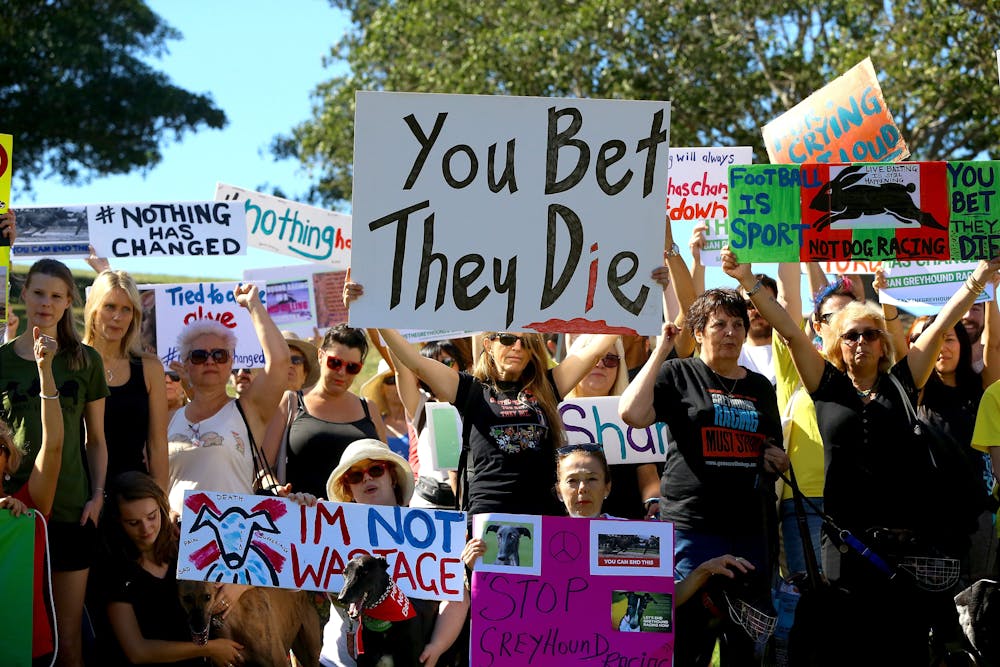 Protesters hold placards during an Anti-Greyhound Racing rally at Sydney Park in 2018, a year after greyhound racing was reinstated in NSW.
AAP Image/Jeremy Ng
Protesters hold placards during an Anti-Greyhound Racing rally at Sydney Park in 2018, a year after greyhound racing was reinstated in NSW.
AAP Image/Jeremy Ng
Is it really benefiting the economy?
Any claimed economic benefits of the greyhound racing industry, and justifications for government support, require scrutiny. Let’s take Tasmania as an example. This month, Tasracing chief executive Paul Eriksson told the Mercury:
while there were other costs associated with the industry, including track maintenance, administration and welfare, it ultimately generated economic benefits to the state of $53.2m and supported 433 full-time equivalent workers.
The figures Eriksson quotes are consistent with those presented in a 2021 economic impact evaluation on the size and scope of the Tasmanian racing industry by consulting business IER.
But how reliable are these estimates? The IER report used Input-Output (I-O) methodology, which focuses on industry spending. It is used to estimate the direct and indirect impacts of an industry according to the value added, income and employment created.
Read more: Be suspicious of claims the mining industry creates non-mining jobs
Although widely used, the I-O methodology has significant limitations, such as restrictive assumptions about supply and demand to the industry.
For the greyhound racing industry, on the demand side, medium-term projections point to a decline due to falling greyhound racing day attendances and animal welfare concerns. In terms of the labour force contribution, greyhound racing represents only 0.19% of the Tasmanian labour force (433 full-time equivalent jobs).
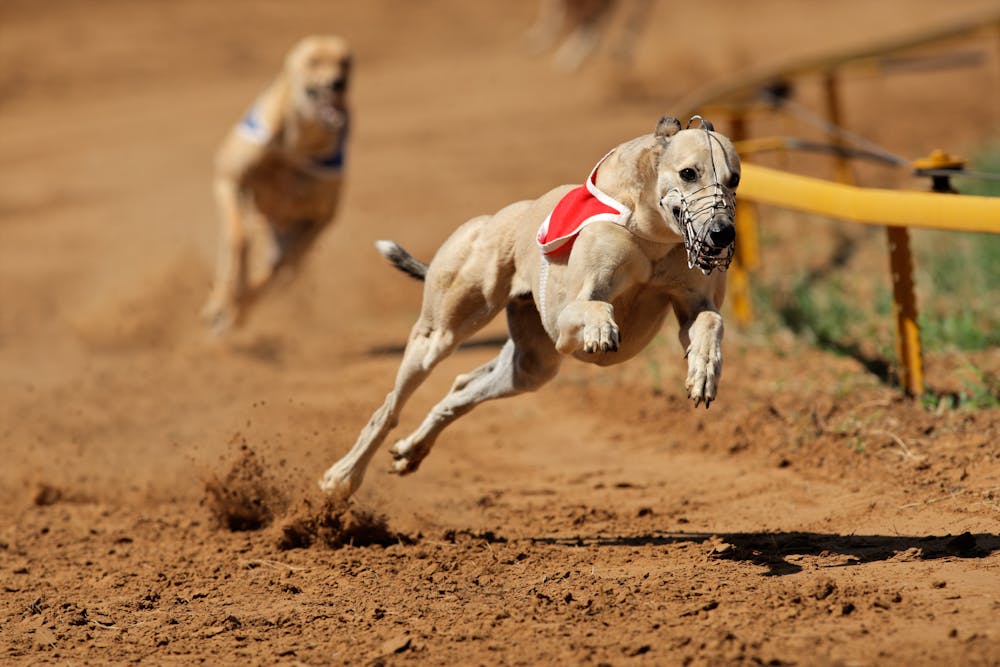 Greyhound racing is legal everywhere in Australia except the ACT.
Shutterstock
Greyhound racing is legal everywhere in Australia except the ACT.
Shutterstock
Transitioning the industry
Only the ACT has successfully banned greyhound racing, as of April 30 2018. Compared to other states, the ACT greyhound racing industry was a soft target for reform, due to is size.
In 2017, only 70 Canberra residents were actively participating in greyhound racing (owners, breeders and trainers). And only around [52 racing greyhounds] were based in the ACT.
Australia’s situation sits in stark contrast to the United States, where only two dog tracks remain across the country after a track in Iowa closed last month.
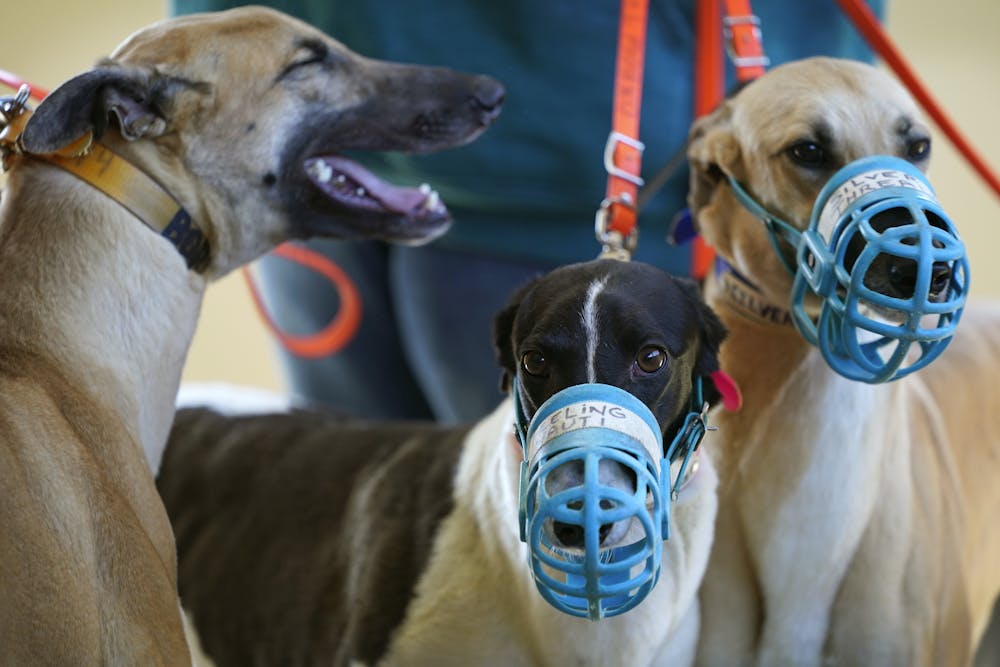 Greyhounds in a holding area before being weighed prior to a race at the Iowa Greyhound Park in the US before the track, one of the last in the US, closes.
AP Photo/Charlie Neibergall
Greyhounds in a holding area before being weighed prior to a race at the Iowa Greyhound Park in the US before the track, one of the last in the US, closes.
AP Photo/Charlie Neibergall
Greyhound racing’s popularity is highest in regional areas where it, for example, provides an important opportunity for social connection. Government financial support seems to lie in the industry’s role as a social hub and as a key form of recreation.
Rather than contributing prize money, governments could instead consider supporting other forms of recreation that fulfil similar community functions – ones that avoid overbreeding dogs, gambling, and that encourage positive well-being outcomes.
Decisions about what this might look like ought to be the result of community consultation at a local level.
The future of Australia’s greyhound racing lies in the balance of government willingness to provide ongoing support using taxpayer money. But this cannot be taken as a given in our changing and unpredictable political landscape.
Read more: Greyhound pups must be tracked from birth to death, so we know how many are killed
Authors: Alexandra McEwan, Lecturer: Law, CQUniversity Australia


















