

the burglary that launched a thousand scandals
- Written by: Rodney Tiffen, Emeritus Professor, Department of Government and International Relations, University of Sydney
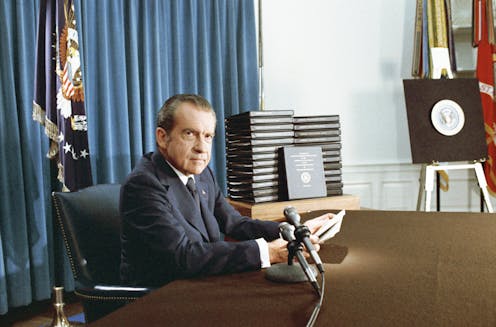
One of the more curious legacies of the Watergate scandal is so obvious that we barely notice it.
Watergate was the name of the Washington office complex where five men – later revealed to be working on behalf of US president Richard Nixon’s administration – were discovered burgling the Democratic Party’s national headquarters. Their arrest on June 17 1972 – 50 years ago today – not only led eventually to Nixon’s resignation but also fuelled an international tendency to add “-gate” to anything that looks scandalous.
The fashion was started by New York Times columnist William Safire, a former Nixon speechwriter, apparently to defend his former boss by showing just how prevalent scandals were. Early cases included Koreagate (following revelations of secret Korean donations to congressional candidates in the 1976 elections) and Billygate (named after president Jimmy Carter’s wayward younger brother, whose high-profile antics included promoting a new beer, Billybeer, and receiving money from the Libyan government) and Lancegate (sparked by the dubious business affairs of Carter cabinet member Bert Lance).
Fifty years later, the suffix is as popular as ever. When Will Smith dashed on stage and slapped MC Chris Rock for making a joke about his wife at this year’s Academy Awards, the incident was immediately labelled Slapgate.
More seriously, when British prime minister Boris Johnston and his colleagues defied government bans on social gatherings designed to curb the spread of COVID, the term Partygate was quickly, and damagingly, coined by the media.
Sometimes “-gates” go head to head, most famously during the 2016 US presidential election campaign. Around a month before the election, a tape emerged of Trump boasting to a male colleague about the things you can do to women if you’re a star. Inevitably it attracted the distasteful label, Pussygate, and so dominated the news that many thought Trump would have to withdraw his candidacy.
The other side of the equation came a couple of weeks later, when Emailgate made a comeback. It had been revealed some years earlier that Hillary Clinton had used private email rather than the official government server when she was secretary of state. Now, FBI director James Comey announced he was re-opening investigations. By giving Trump licence to denounce Clinton’s “corruption”, the decision guaranteed that the last weeks of the campaign would be dominated by this issue. Days before voting day, Comey cleared Clinton.
The prominence of the issue, highlighting what many thought was the tendency of the Clintons to make their own rules, may have caused some potential supporters to stay home, and so affected the election result.
Read more: From irreverence to irrelevance: the rise and fall of the bad-tempered tabloids
My favourite “-gate” emerged from the scandal engulfing America’s most famous TV evangelist, Jim Bakker, and his wife Tammy after their multi-million dollar empire collapsed. Jim was eventually imprisoned for fraud and various sexual liaisons. The scandal was dubbed Pearlygate.
Perhaps the ultimate in wordplay came during two scandals labelled Gategate. The first was a brief episode in the colourful career of Colonel Oliver North, a Reagan administration official closely associated with the Iran-Contra scandal (sometimes called Irangate). During the furore, North was given taxpayer assistance to increase security at his home; the extravagance involved was labelled Gategate.
The other Gategate stretched on for a couple of years. In 2012, conservative MP Andrew Mitchell attempted to leave Downing Street by the main gate, only to be told by a police officer to use another one. He allegedly lost his temper and, amid his stream of abuse, called the officer a “pleb”. The subsequent uproar forced Mitchell to resign. Both politician and police officer launched defamation suits against the other, but the judge ruled in the police officer’s favour. British media used both Plebgate and Gategate as shorthand for the affair.
The term also spread to Australia, though not always to describe allegations with a solid basis. Utegate involved a charge of corruption launched spectacularly in 2009 by opposition leader Malcolm Turnbull against prime minister Kevin Rudd and treasurer Wayne Swan. Turnbull’s claim that they had acted improperly on behalf a Queensland car dealer seemed dramatic and damaging, but it turned out the key evidence was a forgery by Treasury official Godwin Grech. The charge collapsed in ignominy.
The list of scandals goes on. When NSW premier Barry O’Farrell was shown to have misled the Independent Commission Against Corruption by denying having received a $3000 bottle of Grange Hermitage from a Liberal colleague, Grangegate was the obvious shorthand. O’Farrell resigned as premier. When the speaker of the House of Representatives, Bronwyn Bishop, used taxpayers’ money to fly to a Liberal Party fundraiser at a cost of around $5000, Choppergate was born. Bishop resigned as speaker and lost preselection at the next election.
When Australian cricketers were found to have tampered with the ball during a test match in South Africa in 2018, the affair was labelled Sandpapergate. Three players, including captain Steve Smith and vice-captain David Warner, received suspensions.
Coming full circle, Australia had its own Watergate in 2019. A water buyback payment of $80 million under the Murray–Darling Basin scheme went to a company registered in the Cayman Islands. Minister Barnaby Joyce approved the payment, but it emerged that the company had been founded by another minister, Angus Taylor.
Read more: Australia's 'watergate': here's what taxpayers need to know about water buybacks
After 50 years, though, “-gate” has lost much of its force – and might even be an obstacle to rational debate.
On one notorious occasion, for example, the suffix was used widely to impute serious wrong-doing when none had occurred. In the lead-up to the Copenhagen summit on global warming in late 2009, emails from the Climate Research Unit at the University of East Anglia were hacked and snippets selectively publicised by a group of climate sceptics.
A series of inquiries eventually confirmed the integrity of the Centre’s research, but the hackers had succeeded in casting aspersions on climate science at a strategic moment, and part of their success was in the almost universal use in the media of the derogatory term, Climategate.
What these 50 years of examples show, above all, is that we’ve become increasingly desensitised to scandalous behaviour of many kinds. In a long-running scandal with several twists and turns – such as Boris Johnson’s Partygate, or Watergate itself – the label can be helpful shorthand. Most often, though, what was once attention-grabbing and sometimes an amusing gimmick has become a stale cliché.
Authors: Rodney Tiffen, Emeritus Professor, Department of Government and International Relations, University of Sydney
Read more https://theconversation.com/watergate-at-50-the-burglary-that-launched-a-thousand-scandals-185030



















