

How are PhD students meant to survive on two-thirds of the minimum wage?
- Written by: Nathan Garland, Lecturer in Applied Mathematics and Physics, Griffith University

Over the decades, supportive parents of Australian students on the cusp of graduating from their undergraduate studies have occasionally been struck by a bewildering decision by their pride and joy. Instead of pursuing an appetising salary in a prestigious company, their student has instead decided to do the unthinkable: they’re going to do a PhD. Where’s the money in that? What will we tell the neighbours?
A PhD program is foremost a training experience. A PhD student works a full-time apprenticeship (38 hours a week on average) in their chosen research field, guided by expert mentors along the way. While the choice to enter a PhD program is primarily based on a student wanting to upskill and learn, much like the choice to pursue an undergraduate degree, the starting point, method of study and outputs of a PhD are very different.
In Australia, the standard scheme to fund the living costs of PhD candidates is a tax-free stipend from their university. The university is allocated the funds via the Research Training Program (RTP).
This stipend is now $28,854 a year (indexed annually against inflation). That’s only two-thirds of the national minimum wage after last week’s increase to $42,246.88.
Read more: This 5.2% decision on the minimum wage could shift the trajectory for all
In weekly terms an income of $554.88 puts PhD candidates well below the poverty line of $608.96 for a single person if they have to pay for housing. Further, it’s close to an all-time low of 30% as a proportion of average full-time earnings.
In 2017 a sliding scale of stipends was introduced. Looking at the websites of the 39 members of Universities Australia in June 2022, it is encouraging to see a few universities offer higher rates than the required minimum for their PhD programs. However, most universities still mandate the lowest base rate.
A fair shake of the sauce bottle
This funding arrangement has been in place for some time, serving the community reasonably well. However, in the current economic climate of uncertainty, rising costs of living, skyrocketing rents and the Fair Work Commission’s decision to increase the minimum wage by 5.2%, it is worth comparing historical stipend rates, dating back to 1959, with other relevant yardsticks of income.
To make a fair comparison, we could scale up historically recorded weekly average, median and minimum wages over a 52-week year, noting that most Australian PhD programs permit 20 days of paid personal leave per year. Below, we see how these annual incomes have evolved over time since the inception of the PhD stipend.
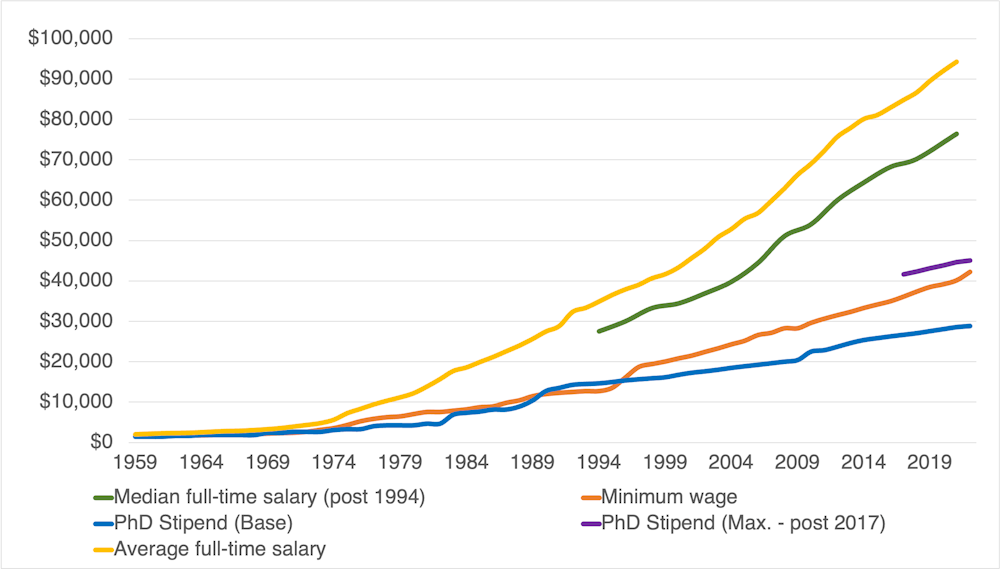
Alternately, we can plot the PhD base rate and minimum wage as proportions of the average full-time income. Also shown is the consumer price index (CPI) as a standard measure of inflation, to give us some context – especially at this time of soaring living costs.
At present, PhD stipends languish far below the minimum wage, even allowing for tax on the minimum wage (take off roughly $4,600 for the new minimum wage). The PhD stipend is at a near historical low when compared to the average full-time annual income.
Clearly, from the historical trends in the above graphs, things weren’t always this bad. The minimum wage and PhD stipend values have been comparable, but now they are well and truly detached.
Read more: Is it a good time to be getting a PhD? We asked those who've done it
Most PhD candidates have already done four or five years of university studies and have advanced, valuable skill sets. Being asked to live far below minimum wage seems a little unfair.
It’s also worth considering the overall benefits and impacts of knowledge generated a PhD student generates. They produce journal articles throughout their PhD project. Being told to survive well below minimum wage, while making valuable contributions to society and the future of Australia, doesn’t sound like a fair go for those who have a go, as a former prime minister once said.
Read more: 1 in 5 PhD students could drop out. Here are some tips for how to keep going
But there is hope
While these trends and current situations don’t make for happy reading, there is hope, and precedent for change. The above graphs show the Rudd-Gillard Labor governments arrested the free-fall in PhD stipend value around 2009. This happened in response to a proposal by the Council of Australian Postgraduate Associations after PhD students fell below the poverty line for the first time.
Looking abroad to Europe, countries like the UK, Germany and Italy show us it is possible to value the hard work of research students at universities.
Read more: Australia can get a better return on its investment in PhD graduates
The COVID-19 pandemic allowed us to consider the immediate relevance of cutting-edge science, technology and medical research. As the world waited for an end to lockdowns and uncertainty, PhD students were making vital contributions to help find a way out of our global predicament. Although usually in a supporting capacity, their role required a significantly advanced and niche skill set.
Some of these PhD students across Australia probably could have made a bit more money working fewer hours if they did run off and join the circus instead, but we’re lucky they didn’t.
Authors: Nathan Garland, Lecturer in Applied Mathematics and Physics, Griffith University


















