

A New Pacific Reset? Why NZ must prioritise climate change and labour mobility
- Written by: Robert Scollay, Honorary Associate Professor of Economics, University of Auckland
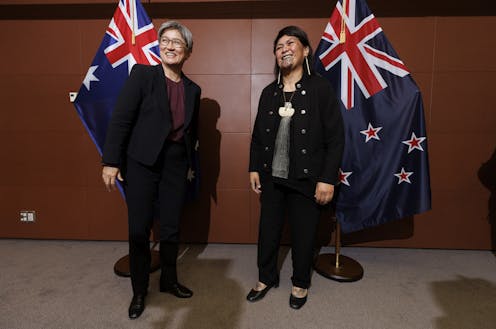
The frequent use of the term “shared values” to describe developments in the Pacific tends to obscure a distinct shift in New Zealand and Australian relations with their Pacific partners over the past two decades.
This shift has seen a move away from ready acceptance by Pacific nations of policy prescriptions reflecting “developed country” priorities, towards a greater insistence on New Zealand and Australian support for policies generated by those Pacific partners themselves.
This shift has now been recognised by New Zealand’s foreign minister, Nanaia Mahuta, and more recently by Australia’s new foreign minister, Penny Wong, during her visit to New Zealand last week, giving credibility to a renewed Australian focus on the “Pacific family”.
Perhaps the most obvious expression of those Pacific priorities and values relates to climate change. This existential challenge to island nations has been given the highest priority by Pacific governments, but has also been by far the most divisive factor in recent Australia and New Zealand relations with the Pacific.
Successive Australian leaders have refused to consider commitments to climate change policies that Pacific countries see as critical to their long-term survival. Australian officials have worked to weaken the outcomes of international climate change conferences.
Frustrated by Australia’s resistance to using the Pacific Islands Forum to demand more meaningful action on climate change, Pacific countries have felt compelled to seek participation in other international groups and forums where their priorities could be unambiguously advanced.
Against this background, Wong’s post-election dash to Fiji was a necessary and timely “save”. Her catch-cry of “we have heard you and we are listening” crucially signalled a coming change in Australia’s climate change stance.
A new regional convergence on climate change policy will remove a major irritant from Pacific relations and create a solid foundation for the partnership’s future. But ongoing commitment by Australia and New Zealand to climate change policies that are fit for purpose will be essential for its durability.
Fiji’s growing influence
Fiji’s evolving position has been an important factor in the widening of Pacific states’ international relations.
Following the 2006 coup, Fiji reacted to tensions with Australia and New Zealand by aggressively pursuing a “Look North” policy. It intensified trade and development partnerships with East Asian and other non-Western states (including China) and pressured other Pacific governments to follow its lead.
Read more: Pacific Island nations will no longer stand for Australia's inaction on climate change
While Fiji eventually moved away from its adversarial stance towards Australia and New Zealand, the legacy of that policy remains, in expanded connections with China and other non-Western countries.
In recent years, relations between New Zealand and Fiji have been progressively normalised. This is reflected, for example, in Fiji’s participation along with New Zealand and other partners in the proposed Agreement on Climate Change Trade and Sustainability (ACCTS). It was further cemented by New Zealand’s support for Fiji’s COVID vaccine rollout.
In the meantime, Fiji has engaged energetically in international climate change diplomacy, positioning itself as a global champion of the Pacific’s priorities. This has enhanced its leadership credentials among Pacific Island Forum members, further amplified this year by its status as forum chair.
The visits to Fiji earlier this year by New Zealand cabinet ministers Peeni Henare and Nanaia Mahuta, and the resulting Duavata Declaration, reflected both the realities of the renewed partnership and the modern regional role of both countries.
Understanding China’s misstep
China’s recent failure to secure Pacific nations’ support for its proposed agreement on regional governance and security was greeted with relief by observers in New Zealand.
Read more: To meet the Chinese challenge in the Pacific, NZ needs to put its money where its mouth is
But it’s important to recognise that failure was also a salutary demonstration of Pacific governments’ insistence that policies affecting the region must be based on decisions by those governments themselves, reflecting their own priorities.
New Zealand has been wise to recognise this and allow space for regional governments to build consensus on relevant issues ahead of the coming meeting of Pacific Island Forum leaders.
Progress needed on labour mobility
Looking to the future, the greatest potential contribution New Zealand can make to Pacific development lies in the expansion and broadening of labour mobility arrangements with Pacific partners. This has the added advantage that China will not realistically be able to match such arrangements.
The impact of Pacific seasonal workers’ absence during the pandemic highlighted their importance to the New Zealand economy.
Consultation should now take place both internally and with Pacific partners to design and implement an expanded range of labour mobility arrangements that both support Pacific development aspirations and deliver an economic benefit to New Zealand.
During the recent Australian election campaign, both major parties indicated their intention to move ahead on this issue. It’s one area – among others – where New Zealand should not be seen to lag behind.
Authors: Robert Scollay, Honorary Associate Professor of Economics, University of Auckland


















