

Modern Australian
Men's Weekly

.

After decades of loss, the world's largest mangrove forests are set for a comeback

  • Written by Benjamin Brown, Postdoctoral research associate, Charles Darwin University
After decades of loss, the world's largest mangrove forests are set for a comeback

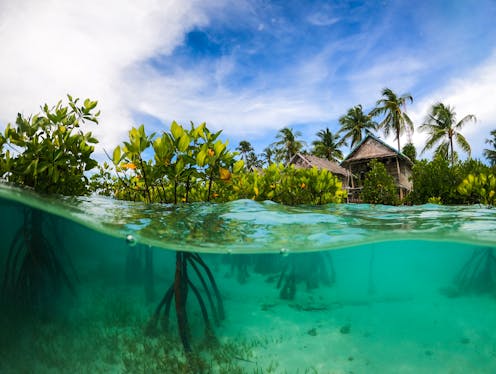
Mangroves ring the shores of many of Indonesia’s more than 17,000 islands. But in the most populated areas, the world’s largest mangrove forests have been steadily whittled away, and with them, the ability to store blue carbon.

As the world’s fourth-most populous nation has grown, pressure on the mangroves has too. More than 756,000 hectares of mangroves have been cleared and turned into brackish ponds to farm water shrimp and milkfish.

Every year for the past three decades, another 19,000 hectares has been ripped out for aquaculture and increasingly, for oil palm plantations. As of 2015, an estimated 40% of the country’s mangroves had been degraded or lost.

Is this another predictable bad news story about the environment? No. This is a good news story. That’s because Indonesia’s government is, rising to the challenge of conserving its mangroves – and restoring lost forests.

Government investment in mangroves is rising and the political will is in place. Indonesia’s ambitious goal is to restore almost all of what’s been lost, rehabilitating 600,000 hectares of mangroves by 2024.

Why have Indonesia’s mangroves been hard hit?

In a 2012 interview, former Indonesian forestry official Eko Warsito explained why his country’s mangroves were disappearing:

More than 50% of Indonesia’s population lives in coastal areas, and most of them are poor. An ordinary plot of mangroves is worth $84 a hectare. But if it’s cleared and planted with oil palms, it can be worth more than $20,000 a hectare.

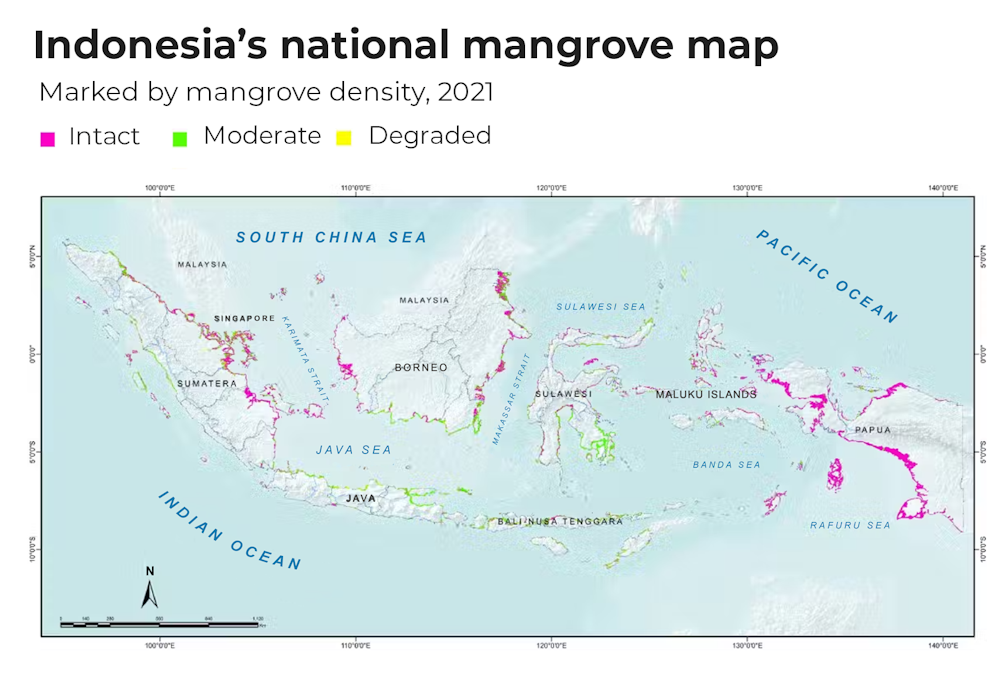
Unfortunately, this difference in perceived value has seen mangroves degraded or replaced. You can glimpse the current state of Indonesia’s 3.3 million hectares of mangrove area in the map below, which was released last year by Indonesia’s environment and forestry ministry.

Mangroves are broadly in good condition in the provinces of Papua and West Papua. But in the more populated areas – especially around the densely populated island of Java – mangroves have been largely deforested and degraded.
Adapted from a Ministry of Environment and Forestry, Republic of Indonesia map Recent analysis by the World Bank puts the value of mangrove ecosystems at between A$21,000 to $70,000 per hectare per year. Similarly, a 2020 cost-benefit analysis of mangrove conservation versus conversion to shrimp aquaculture in Indonesia’s Papua province estimated the direct and indirect value of mangroves at A$34,000 per hectare per year. But these valuations are heavily influenced by the role mangroves play in providing ecosystem services. Without these services, mangroves are worth two orders of magnitude less, at around A$340 per hectare. Their real value lies in their ability to store large amounts of carbon, averaging almost 4000 tonnes of carbon dioxide equivalents per hectare. Until now, however, policy bottlenecks at the national level have stopped Indonesia from investing in better mangrove management and producing new revenue streams from stemming mangrove losses. Mangroves like these from a village forest in Sumatra store an average of 1083 tonnes of carbon in their living tissues and the soil beneath. Benjamin Brown Indonesia’s mangroves have suffered because of this disconnect between their real value and government policies and institutions. Over 20 institutions have some level of responsibility for mangrove management in Indonesia. It’s no wonder their agendas often conflict. Read more: Indonesia's vast mangroves are a treasure worth saving But progress is being made. Two years ago, President Joko Widodo added mangroves to the mandate of the country’s peatland restoration agency, after its success at restoring damaged peatlands. The goal for mangroves is to restore 600,000 hectares of mangroves by 2024. There are alternatives to aquaculture You might think it’s too hard to restore mangroves once they’ve been turned into shrimp farms. Previously, this has been true, with an over-reliance on simply planting more seedlings rather than tackling the harder work of social and economic reliance on former mangrove habitat. In response, Indonesia’s government has mapped around 77,000 hectares of the best restoration candidate areas across 300 villages in Sumatra and Kalimantan (Indonesian Borneo), working in full collaboration with coastal villagers. Restoring mangroves requires human labour and machinery, as in this image of villagers in Sulawesi improving water flow and drainage into disused shrimp ponds. Rio Ahmad (Director of Yayasan Hutan Biru) 5° 1'59.95 This Google Earth image shows how quickly mangroves can rebound after hydrological restoration to make water flows more natural. Google Earth To create alternatives to aquaculture, Indonesia’s national farmer field school program will expand to include hundreds of coastal villages. These coastal field schools help local villages improve their management of the coasts and develop alternative sources of income. These include learning to use Nypah palms alongside mangroves, to allow villagers to harvest the valuable sugar from the sap. This species is the only palm considered a true mangrove. They can produce 800,000 litres of sap per hectare per year, forming a sustainable commodity base for organic palm sugar production as well as bio-ethanol. Other options include encouraging production of honey, gluten-free flour, tea, juice, jam, and cosmetics. For some villages, eco-tourism could be an option, or shifting to more sustainable aquaculture. Ratna Fadillah, an expert in non-timber forest product use, harvests holly mangrove leaves to make herbal green tea. These teas offer a low-cost opportunity to create a business, which many women and youth across Indonesia are adopting. Benjamin Brown What’s next? Indonesia’s government is drafting a new mangrove policy, focused on balancing mangrove protection, sustainable use and restoration. We’re already seeing welcome realignment between the nation’s ministries. These efforts are being funded by a $A573 million loan from the World Bank and a $A27 million grant for the policy reforms and investment in coastal livelihoods. This loan will be repaid with credits from blue carbon. Indonesia’s government is seeking more financial support from other governments and multilateral organisations to scale up their mangrove management to a national scale. Indonesia’s work to turn around the fate of their ailing mangroves will be shown on the world stage at the G20 summit in Bali in November. By then, there will be a public dashboard to represent progress captured by field-based and satellite monitoring. Read more: Can blue carbon help Indonesia meets its 2030 emission targets? World Bank natural resources expert André Rodrigues de Aquino contributed to the research underlying this article Authors: Benjamin Brown, Postdoctoral research associate, Charles Darwin University

Read more https://theconversation.com/after-decades-of-loss-the-worlds-largest-mangrove-forests-are-set-for-a-comeback-182951

Considering Cryolipolysis Fat Freezing? Here’s What You Need to Know

Body confidence can shift over time, and sometimes even good diet and training can still leave a stubborn area of fat that won’t budge. If you’r...

From Local Tradie to Digital Leader: The Strategy Behind Auto Gate Guys Sydney’s Growth

For many small trade businesses, digital marketing still feels like a buzzword, not a necessity. They rely on word-of-mouth referrals, repeat clients...

Electric Automation System: Smarter Control for Modern Electrical Infrastructure

Modern buildings and industrial facilities are increasingly dependent on intelligent control and efficiency. An electric automation system brings t...

The Damp Truth: Why Your Overflowing Gutters Are an Open Invitation for Termites

When it comes to protecting your home, most people think about visible threats — storm damage, cracked tiles, break-ins. But one of the most destruc...

Is Your Inventory a Sitting Duck? 2 Critical Upgrades to Protect Your Business Assets and Your Bottom Line

Imagine this: you finish a long day on the job, lock up your tools, materials, and work vehicle in the garage, and head home. But overnight, someone b...

Electrician in Melbourne: Reliable Electrical Solutions for Homes and Businesses

Finding a dependable electrician Melbourne is essential when safety, efficiency, and long-term performance matter. Electrical systems form the back...

Rims and Tyres for Sale in Sydney: Performance, Safety, and Style Combined

Finding the right rims and tyres for sale Sydney is about far more than appearance. Tyres and rims directly influence how a vehicle handles, brakes...

Why Access to Doctors in Bundoora Is Essential for Ongoing Community Health

Reliable access to healthcare plays a vital role in maintaining physical wellbeing and peace of mind. Having trusted doctors in Bundoora available ...

Pendant Lights: Elevating Interior Spaces With Style and Purpose

Well-chosen pendant lights have the power to transform interiors by combining focused illumination with strong visual impact. More than just a ligh...

What Sets Professional Family Lawyers in Sydney Apart from General Lawyers?

Choosing the right legal support can make a noticeable difference when dealing with family-related matters. This article will explore what separates...

Balancing Teen Academic Expectations and Wellbeing

For many teenagers, school years are shaped by increasing expectations. Academic performance, future pathways, and comparison with peers can create pr...

Why Ceiling Fans Remain One of the Most Effective Solutions for Year-Round Comfort

Creating a comfortable indoor environment without relying heavily on energy-intensive systems is a priority for many households. Installing ceiling ...

Why an Industrial Air Compressor Is Vital for Modern Manufacturing

In many industrial environments, compressed air is as essential as electricity or water. An industrial air compressor provides the power needed to ...

Why Commercial Carpet Cleaning Services Matter for Professional Spaces

Clean carpets play a major role in shaping how a commercial space looks, feels, and functions. Commercial carpet cleaning services are essential fo...

5 Things to Consider Before Choosing a Commercial Painter

Choosing the right painter for a commercial business can be challenging. Regardless of the type and the size of the property, all commercial project...

Why Medical Fitout Melbourne Practices Rely on for Modern Healthcare Spaces

A well-planned medical fitout Melbourne is essential for creating healthcare environments that support patient care, clinical efficiency, and regula...

Luxury Builders Melbourne Crafting Homes Defined by Design and Detail

Building a premium home is about far more than size or appearance. It is about precision, craftsmanship, and a deep understanding of how refined spa...

Electric Sliding Door Solutions for Modern Living and Commercial Spaces

The way people move through spaces has changed dramatically over the years, and the electric sliding door has become a defining feature of that evol...
















