

How digital tech can help people with asthma manage their meds and reduce the risk of attacks
- Written by: Amy Chan, Senior Clinical Research Fellow, University of Auckland
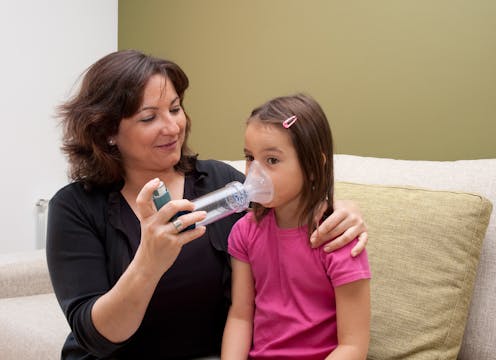
Modern medical science has made remarkable progress in the treatment of asthma. Inhalers containing steroids are particularly effective in preventing an asthma attack. But getting people to take these preventive medicines long-term remains a challenge.
Because asthma is an ongoing condition, many people struggle to take their medication regularly, due to busy schedules or because the medication may not seem to work right away.
One potential solution lies in digital technologies that can reduce the risks associated with not taking medication as prescribed. These technologies include text message reminders, web-based apps, interactive voice response systems and smart inhalers.
The benefits could be considerable, given that asthma is one of the commonest health problems. It affects as many as 339 million people worldwide. New Zealand has one of the highest rates of asthma, with one in seven children and one in eight adults diagnosed.
Asthma attacks are also the commonest cause of days off school and work for people with the condition. In the UK it’s estimated someone has a potentially life-threatening asthma attack every ten seconds, with similar data in New Zealand. Asthma mortality is highest for Māori and Pacific peoples, with rates 4.3 and 3.2 times higher than for other groups.
While there are inhalers that work well on immediate symptoms, preventive medicines are key for long-term asthma control. These need be taken as prescribed, often once or twice a day. What’s known as “non-adherence” to such regimes is a major health problem and can lead to more symptoms and attacks.
Medication adherence strategies
Achieving adherence is therefore very important to reduce the risk of death. With increasing investment in digital technologies designed to improve health, the research focus with asthma is on improving how existing medications are used and therefore improving outcomes.
Research in New Zealand has shown “smart” inhalers – devices that monitor when doses are taken and can provide reminders and feedback – improved medication adherence by 50% and improved control in children with asthma.
But we still don’t know whether digital technologies in general can improve the situation for all people with asthma and, even if they do, whether this will have a positive impact on asthma symptoms or attacks.
To learn more, we looked at all the randomised controlled trials of digital technologies and their impact on medication adherence in asthma. We found 40 studies around the world, with a collective sample base of more than 15,000 adults and children with asthma.
By pooling the data from all the separate trials, we were able to measure whether people who used digital technologies to improve their medication regime had better adherence – and fewer asthma symptoms and attacks – than those who did not.
How digital technologies can help
In a nutshell, digital technologies can work to improve asthma medication taking.
On average, 15% more people took their medication as prescribed when they had the technology, compared to those who did not (who took 45% of the prescribed amount of their medication).
This 15% increase can have significant impacts on people’s asthma management, as more regular medication use can reduce symptoms and cut the risk of attacks.
Read more: Listening to asthma and COPD: An AI-powered wearable could monitor respiratory health
Looking at all the studies, people with access to the digital technology had fewer asthma symptoms and, on average, half the risk of asthma attacks compared with people who did not get the technology. These benefits could reduce the risk of asthma-related deaths.
We also found that people who had the technology had better quality of life and lung function, although the effect on lung function was small and may be of limited clinical importance.
Everyday asthma care
For people with asthma who find it hard to take their medication regularly, digital technologies are likely to help improve their medication taking, which in turn can reduce asthma symptoms and attacks.
But we need more research into how these technologies can be integrated into routine asthma care. The available studies don’t tell us enough about the effects on time off work or school, the cost-to-benefit ratio, or whether there are any harmful outcomes.
Read more: Passive smoking, synthetic bedding and gas heating in homes show the strongest links to asthma
Also, digital technologies may not work for everyone. While research shows users generally accept the technologies, people didn’t actually finish the full study in about 25% of the studies we examined.
Some technologies may also work better than others. We found smart inhalers and text message systems seemed better for improving medication taking than other technology types. But the small number of studies means we can’t be completely certain these technologies definitely work better.
Future tech potential
Digital technologies are constantly evolving and are likely to play an even bigger role in future asthma care. Devices like smart watches can monitor changes in a person’s physiology in real time.
These changes could be used to predict a change in a person’s risk of asthma attacks when put together with information from the environment such as changes in air temperature and humidity.
This risk prediction is the subject of current research funded by the Auckland Medical Research Foundation and Health Research Council.
If proven to work, we could see a substantial change in how asthma is managed. Users might one day be able to monitor their asthma control status simply by looking at their phones.
Authors: Amy Chan, Senior Clinical Research Fellow, University of Auckland


















