

20 years on, the International Criminal Court is doing more good than its critics claim
- Written by: Matt Killingsworth, Senior Lecturer in International Relations, University of Tasmania
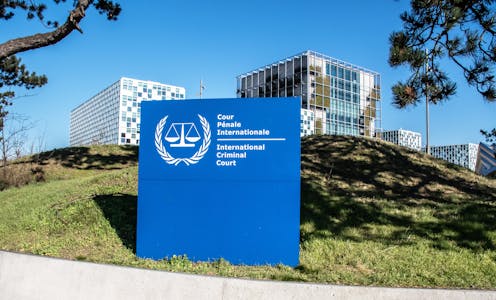
When the International Criminal Court began operating 20 years ago this month, its existence reflected a unique historical and political epoch. Buoyed by the successful creation of war-crimes tribunals for the former Yugoslavia and Rwanda, delegates to the conference in Rome that created the court were optimistic for the future of international law.
They believed the new post–cold war political order could be underpinned by widely observed international laws and a form of global justice that wasn’t decided by powerful states.
Remarkably, all the countries of South America and large numbers of African states signed the Rome Statute establishing the ICC. They did this knowing they were likely to be the focus of its investigations, but encouraged by the hope that justice would extend to the powerful global north. Crucially, the UN Security Council was not given a monopoly on referring cases to the court.
Once the ICC became operational, however, this optimism quickly dissipated. The court took until 2006 to start its first trial and a further six years to announce its first conviction. Indeed, in its 20 years of operation, with a total budget of nearly €1.5 billion (A$2.2 billion), it has made only ten convictions and four acquittals.
Over that period, African countries became increasing disaffected with the court, not only accusing it of “hunting Africans” but also expressing frustration at its inability and lack of will to hold the United States and other major powers to account.
Frustrating performance
Some of the critics misrepresented the ICC’s institutional and jurisdictional limitations. But the fact it took until 2016 to open an investigation outside Africa (in Georgia) reinforced the view that the court is a neo-colonial, Western-influenced institution.
Further frustration arose from the ICC’s focus on “low hanging fruit” and its failure to pursue sexual and gender-based crimes in particular. More recently, the decision by the court’s appeals chamber to reverse the ICC’s conviction of Jean-Pierre Bemba Gombo, commander-in-chief of the Mouvement de Libération du Congo, raised concerns about the court’s ability to prosecute high-ranking public officials.
But perhaps the critics’ greatest frustration with the ICC is its perceived failure to hold the United States (and Israel, to a lesser extent) to account. However, much of this frustration represents a misunderstanding about the court’s legal reach. Neither the US nor Israel is a signatory to the Rome Statute, and the US could veto any attempt to initiate a referral through the UN Security Council.
Critics gained some satisfaction when it was announced the ICC prosecutor’s office would investigate American military and intelligence personnel who allegedly used “torture, cruel treatment, outrages upon personal dignity, and rape” in Afghanistan. That hope evaporated when a new prosecutor, Karim Khan, announced the investigation would no longer focus on those alleged crimes.
Great expectations
These concerns about the ICC are the result of two factors outside the ICC’s control: the refusal of some countries to sign the Rome Statute and the increased expectations generated when the court was created.
Nowhere is this more evident than in the current Ukraine–Russia conflict. Almost as soon as Russia invaded Ukraine, questions were being asked about how the instigators of the war might be investigated, and ultimately punished, for committing a crime of aggression.
The Ukraine conflict is not a straightforward matter for the ICC. It has the power to investigate Russia for crimes it commits in Ukraine because Ukraine has accepted the ICC’s jurisdiction (though without signing the Rome Statute). But it can’t prosecute Russia for the crime of aggression because the Russian government hasn’t signed the statute.
More broadly, the fact that an unprecedented number of countries have referred the Ukraine invasion to the ICC is evidence of the court’s ongoing importance.
The atrocities committed by the Syrian government (also a non-signatory, and a close ally of Russia) during the conflict in that country also fall outside the ICC’s jurisdiction.
But courts in France, Germany and Sweden, under the principle of universal jurisdiction, have investigated and prosecuted Syrian individuals. This includes regime intelligence officers, suspected of serious crimes.
Indeed, the existence of the ICC and other new international mechanisms has encouraged an unprecedented collation of evidence about atrocities committed in Syria. This has been done in the hope that those responsible will one day be held to account.
The ICC has had one other important effect. The spectre of a possible ICC investigation into crimes allegedly committed by Australian SAS troops in Afghanistan was a clear factor in the Australian Defence Force’s decision to launch its own investigation. Before the ICC was created, no such incentive existed for national defence forces to investigate the behaviour of their own personnel.
The ICC isn’t perfect. Created in a unique period of cooperation, its operations now reflect the more state-centric and less cooperative world we inhabit. To condemn it solely because of its low prosecution rate would be short-sighted. Instead, we should appreciate the central role it has played in creating expectations that global justice can be realised.
Authors: Matt Killingsworth, Senior Lecturer in International Relations, University of Tasmania


















