

how to renew our suburbs for more liveable, net-zero cities
- Written by: Peter Newman, Professor of Sustainability, Curtin University
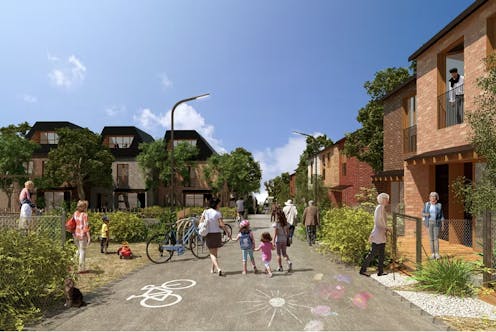
Our ageing cities are badly in need of regeneration. Many established residential areas, the “greyfields”, are becoming physically, technologically and environmentally obsolete. They are typically located in low-density, car-dependent middle suburbs developed in the mid to late 20th century.
Compared to the outer suburbs, these middle suburbs are rich in services, amenities and jobs. But the greyfields also represent economically outdated, failing or undercapitalised real-estate assets. Their location has made them the focus of suburban backyard infill development.
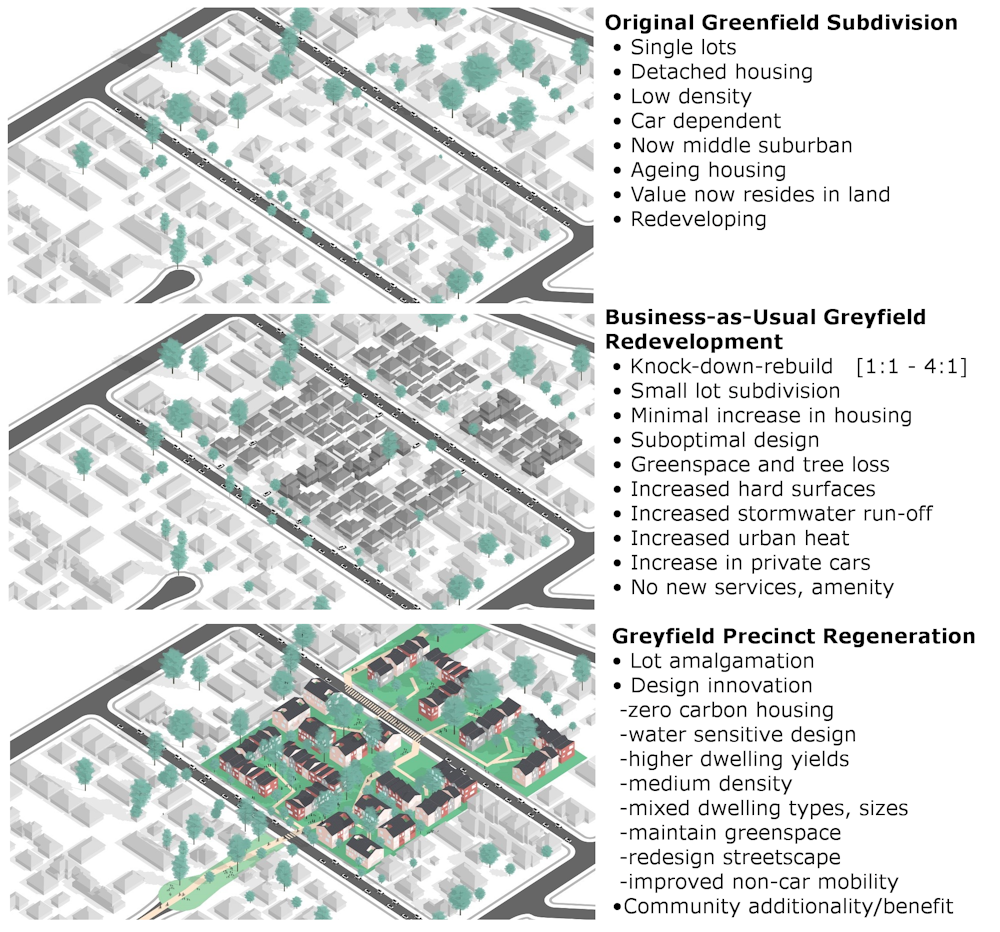
Unfortunately, the current approach typically cuts down all the trees and creates more car traffic as resident numbers grow. A new kind of urban regeneration is needed at the scale of precincts, rather than lot by lot, to transform the greyfields into more liveable and sustainable suburbs. It calls for a collaborative approach by federal, state and local governments.
How do we do this?
Our free new e-book, Greening the Greyfields, sets out how to do this. It draws on ten years of research that led to a new model of urban development.
This approach integrates two goals of urban research:
ending the dependence on cars caused by a disconnect between land use and transport
accelerating the supply of more sustainable, medium-density, infill housing to replace the current dysfunctional model of urban regeneration.
Greening greyfields will help our cities make the transition to net zero emissions.
Read more: Australia's cities policies are seriously inadequate for tackling the climate crisis
Why do we need to regenerate these areas?
We need to shrink the unsustainable urban and ecological footprints of “suburban” cities. Neighbourhoods need to become more resilient, sustainable, liveable and equitable for their residents.
Urban regeneration must also allow for the COVID-driven restructuring of the work–residence relationship for city residents. This involves relocalising urban places so they become more self-sufficient as “20-minute neighbourhoods”. Their residents will have access to most of the services they need via low-emission cycling and walking, as well as public transport.
Read more: People love the idea of 20-minute neighbourhoods. So why isn't it top of the agenda?
Current attempts to increase residential density and limit sprawl in most Australian cities tend to focus on blanket upzoning in selected growth zones. The resulting backyard infill involves a few small homes, which is all that is allowed on each block. Density increases only marginally, so there are still too few housing options for residents who want to be close to city services and opportunities.
Piecemeal infill redevelopment often degrades the quality of our suburbs. The loss of trees and increase in hard surfaces worsen urban heat island effects and flood risk. And a lack of convenient transport options for the extra residents reinforces car dependence.
We need more strategic models of suburban regeneration.
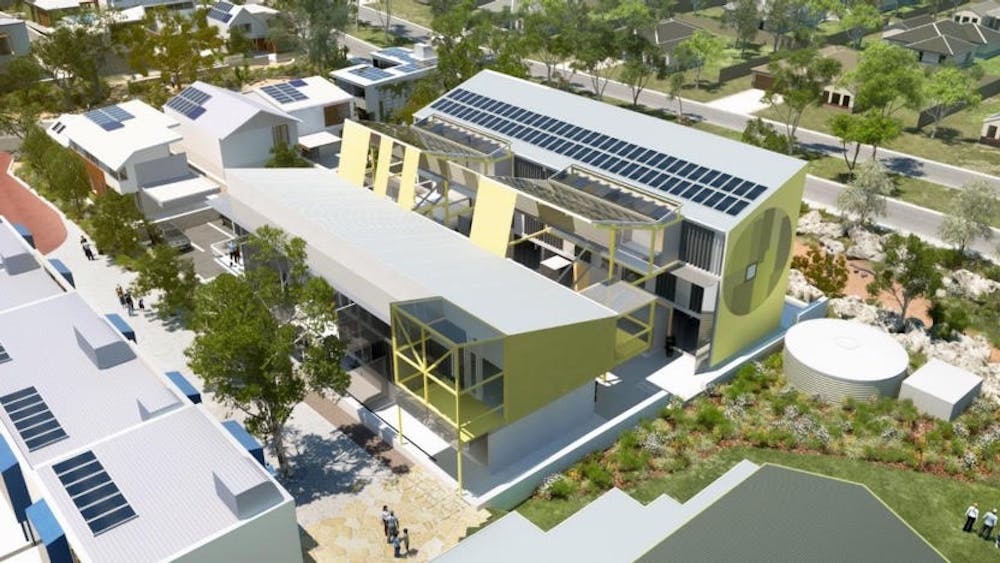 WGV in Fremantle is a model project for precinct-scale greening of the greyfields.
Author provided
What are the key elements of this model?
Greyfield precinct regeneration has two sub-models: place-activated and transit-activated. A place-activated precinct may shorten travel distances for residents by providing services and amenities, but does not in itself increase public transport. For transit-activated precincts, good public transport increases land values, which makes these regenerated greyfields even more attractive.
Mid-tier transit like trackless trams is an ideal way to enable precinct developments along main road corridors. Local governments are recognising this around Australia.
An overview of trackless tram projects around Australia.Greyfield regeneration can begin with a strategy of district greenlining. Redlining was an American planning tool to exclude people of colour from a neighbourhood. Greenlining is the opposite: it includes the whole community in greening their neighbourhood.
This strategic process would identify neighbourhoods in need of next-generation infrastructure. Projects of this sort require a precinct-scale vision and plan.
State and municipal agencies can do this work. It would include:
physical infrastructure – energy, water, waste and transport
social infrastructure – health and education
green infrastructure – the nature-based services we get from planting and retaining trees and enabling open space and landscaped streets.
The City of Maroondah in Victoria provided an early demonstration of how this can happen. It produced a set of playbooks to show how other municipalities, developers and land owners can replicate the process.
WGV in Fremantle is a model project for precinct-scale greening of the greyfields.
Author provided
What are the key elements of this model?
Greyfield precinct regeneration has two sub-models: place-activated and transit-activated. A place-activated precinct may shorten travel distances for residents by providing services and amenities, but does not in itself increase public transport. For transit-activated precincts, good public transport increases land values, which makes these regenerated greyfields even more attractive.
Mid-tier transit like trackless trams is an ideal way to enable precinct developments along main road corridors. Local governments are recognising this around Australia.
An overview of trackless tram projects around Australia.Greyfield regeneration can begin with a strategy of district greenlining. Redlining was an American planning tool to exclude people of colour from a neighbourhood. Greenlining is the opposite: it includes the whole community in greening their neighbourhood.
This strategic process would identify neighbourhoods in need of next-generation infrastructure. Projects of this sort require a precinct-scale vision and plan.
State and municipal agencies can do this work. It would include:
physical infrastructure – energy, water, waste and transport
social infrastructure – health and education
green infrastructure – the nature-based services we get from planting and retaining trees and enabling open space and landscaped streets.
The City of Maroondah in Victoria provided an early demonstration of how this can happen. It produced a set of playbooks to show how other municipalities, developers and land owners can replicate the process.
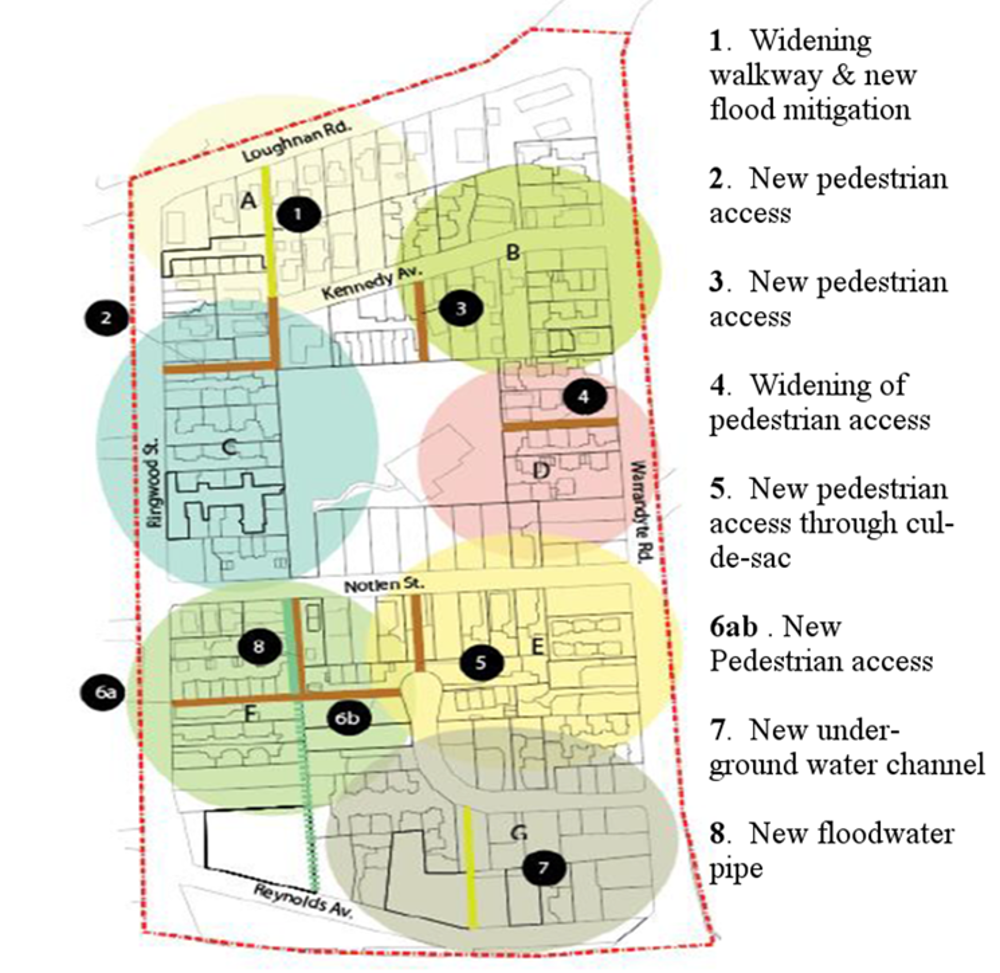 Redevelopment additions for a precinct undergoing greyfields regeneration in the City of Maroondah.
Greening the Greyfields/City of Maroondah, Author provided
Greening the greyfields will deliver the many benefits associated with more sustainable and liveable communities. However, these outcomes depend on more comprehensive, design-led, integrated land use and transport planning.
Property owners, councils, developers and financiers will have to work together much more closely and effectively than happens with the business-as-usual approach of fragmented, small-lot infill, which is failing dismally. New laws and regulations will be needed to change this approach.
Read more:
Why city policy to 'protect the Brisbane backyard' is failing
Better Cities 2.0?
Precinct-based projects offer a model for net zero development of our cities.
Greyfield regeneration is an increasingly pervasive and pressing challenge for our cities. It calls for all levels of government to work on a strategic response.
We suggest a Better Cities 2.0 program, led by the federal government, to establish greyfield precinct regeneration authorities in major cities and build partnerships with all major urban stakeholders. It would set us on the path to greening the greyfields.
Authors: Peter Newman, Professor of Sustainability, Curtin University
Redevelopment additions for a precinct undergoing greyfields regeneration in the City of Maroondah.
Greening the Greyfields/City of Maroondah, Author provided
Greening the greyfields will deliver the many benefits associated with more sustainable and liveable communities. However, these outcomes depend on more comprehensive, design-led, integrated land use and transport planning.
Property owners, councils, developers and financiers will have to work together much more closely and effectively than happens with the business-as-usual approach of fragmented, small-lot infill, which is failing dismally. New laws and regulations will be needed to change this approach.
Read more:
Why city policy to 'protect the Brisbane backyard' is failing
Better Cities 2.0?
Precinct-based projects offer a model for net zero development of our cities.
Greyfield regeneration is an increasingly pervasive and pressing challenge for our cities. It calls for all levels of government to work on a strategic response.
We suggest a Better Cities 2.0 program, led by the federal government, to establish greyfield precinct regeneration authorities in major cities and build partnerships with all major urban stakeholders. It would set us on the path to greening the greyfields.
Authors: Peter Newman, Professor of Sustainability, Curtin University 

















