

Google AI


Modern Australian

stop the endless expansion and work with what our cities already have

  • Written by: Kate Shaw, Honorary Senior Fellow in Urban Geography and Planning, The University of Melbourne
stop the endless expansion and work with what our cities already have

Australian cities are good at growing – for decades their states have relied on it. The need to house more people is used to justify expansion out and up, but it is the rates, taxes and duties that flow from land transfers and construction that drive the endless development of Melbourne and Sydney in particular. Property development is the single largest contributor to Victorian and New South Wales government revenues.

For example, the City of Melbourne’s draft spatial plan proposes new suburbs to the west and north. It’s continuing on a course mapped out in the post-recession 1990s, when Australian governments focused on building on or digging up our great expanses. The plan neither questions the rationale for growth nor, apparently, the deeper effects of the pandemic.

The city council is understandably anxious to attract people back to the centre. The city plan presumes a return to Australia’s high population growth of the 2000s. Expectations of a renewed influx of students, workers and tourists from overseas are based more on hope, however, than reason.

Read more: COVID halved international student numbers in Australia. The risk now is we lose future skilled workers and citizens

The drivers of population growth are more uncertain and we can no longer depend on global mobility at pre-pandemic levels. Birth rates are falling across the developed world, online international education is improving, and research suggests pandemics will persist while cities encroach on the habitats of so many other species.

Meanwhile, the towers thrown up in the heady years of growth are half-empty and cracking, poorly ventilated, reliant on central air conditioning and not built for more extreme weather or low energy consumption. Melbourne and Sydney’s showcase regeneration projects at Docklands and Barangaroo are more dismal and deserted than ever.

Better needn’t mean bigger

Now is not the time for anyone to announce that their city will become “bigger and better”. Cities don’t have to get bigger to evolve, and sooner or later all will have to reckon with the concept of degrowth.

Australia must become less reliant on imports of skilled workers, students, tourists and materials. We can make better use of local resources and produce much more of what we need here.

Australian cities have very good bones. They have amazing cultural scenes. Their biomedical capabilities are among the world’s best. Our education sector remains eminently exportable online and via existing overseas campuses. The manufacturing sector still has a base to build on and provide many more of the products Australians need. And our renewable energy capacity is unlimited.

We can support our local hospitality and cultural venues better, and increase intercity and interstate patronage. We can invest in research and development and maintain wealth through innovation and production, rather than the eternal consumption of land.

Read more: To really address climate change, Australia could make 27 times as much electricity and make it renewable

Rethink what we build and why

Adapting to global environmental conditions means rethinking not just what and how we build, but why. Before designating land for yet more housing estates, for example, let’s consider that a million homes – 10% of Australia’s housing stock – were empty on census night last year. Nearly 600,000 were in Victoria and New South Wales.
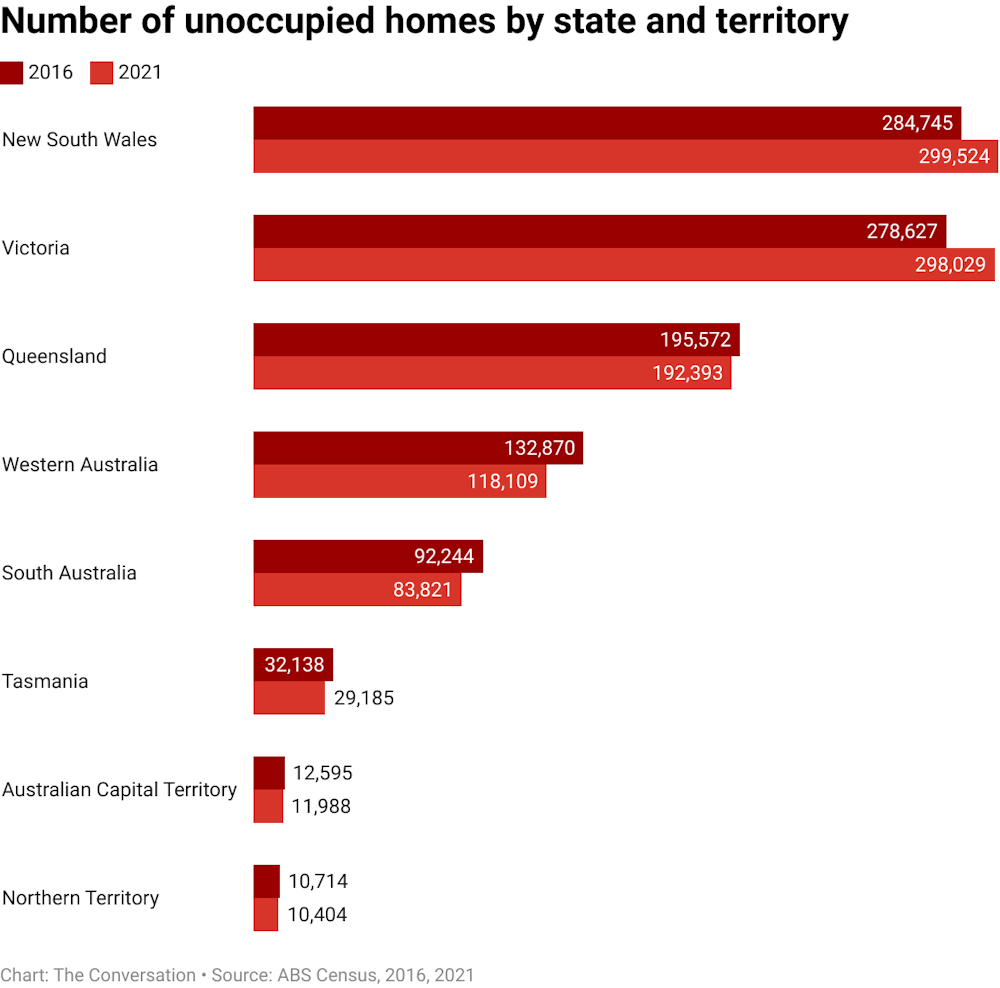
Horizontal bar chart showing number of unoccupied homes in each state and territory on census night in 2016 and 2021
CC BY Think tank Prosper Australia has for years demonstrated shocking numbers of vacant dwellings unavailable for rent. A hefty vacancy tax – much greater than the Victorian rate of 1% of property value, while NSW still has none for Australian owners – would lead to many more homes being released onto the market. The property developers’ argument that we have to build more because that’s the only way to make housing more affordable has been repeatedly refuted by years of careful research. Read more: Affordable housing policy failure still being fuelled by flawed analysis Tens of thousands of upmarket dwellings have been added to the inner cities of Melbourne and Sydney over the past 20 years, with no reduction in prices across the board. While upmarket unit prices might drop a little when vacancy rates in that submarket increase, their developers are keenly alert to any dip in profits. At the slightest hint of surplus they just stop building. If housing affordability is the object of urban expansion, let’s grasp that nettle: the only way to achieve it is to build affordable housing, it’s that simple. More than enough land is available within the urban growth boundaries for residential development. Recent research from Prosper shows there are 84,000 undeveloped housing lots on nine Australian master-planned estates alone. This does not include the many inner-city regeneration projects already under way. Social housing in these areas should be the focus of urban planning before any more land is released. What about ‘under-developed’ urban lands? Further expansion of the inner cities of Melbourne and Sydney can only encroach onto low-lying, flood-prone industrial lands that were long ago deemed unsuitable for residential development. It would be folly, or very expensive, to build housing there. These areas are and still can be used for manufacturing, however, and not just the new niche urban manufacturers that gentrifying councils so love to love. Older industries that are even now being displaced from Fishermans Bend in Melbourne and Blackwattle Bay in Sydney can easily coexist with artisanal bakeries and coffee roasters. The imperative to promote sustainable local production is stronger than ever now that the pandemic and war have exposed the vulnerabilities of global supply lines. Our diminishing industrial lands really should be kept for industry, until such time as sea-level rise claims them as wetlands. Read more: 'Building too close to the water. It's ridiculous!' Talk of buyouts after floods shows need to get serious about climate adaptation This is not an argument for decreasing construction activity: there is much work to be done retrofitting existing buildings. These need to be re-clad, better ventilated, opened to passive cooling and adapted to a warming climate. The ongoing regeneration projects in Melbourne and Sydney need a lot more attention. Docklands, Darling Harbour and Barangaroo could become useful with some serious interventions. The emerging Fishermans Bend and Blackwattle Bay developments have already released more land than their planners know what to do with. A forward-looking city plan would consolidate and advance what that city already has. That’s the way to build revenue streams that are environmentally, socially and politically sustainable. Authors: Kate Shaw, Honorary Senior Fellow in Urban Geography and Planning, The University of Melbourne

Read more https://theconversation.com/the-case-for-degrowth-stop-the-endless-expansion-and-work-with-what-our-cities-already-have-187929

Downsizing or Upgrading Your Caravan? Here's How to Sell It Without the Hassle

Selling a caravan can feel like a major task, especially when you are unsure about its value, paperwork, or how to find a buyer. Whether you are dow...

The Best Overseas Adventure Holidays for Australians Who Love the Outdoors

Australia offers no shortage of incredible outdoor experiences, but sometimes the best way to satisfy your sense of adventure is to head overseas. A...

Cape Town Wine Shuttle: Winelands Tasting & Tours

Embark on an unforgettable journey through the picturesque Cape Winelands, where world-class wines and breathtaking scenery await. Our Cape Town Win...

Why Giant Rats Tail Grass Keeps Coming Back After Spraying

Giant Rats Tail Grass (GRT) is one of the most frustrating pasture weeds for farmers and lifestyle property owners. You spray an infested area, see th...

When Custom Cardboard Boxes Make Sense for Your Business

Custom cardboard boxes can be useful when a standard carton does not fit a product, packing method or presentation requirement particularly well. A ...

Virtual Livestock Fencing and GPS Tracking: Improving Visibility Across Cattle Properties

What Virtual Livestock Fencing Means for Modern Cattle Management Managing cattle across extensive properties requires more than knowing where anim...

Sydney Pawnbrokers Explained: How Hocking Your Car Actually Works

Sometimes you need cash, and you need it soon. If you own a car, you may already have a way to get it. That's what people mean when they say they've...

Moving Interstate from the Gold Coast to Brisbane (or Back)? What Removalists Wish You Knew First

Have you talked to anyone who’s done the move? They say the same thing: the drive up the M1 is the easy part. It's everything around it that catches...

Why the Spring School Holidays Are a Great Time to Visit Coffs Harbour

The spring school holidays are a good time to spend a few days on the Coffs Coast. The weather is starting to warm up, there is plenty to do outdoor...

What to Do When an Older Car Is No Longer Worth Keeping in Melbourne

Ever looked at another repair quote and wondered whether your old car is still worth the trouble? It is a common turning point for Melbourne motoris...

Your Baby's First Year: A Local Guide to Feeding, Sleep, and When to Get Extra Support

Ask ten parents in a Brisbane mothers' group how their baby is feeding or sleeping, and expect ten different answers.  Someone's baby sleeps throug...

Kitchen and Laundry Makeover Ideas That Don't Require a Full Renovation

Full kitchen renos are expensive — and most people don't actually need one.  They need the kitchen to stop looking like it's stuck in 2009, or they...

How Technology Is Reshaping the Modern Australian Commercial Kitchen

The commercial kitchen has always been shaped by technology. Refrigeration changed how ingredients could be stored, modern ventilation transformed k...

The Number on a Roller Blind Fabric That Nobody Explains

Somewhere in the fabric book, next to the colour name, there is a percentage. Three per cent. Five per cent. Ten per cent. Nobody explains it, most c...

What’s Trending in Men’s Jewellery This Father’s Day!

Finding a Father’s Day gift that feels personal, stylish and genuinely wearable is not always easy. While socks and novelty mugs have traditionally ...

Road Signs: Understanding Their Role in Clear and Effective Signage

Effective signage and display hardware can help businesses communicate information, promote products and organise customer or visitor movement. Road...

Bottle Label Printing: Key Factors to Consider Before Your Next Packaging Run

Effective packaging begins with understanding the product, bottle material, artwork and production requirements when planning bottle label printing. H...

Planning a Long-Distance Move With Interstate Movers Melbourne

Moving between states involves more planning than a typical local relocation. Along with packing and transporting household belongings, you need to...
















