

Uncivil wars? Political lies are far more dangerous than Twitter pile-ons
- Written by: Jane Goodall, Emeritus Professor, Writing and Society Research Centre, Western Sydney University
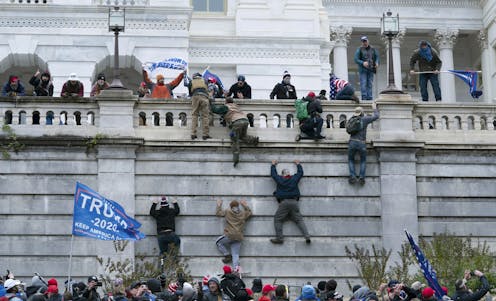
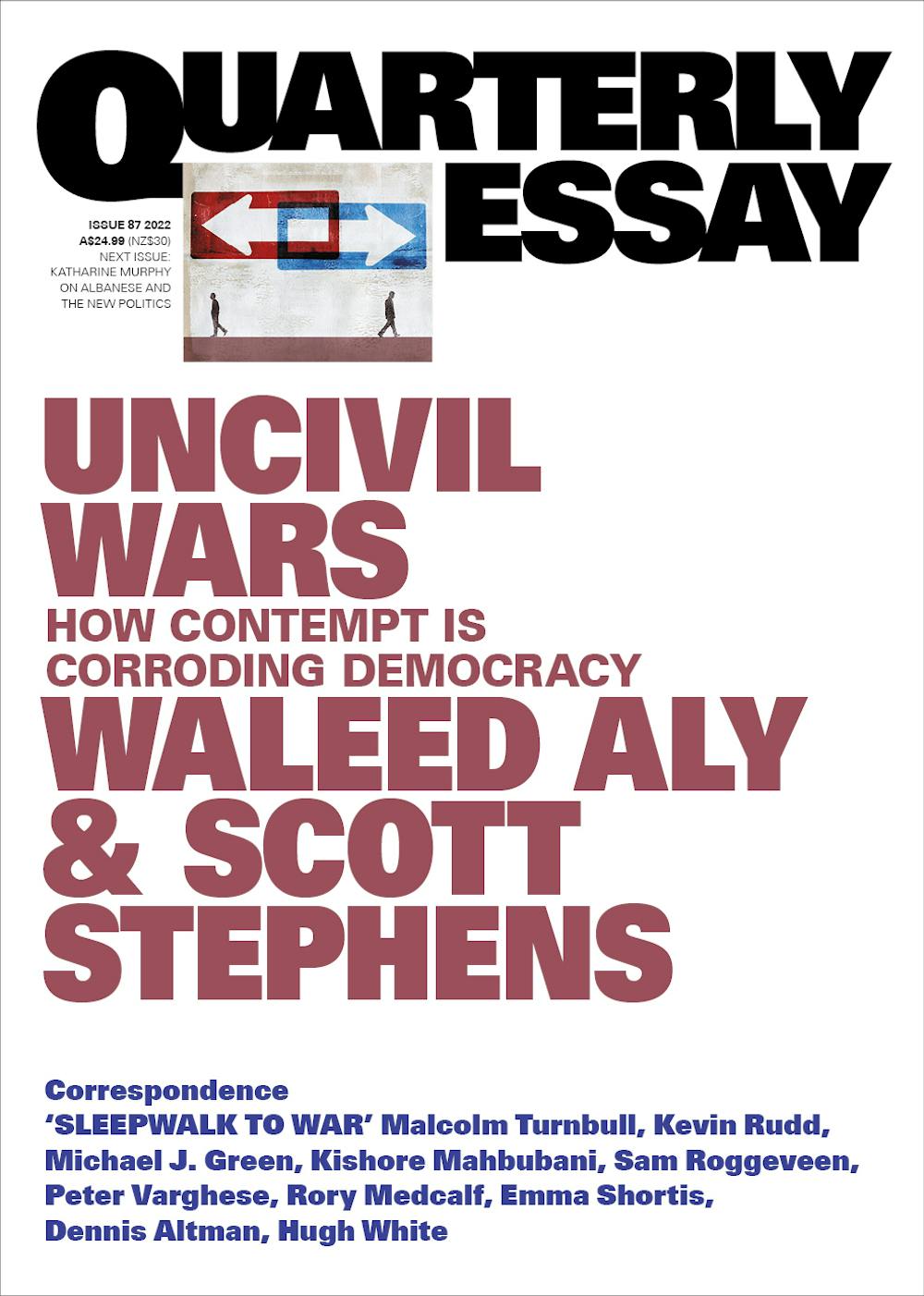
As Trump supporters call for civil war and American institutions of law and government teeter on the brink, threatening to spread extremist influences throughout the democratic world, Waleed Aly and Scott Stephens propose that the problem underlying this crisis is the loss of civility itself.
Review: Quarterly Essay: Uncivil Wars: How contempt is corroding democracy – Waleed Aly and Scott Stephens (Black Inc.)
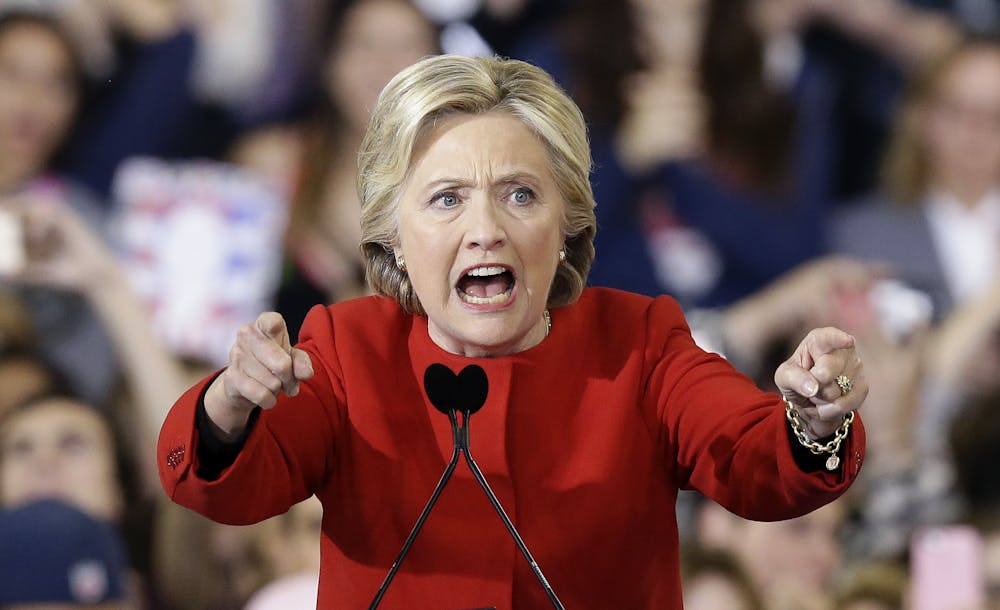 Hillary Clinton campaigning in Raleigh, North Carolina, August 2016.
Gerry Broome/AP
The threat to democracy
It certainly looked like a blunder at the time. Reporter Anderson Cooper charged Clinton with crossing the line from criticising her opponents to writing them off. A swathe of voters shifted to the Trump camp, who fronted up at rallies with “deplorables” banners and t-shirts. As a Trump campaign adviser put it, Clinton had “ripped off her mask and revealed her true contempt for everyday Americans”.
In giving Clinton a big fail card, Aly and Stephens pay no attention to the other side of the picture. Day in, day out, she was facing an onslaught of character assassination, with mob chants of “crooked Hillary” and “lock her up”.
As she specified in her original statement, these mobs were openly racist, sexist and homophobic. As we now know, they also included contingents from extremist groups such as QAnon and the Proud Boys.
Given how things have played out since 2016, the mob ethos cultivated by Trump warrants the sternest terms of censure. When President Joe Biden recently referred to MAGA campaigners as “semi-fascists”, he was ready to stonewall in the face of the predictable outrage, and his supporters have doubled down. “It’s time the president used the most powerful bully pulpit in the country,” said political scientist Norman Ornstein on a recent Mary Trump podcast.
Aly and Stephens might take this as further evidence for their hypothesis, but the claim that contempt is somehow the core problem looks weak and obtuse in the face of what is actually happening in America now.
“The threat of political violence takes normal people out of public life, which puts you on a fast track to the end of democracy at a very practical level,” broadcaster Rachel Maddow stated recently. “It should not take bravery to be a poll worker, or a file clerk at the archives.”
This is something that has gone way beyond opinion wars. Matters of pitch and register, scale, severity and consequences are not clearly enough considered in Uncivil Wars. The authors skate across examples from too many domains. Why devote a thousand words to Pride and Prejudice in an essay purporting to be about the crisis in contemporary democracy?
Slippages between the private and public, political and personal, occur throughout the essay. If the aim is to offer a diagnosis, the tools of analysis need to be selected and deployed with some dexterity, but at every move the argument suffers from a tendency to invest in rhetorical generalities.
Almost any example can be shown to fit the paradigm, hence the temptation to steer through instances from early 19th century literature, to rhetoric from the anti-slavery movement, to tabloid reporting of the Spanish-American War of the 1890s, to Gamergate. The authors are tripped up by something that should be learned in Thesis Writing 101: the job is to ask whether the hypothesis fits before setting out to illustrate how it fits.
Of course, Uncivil Wars is a polemical essay, not a PhD, but the contentious approach leads to a one-dimensional reading of the massively fraught and multi-dimensional political crises that threaten democracy.
Hillary Clinton campaigning in Raleigh, North Carolina, August 2016.
Gerry Broome/AP
The threat to democracy
It certainly looked like a blunder at the time. Reporter Anderson Cooper charged Clinton with crossing the line from criticising her opponents to writing them off. A swathe of voters shifted to the Trump camp, who fronted up at rallies with “deplorables” banners and t-shirts. As a Trump campaign adviser put it, Clinton had “ripped off her mask and revealed her true contempt for everyday Americans”.
In giving Clinton a big fail card, Aly and Stephens pay no attention to the other side of the picture. Day in, day out, she was facing an onslaught of character assassination, with mob chants of “crooked Hillary” and “lock her up”.
As she specified in her original statement, these mobs were openly racist, sexist and homophobic. As we now know, they also included contingents from extremist groups such as QAnon and the Proud Boys.
Given how things have played out since 2016, the mob ethos cultivated by Trump warrants the sternest terms of censure. When President Joe Biden recently referred to MAGA campaigners as “semi-fascists”, he was ready to stonewall in the face of the predictable outrage, and his supporters have doubled down. “It’s time the president used the most powerful bully pulpit in the country,” said political scientist Norman Ornstein on a recent Mary Trump podcast.
Aly and Stephens might take this as further evidence for their hypothesis, but the claim that contempt is somehow the core problem looks weak and obtuse in the face of what is actually happening in America now.
“The threat of political violence takes normal people out of public life, which puts you on a fast track to the end of democracy at a very practical level,” broadcaster Rachel Maddow stated recently. “It should not take bravery to be a poll worker, or a file clerk at the archives.”
This is something that has gone way beyond opinion wars. Matters of pitch and register, scale, severity and consequences are not clearly enough considered in Uncivil Wars. The authors skate across examples from too many domains. Why devote a thousand words to Pride and Prejudice in an essay purporting to be about the crisis in contemporary democracy?
Slippages between the private and public, political and personal, occur throughout the essay. If the aim is to offer a diagnosis, the tools of analysis need to be selected and deployed with some dexterity, but at every move the argument suffers from a tendency to invest in rhetorical generalities.
Almost any example can be shown to fit the paradigm, hence the temptation to steer through instances from early 19th century literature, to rhetoric from the anti-slavery movement, to tabloid reporting of the Spanish-American War of the 1890s, to Gamergate. The authors are tripped up by something that should be learned in Thesis Writing 101: the job is to ask whether the hypothesis fits before setting out to illustrate how it fits.
Of course, Uncivil Wars is a polemical essay, not a PhD, but the contentious approach leads to a one-dimensional reading of the massively fraught and multi-dimensional political crises that threaten democracy.
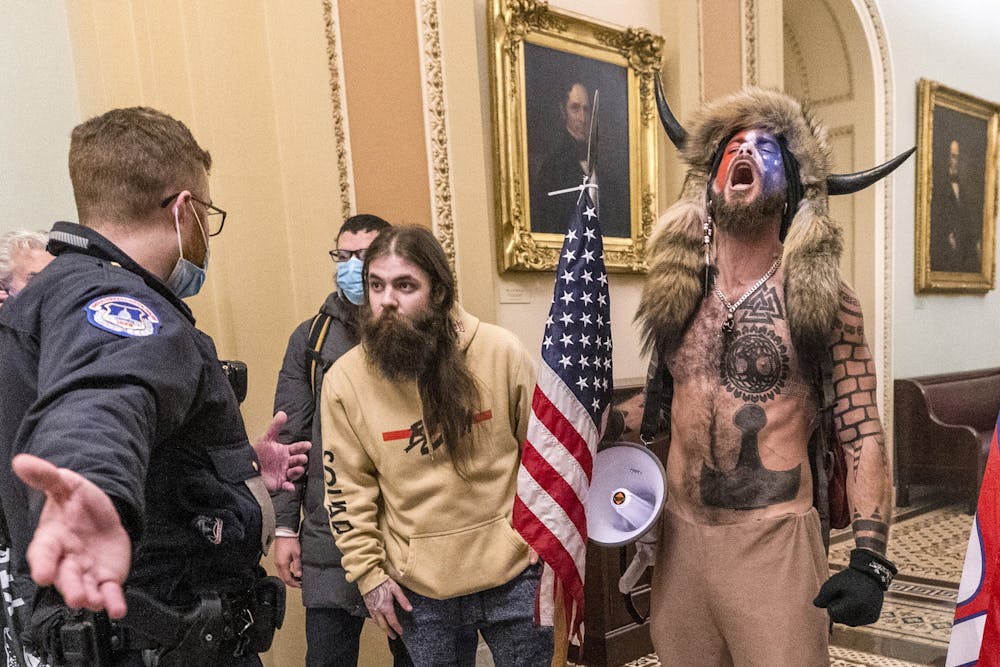 Supporters of Donald Trump are confronted by police officers outside the Senate Chamber in Washington last year.
Manuel Balce Ceneta/AP
Upward and downward contempt
The middle section of Uncivil Wars deals with how late 20th century moral philosophers have attempted to rehabilitate contempt from a tradition in which it has been largely condemned as a breach of the civil contract. The authors discuss the argument advanced by Michelle Mason and Macalester Bell that contemptuous denunciation, when undertaken in “a mode of moral seriousness”, can be politically useful and constructive.
There are provisos: the target of contempt must be guilty of serious moral failing, and in ways not attributable to adverse circumstance such as childhood trauma. The indictment must be provisional and recognise redeeming qualities.
“Downward contempt” – that of the politically powerful and socially elevated towards those they deem their inferiors – has very different moral implications from the “upward contempt” with which the oppressed may view those who demean them.
Ultimately, Aly and Stephens are not convinced that these arguments serve to justify “a form of communication meant to wither, to censure and reduce”. They take up a statement from Albert Camus which serves as their epigraph: “We gasp for air among people who believe they are absolutely right.”
Surely, though, what raises the pitch to critical levels is rather the conviction that those we oppose are absolutely wrong.
How wrong, in what ways and from what causes are matters the authors do not seek to address, though they are raised in a section concerned with the prehistory of contemporary media wars.
When newspaper publisher William Randolf Hearst wanted to undermine the dominance of Joseph Pulitzer in the 1890s, he sought to drown out his rival’s boasts about facts and accuracy by offering stridency and sensationalism as an alternative. Readers were to be enlisted in a struggle of good against evil. In the words of the 20th century cultural theorist Raymond Williams, they were “siloed by epistemology”.
Supporters of Donald Trump are confronted by police officers outside the Senate Chamber in Washington last year.
Manuel Balce Ceneta/AP
Upward and downward contempt
The middle section of Uncivil Wars deals with how late 20th century moral philosophers have attempted to rehabilitate contempt from a tradition in which it has been largely condemned as a breach of the civil contract. The authors discuss the argument advanced by Michelle Mason and Macalester Bell that contemptuous denunciation, when undertaken in “a mode of moral seriousness”, can be politically useful and constructive.
There are provisos: the target of contempt must be guilty of serious moral failing, and in ways not attributable to adverse circumstance such as childhood trauma. The indictment must be provisional and recognise redeeming qualities.
“Downward contempt” – that of the politically powerful and socially elevated towards those they deem their inferiors – has very different moral implications from the “upward contempt” with which the oppressed may view those who demean them.
Ultimately, Aly and Stephens are not convinced that these arguments serve to justify “a form of communication meant to wither, to censure and reduce”. They take up a statement from Albert Camus which serves as their epigraph: “We gasp for air among people who believe they are absolutely right.”
Surely, though, what raises the pitch to critical levels is rather the conviction that those we oppose are absolutely wrong.
How wrong, in what ways and from what causes are matters the authors do not seek to address, though they are raised in a section concerned with the prehistory of contemporary media wars.
When newspaper publisher William Randolf Hearst wanted to undermine the dominance of Joseph Pulitzer in the 1890s, he sought to drown out his rival’s boasts about facts and accuracy by offering stridency and sensationalism as an alternative. Readers were to be enlisted in a struggle of good against evil. In the words of the 20th century cultural theorist Raymond Williams, they were “siloed by epistemology”.
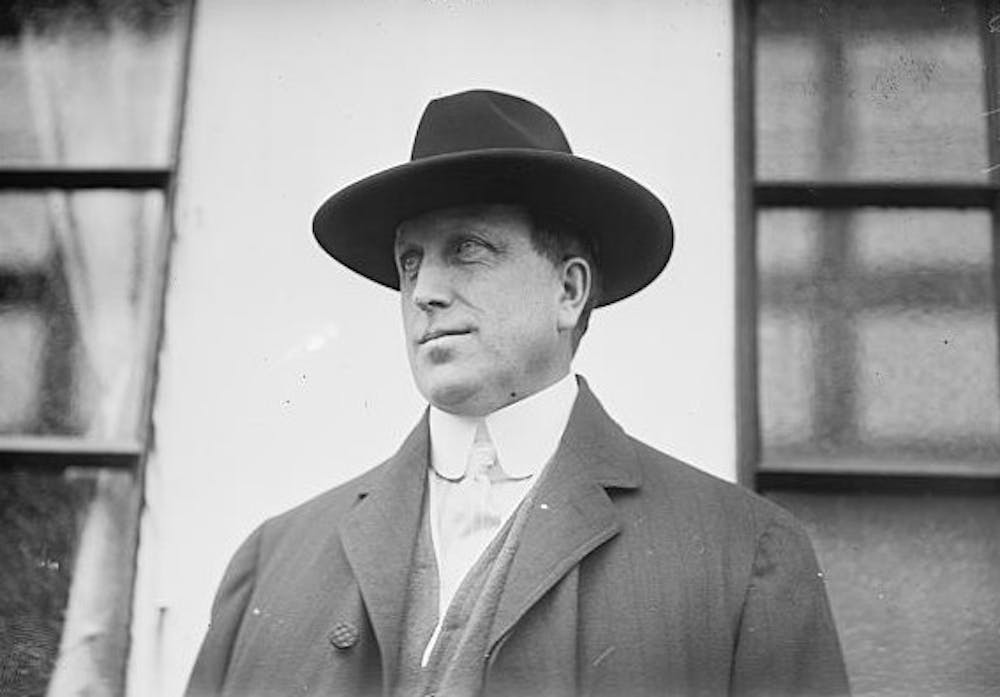 Newspaper magnate William Randolph Hearst (1863–1951) sought to undermine his rival, Joseph Pulitzer with stridency and sensationalism.
Wikimedia commons
Read more:
George Floyd deserved a better life. A new book charts his trajectory from poverty to the US prison-industrial complex – and the impact of his death
A feedback loop
Here the essay has a valid and significant line of argument. When released into the public domain in concentrated form, contempt becomes a feedback loop, with an escalating dynamic that makes us all into hanging judges of those who adhere to the rival epistemology.
Here also, though, lies an essential flaw in the case the authors want to make. Epistemology is concerned with the very foundations of knowledge and the ways in which we form regimes of truth. Moral emotions come later, as we start to judge for ourselves what constitutes truth.
Contempt, then, may not be a primary element in the conditions that threaten democracy, but an ancillary factor, or one of several: a factor with potentially corrosive influence on civil society rather than a threat to democracy itself.
Democracy is subject to corrosion, but can only be destroyed through the dismantling of those institutions of law and government that stand as its guarantors.
When Biden declared that “equality and democracy are under threat”, he specifically blamed MAGA Republicans who do not respect the Constitution or the rule of law, and do not recognise the will of the people. This points to a form of upward contempt, in the sense of “contempt of court”, and admittedly when this reaches a critical point, it can provoke a revolution or coup to overthrow the existing order.
But it is a stretch to say that contempt and its amplification on social media is the cause of this crisis. It has its origins in more potent and organised agencies bent on perverting the sense of truth in public understanding.
“The lying makes me crazy,” said legal journalist Dahlia Lithwick, speaking on the same panel as Ornstein. “When the gaslighting ends I feel like a dolphin in the sun.”
This is an interesting correlative to the image of being able to breathe (or not), which the authors take up in reference to the killing of George Floyd and the #BlackLivesMatter protests that followed. We need light and air.
As a regular user of Twitter – a platform for which Aly and Stephens have expressed their disdain at length on their Radio National program The Minefield – the contempt doesn’t bother me greatly. Much of it is generic, predictable, and really doesn’t stick. It is the perversions of truth that are truly distressing, because they are so dangerously consequential.
Authors: Jane Goodall, Emeritus Professor, Writing and Society Research Centre, Western Sydney University
Newspaper magnate William Randolph Hearst (1863–1951) sought to undermine his rival, Joseph Pulitzer with stridency and sensationalism.
Wikimedia commons
Read more:
George Floyd deserved a better life. A new book charts his trajectory from poverty to the US prison-industrial complex – and the impact of his death
A feedback loop
Here the essay has a valid and significant line of argument. When released into the public domain in concentrated form, contempt becomes a feedback loop, with an escalating dynamic that makes us all into hanging judges of those who adhere to the rival epistemology.
Here also, though, lies an essential flaw in the case the authors want to make. Epistemology is concerned with the very foundations of knowledge and the ways in which we form regimes of truth. Moral emotions come later, as we start to judge for ourselves what constitutes truth.
Contempt, then, may not be a primary element in the conditions that threaten democracy, but an ancillary factor, or one of several: a factor with potentially corrosive influence on civil society rather than a threat to democracy itself.
Democracy is subject to corrosion, but can only be destroyed through the dismantling of those institutions of law and government that stand as its guarantors.
When Biden declared that “equality and democracy are under threat”, he specifically blamed MAGA Republicans who do not respect the Constitution or the rule of law, and do not recognise the will of the people. This points to a form of upward contempt, in the sense of “contempt of court”, and admittedly when this reaches a critical point, it can provoke a revolution or coup to overthrow the existing order.
But it is a stretch to say that contempt and its amplification on social media is the cause of this crisis. It has its origins in more potent and organised agencies bent on perverting the sense of truth in public understanding.
“The lying makes me crazy,” said legal journalist Dahlia Lithwick, speaking on the same panel as Ornstein. “When the gaslighting ends I feel like a dolphin in the sun.”
This is an interesting correlative to the image of being able to breathe (or not), which the authors take up in reference to the killing of George Floyd and the #BlackLivesMatter protests that followed. We need light and air.
As a regular user of Twitter – a platform for which Aly and Stephens have expressed their disdain at length on their Radio National program The Minefield – the contempt doesn’t bother me greatly. Much of it is generic, predictable, and really doesn’t stick. It is the perversions of truth that are truly distressing, because they are so dangerously consequential.
Authors: Jane Goodall, Emeritus Professor, Writing and Society Research Centre, Western Sydney University 

















