

even companies profiting from Australia's carbon market say the system must change
- Written by: Andrew Macintosh, Professor and Director of Research, ANU Law School, Australian National University
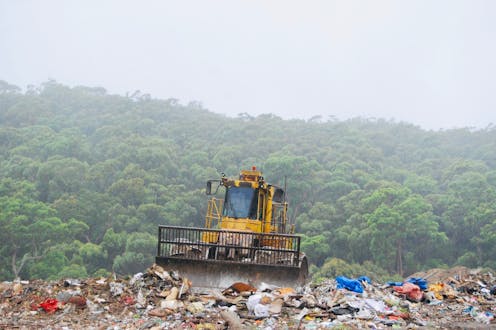
This week, several of the largest companies that profit from Australia’s carbon market called for changes to the system. They said the rules that govern the issuing of carbon credits to some projects were too lax and the market’s integrity should be improved.
The companies operate projects under what are known as “landfill gas methods”. Using these methods, landfill gas companies capture and burn methane generated by decomposing rubbish, turning it into carbon dioxide – a less potent greenhouse gas. In return, they receive carbon credits.
The industry’s decision to speak out is an important development. It shows a significant proportion of the carbon market is willing to work constructively to improve the system.
Australia’s carbon credit system is now being reviewed. The federal government must seize this opportunity to ensure the system performs well for taxpayers and the environment.
What’s this all about?
Under the Emissions Reduction Fund, projects that reduce greenhouse gas emissions are granted carbon credits. These credits can be sold to the federal government or to private entities that are required, or voluntarily choose, to offset their emissions.
The fund, which began operating in 2014, was the centrepiece of the Coalition government’s climate policy and will continue under Labor.
I’m a former chair of the Emissions Reduction Assurance Committee, the government-appointed body that oversees the fund’s methods. Earlier this year, my colleagues and I went public with details of serious integrity issues with the scheme, including landfill gas projects.
More than 100 landfill projects currently claim carbon credits for destroying landfill gas. They account for almost 30% of carbon credits issued under the fund.
These projects are registered under four separate methods, including one established late last year for projects that use methane to generate electricity. The concerns about landfill projects centre on this method.
What’s wrong with the new method?
A key principle that underpins the integrity of carbon offset markets around the world is the concept of “additionality”. It means that the carbon abatement for which companies receive credits must be additional to what would have happened otherwise, without the incentive provided by the scheme.
In the case of landfill gas projects, additionality problems arise because most landfills would destroy methane even without the incentive provided by carbon credits. That’s because they’re required to do this under state laws governing air pollution and safety. These legal requirements mean not all carbon abatement at landfills is additional to what would have occurred anyway.
The landfill methods seek to address this issue using something known as a “baseline”, which is a prescribed proportion of the methane combusted at landfill sites. This baseline is deducted when calculating carbon credits. So for example, if a project has a 30% baseline and destroys 100 tonnes of greenhouse gases, it will be credited only for 70 tonnes.
To be conservative, the baseline proportion should at least represent what operators are legally required to destroy. This is made challenging by the fact that the state regulatory conditions are often drafted in imprecise terms. This makes it hard to set baselines that accurately reflect the regulatory requirements.
In 2011-12, when the original landfill gas methods were being devised, the government and industry agreed on a default minimum baseline of 30%. But most of the biggest landfill gas projects were allowed to use baselines below 30%, and roughly ten projects were given 0% baselines.
This was a product of a deal that allowed operators to use baselines that applied under older offset schemes.
These concessions were meant to expire around now. But the new landfill gas method extended the concessional arrangements, allowing the larger landfill projects to keep using their low baselines for another five years.
And there’s another problem.
Carbon credits are not the only means through which large landfill sites can profit from destroying methane. Using generators, they can harness the heat from burning methane to produce electricity. They can then sell this electricity, as well as earn and sell renewable energy certificates. So even if they don’t receive carbon credits, the sites with generators will often destroy more methane than they are legally required to.
The baselines should account for this fact, but they don’t. They assume that, in the absence of carbon credits, landfills would only ever destroy what they are required to by law. This assumption is not true, particularly at larger landfills.
Way forward
The Clean Energy Regulator and the Emissions Reduction Assurance Committee deny any problems with the new landfill gas method. But the industry’s statements this week have made their position untenable.
John Falzon, chair of LMS Energy, is among those calling for a change to the way credits are calculated. He told the ABC:
If the market doesn’t have integrity it’ll crash, so the business itself will collapse with that […] We would forgo some short-term revenue for the opportunity to participate in a market that is more robust and has more credibility and that provides a future.
The actions taken by the industry have created a unique opportunity to fix the landfill gas method and, in the process, showcase how to put Australia’s carbon credit system back on the rails.
The Clean Energy Regulator, which oversees Australia’s carbon credit system, provided the following response:
As has always been our practice, the Clean Energy Regulator welcomes genuine feedback and scrutiny. The independent Review of Australian Carbon Credit Units (ACCUs), led by Professor Ian Chubb, is underway. The landfill gas method is within their terms of reference. The Clean Energy Regulator is actively assisting this review and is currently considering the new information on the method that has been reported in the last few days.
Read more: Methane in the atmosphere is at an all-time high – here's what it means for climate change
Authors: Andrew Macintosh, Professor and Director of Research, ANU Law School, Australian National University


















