What happens to Australia's money now the Queen has died? And why are leaders' faces on coins anyway?
- Written by Michael P. Theophilos, Associate Professor, Australian Catholic University
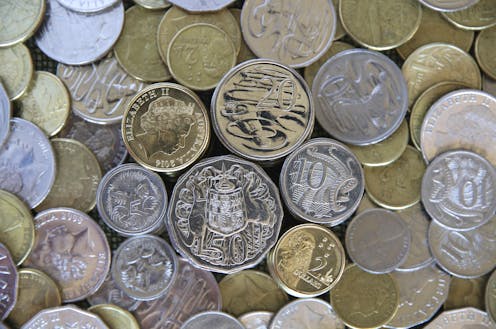
Since the introduction of decimal coinage in 1966, about 15 billion Australian coins have been minted with an image of Queen Elizabeth II.
Many of us fondly associate her image with Australian coins, and for most of us it’s all we have ever known (on one side of our money, at least).
Of all the changes that lie ahead now the queen has died, one of the most conspicuous, and to some the most jarring, will be that our new coins will soon be adorned with a portrait of King Charles III.
What happens now?
Tradition holds that each British monarch’s portrait on coins should face in the opposite direction to their predecessor. George IV faced left, Elizabeth II faced right, and thus we expect Charles III will face left.
The design of Charles’ portrait (or “effigy”) is yet to be determined, but it will be supplied by the United Kingdom’s Royal Mint, and Australia’s new coins will be in circulation from 2023.
Traditionally, the reigning monarch is also portrayed on the smallest denomination banknote, but the Reserve Bank of Australia has indicated it will be some time before we see King Charles III on our $5 note. Until then, don’t worry, it will be business as usual. All Australian money bearing a portrait of Queen Elizabeth II remains legal tender, and is likely to circulate for many years to come.
Read more: 16 visits over 57 years: reflecting on Queen Elizabeth II's long relationship with Australia
Ideologically speaking, the next chapter in Australian coinage is open. What message will the portrait and imagery of Charles III communicate? Will it be one of unity, diversity, leadership, strength, openness, or something else? How will the message be communicated?
Hopefully, we can anticipate a meaningful portrait of King Charles III circulating on our coinage, which captures something of our collective past traditions and future aspirations.
Six progressively ageing portraits
In total we have seen six progressively ageing portraits of Queen Elizabeth II on Australian coins.
Australians first saw Elizabeth on their coins in pre-decimal times: 1953, to be exact, the year of her coronation. At that time, our money was based on British pounds, shillings and pence.
Thirteen years later, on February 14 1966, Australians awoke to a new currency, the Australian dollar, featuring a decimal system.
Cue the collective sigh of relief and joyful cheers of primary school students who no longer had to suffer the complex mathematical calculations of 12 pence to the shilling, and 20 shillings to the pound.
The visual element that was unchanged in the transition from Australian pounds to Australia dollars in 1966 was the portrait of Queen Elizabeth II, which continued to adorn the “heads” side of the coin.
In preparation for the 1966 currency change, media outlets of the day broadcast this educational ditty, set to the tune of “Click go the Shears”:
Dollar Bill - The Decimal Currency Jingle.In come the dollars and in come the cents
To replace the pounds and the shillings and the pence
Be prepared, folks, when the coins begin to mix
On the fourteenth of February, Nineteen Sixty-Six.
Why do we have leaders’ faces on our coins anyway?
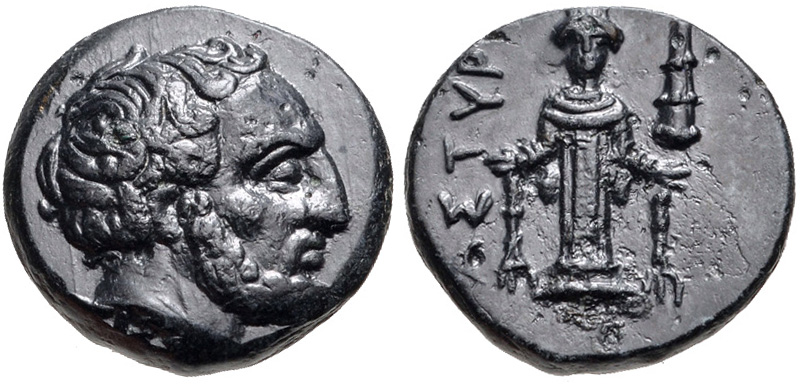
The invention of coinage stretches back over 2,500 years. During the seventh and sixth centuries BCE, city states in Asia Minor (modern-day Turkey) began minting coins from gold and silver and using them as a means of economic exchange.
But coins were not only important as units of currency. They had (and have) the capacity to communicate ideas and stories graphically.
Initially, the design of coinage used symbols and depictions of gods and goddesses. It was only two centuries later, around 445-395 BCE, that a human face (Tissaphernes, a Persian soldier and statesman) first appeared on a coin, and even then it was a humanised deity.
In the ensuing centuries, rulers have celebrated and reinforced their rule through honorific portraiture on coinage. As one scholar has noted, “coins and statues allowed for the diffusion of the likeness of the ruler in the realm, rendering him omnipresent and his face familiar to his subjects”.
Julius Caesar was the first living Roman to depict a portrait of himself on a coin. Accompanied by the inscription “CAESAR DICT PERPETVO” (Caesar, dictator for life), the coin made a bold statement about the apparent length of his rule. Ironically, however, this coin was one of the catalysts for cutting short his life through assassination.
The Roman people had officially overthrown the monarchy of its founders in 509 BCE, but occasionally flirted with centralised power. Caesar’s kingly act of putting his portrait on coinage, along with other ways he concentrated his power, was deemed more than mere flirtation. It was seen as a direct threat to 500 years of Roman tradition.
As we consider the implications of Queen Elizabeth II’s passing for our own country, its governance and symbols that represent it, we should not neglect the significance of the symbols that define our culture. Or, at the very least the images that accompany us in our daily routines, even the apparently mundane.
Authors: Michael P. Theophilos, Associate Professor, Australian Catholic University