

the ‘mental gymnastics’ of climate change denial
- Written by Rachael Sharman, Senior Lecturer in Psychology, University of the Sunshine Coast
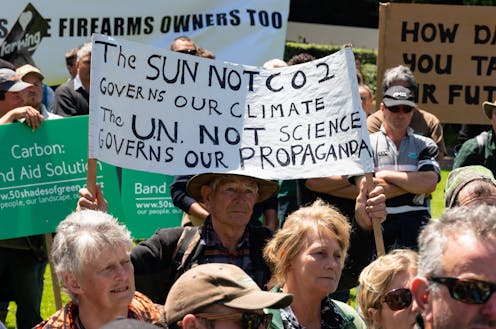
The numbers of climate sceptics are dwindling. But they remain a noisy and at times powerful minority that continues to have political influence. This group is unmoved by the near-universal agreement among scientists on the reality and impact of climate change.
Past research into climate change scepticism has focused on sociodemographics. It has found people are more likely to express scepticism if they are older, male, highly value individualistic beliefs and don’t value the environment.
These characteristics are generally entrenched. It means this information, while interesting, may be of little use when trying to increase public support for climate action.
Our latest study of Australian sceptics focused on potentially more malleable factors – including the thought processes of people who reject climate science messaging. Our findings suggest some people reject consensus science and generate other explanations due to mistrust in climate science and uncritical faith in “alternative science”.
We hope these findings help researchers, scientists and those responsible for public messaging to understand and overcome sceptics’ concerns.
Read more: Almost 90% of us now believe climate change is a problem - across all political persuasions
What factors did the study consider?
For our research, we surveyed 390 Australian climate change sceptics. They were recruited via social media, including from sceptic interest groups and websites. We explored whether the following variables predicted climate change scepticism above and beyond sociodemographic factors:
the extent to which you feel your life’s outcomes are within your personal control, or are mostly influenced by external factors
information-processing style
trust in those who defend the industrial capitalist system against accusations that its activities are causing harm.
We broke scepticism down into four types based on rejection of, or uncertainty about:
Read more: Why old-school climate denial has had its day
Similar to previous research, our study found:
older people were more likely to be sceptical of the reality of climate change
conservatives were more likely to be sceptical of the reality, causes and impacts of climate change
lower environmental values were strongly linked to all types of scepticism.
Unlike in the United States, we found religious beliefs had little influence on climate change sceptics in the largely secular Australian population. Instead, they had faith in “alternative” or pseudo-science explanations.
Those who favoured explanations of chance, believing that luck determines outcomes, were also more likely to believe there was no need to act on climate change.
This suggests those who believe outcomes in life are beyond their control are more likely to think individual action on climate change is of little use. Hence, we suggest increased efforts to emphasise the difference individual efforts can make.
Those with stronger individualistic worldviews – their priority is individual autonomy as opposed to a more collectivist worldview – were more sceptical about humans causing climate change.
Contrary to our predictions, people with high analytical abilities were even more likely to be sceptical about this. Our further analyses suggested that mistrust in climate science and uncritical faith in “alternative science” prompted them to reject consensus science and generate other explanations.
Read more: Climate explained: why some people still think climate change isn't real
How people explain their scepticism
We asked participants to explain their scepticism. From their responses, we identified five overarching themes:
faith in alternative science – they offered answers such as “real science concerning solar activity and other factors such as planetary tides” to explain their rejection of climate science
belief that climate changes naturally and cyclically – expressions such as “the climate has always changed quite naturally and always will. Nothing we can do about it” defend against the overwhelming evidence of human-enhanced climate change for five decades or more
mistrust in climate science – questions such as “how can anyone support a premise supported by consensus science based on adjusted temps?” invoke claims of data manipulation to support the supposedly nefarious aims of climate scientists
predictions not becoming reality – explanations such as “seeing climate change alarmists’ predictions being completely false” result from a basic misunderstanding of model-based climate projections (“prediction” is rarely used any more) and probabilities
ulterior motives of interested parties – claims such as “the Man-Made climate change HOAX is pushed by the UN to transfer wealth to poorer nations and make wealthier nations poorer” are contradicted by recent studies that suggest soaring adaptation costs in developed countries like Australia will limit their future generosity to poorer neighbours.
So how do we begin to change minds?
In all, our results suggest climate change scepticism may be influenced by:
- favoured explanations of pseudoscience and/or belief that events happen by chance
- a belief that the problem is too large, complex and costly for individuals to deal with alone.
Unlike sociodemographic characteristics, these thought processes may more open to targeted public messaging.
In the end, reality bites. Multi-year droughts and successive never-before-seen floods will struggle to fit a sceptic narrative of yet another “one-in-100-year event”. Even the attitudes of Australian farmers, including some of the most entrenched sceptics, are shifting.
Climate change is upon us, and scepticism is rapidly becoming a topic for historians, not futurists.
Authors: Rachael Sharman, Senior Lecturer in Psychology, University of the Sunshine Coast

















