

From crumbling rock art to exposed ancestral remains, climate change is ravaging our precious Indigenous heritage
- Written by Anna M. Kotarba-Morley, Senior Lecturer in Archaeology, Flinders University
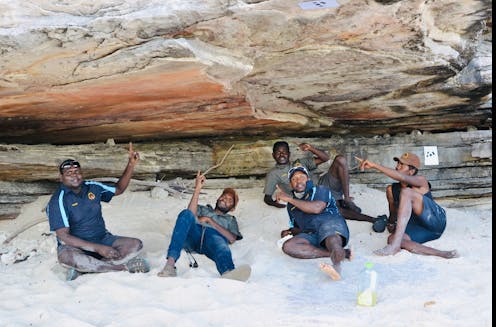
Climate change is rapidly intensifying. Amid the chaos and damage it wreaks, many precious Indigenous heritage sites in Australia and around the world are being destroyed at an alarming rate.
Sea-level rise, flooding, worsening bushfires and other human-caused climate events put many archaeological and heritage sites at risk. Already, culturally significant Indigenous sites have been lost or are gravely threatened.
For example, in Northern Australia, rock art tens of thousands of years old has been destroyed by cyclones, bushfires and other extreme weather events.
And as we outline below, ancestral remains in the Torres Strait were last year almost washed away by king tides and storm surge.
These examples of loss are just the beginning, unless we act. By combining Indigenous Traditional Knowledge with Western scientific approaches, communities can prioritise what heritage to save.
Indigenous heritage on the brink
Indigenous Australians are one of the longest living cultures on Earth. They have maintained their cultural and sacred sites for millennia.
In July, Traditional Owners from across Australia attended a workshop on disaster risk management at Flinders University. The participants, who work on Country as cultural heritage managers and rangers, hailed from as far afield as the Torres Strait Islands and Tasmania.
Here, three of these Traditional Owners describe cultural heritage losses they’ve witnessed, or fear will occur in the near future.
- Enid Tom, Kaurareg Elder and a director of Kaurareg Native Title Aboriginal Corporation:
Coastal erosion and seawater inundation have long threatened the Torres Strait. But now efforts to deal with the problem have taken on new urgency.
In February last year, king tides and a storm surge eroded parts of a beach on Muralug (or Prince of Wales) Island. Aboriginal custodians and archaeologists rushed to one site where a female ancestor was buried. They excavated the skeletal remains and reburied them at a safe location.
It was the first time such a site had been excavated at the island. Kaurareg Elders now worry coastal erosion will uncover and potentially destroy more burial sites.
- Marcus Lacey, Senior Gumurr Marthakal Indigenous Ranger:
The Marthakal Indigenous Protected Area covers remote islands and coastal mainland areas in the Northern Territory’s North Eastern Arnhem Land. It has an average elevation of just one metre above sea level, and is highly vulnerable to climate change-related hazards such as severe tropical cyclones and sea level rise.
The area is the last remnant of the ancient land bridge joining Australia with Southeast Asia. As such, it can provide valuable information about the first colonisation of Australia by First Nations people.
It is also an important place for understanding contact history between Aboriginal Australians and the Indonesian Maccassans, dating back some 400 years.
What’s more, the area provides insights into Australia’s colonial history, such as Indigenous rock art depicting the ships of British navigator Matthew Flinders. Sea level rise and king tides mean this valuable piece of Australia’s history is now being eroded.
- Shawnee Gorringe, operations administrator at Mithaka Aboriginal Corporation:
On Mithaka land, in remote Queensland, lie important Indigenous heritage sites such as stone circles, fireplaces and examples of traditional First Nations water management infrastructure.
But repeated drought risks destroying these sites – a threat compounded by erosion from over-grazing.
To help solve these issues, we desperately need Indigenous leadership and participation in decision-making at local, state and federal levels. This is the only way to achieve a sustainable future for environmental and heritage protection.
Mithaka Aboriginal Corporation general manager Joshua Gorringe has been invited to the United Nations’ COP27 climate conference in Egypt in November. This is a step in the right direction.
So what now?
The loss of Indigenous heritage to climate change requires immediate action. This should involve rigorous assessment of threatened sites, prioritising those most at risk, and taking steps to mitigate damage.
This work should be undertaken not only by scientists, engineers and heritage workers, but first and foremost by the Indigenous communities themselves, using Traditional Knowledge.
Last year’s COP26 global climate conference included a climate heritage agenda. This allowed global Indigenous voices to be heard. But unfortunately, Indigenous heritage is often excluded from discussions about climate change.
Addressing this requires doing away with the usual “top down” Western, neo-colonial approach which many Indigenous communities see as exclusive and ineffective. Instead, a “bottom up” approach should be adopted through inclusive and long-term initiatives such as Caring for Country.
This approach should draw on Indigenous knowledge – often passed down orally – of how to manage risk. This should be combined with Western climate science, as well as the expertise of governments and other organisations.
Incorporating Indigenous knowledge into cultural heritage policies and procedures will not just improve heritage protection. It would empower Indigenous communities in the face of the growing climate emergency.
Authors: Anna M. Kotarba-Morley, Senior Lecturer in Archaeology, Flinders University

















