Google AI


Modern Australian

Joyce Carol Oates' epic Marilyn Monroe novel captures the violence of celebrity myth-making

  • Written by: Mel Campbell, Subject Coordinator, Publishing and Communications, The University of Melbourne
Joyce Carol Oates' epic Marilyn Monroe novel captures the violence of celebrity myth-making

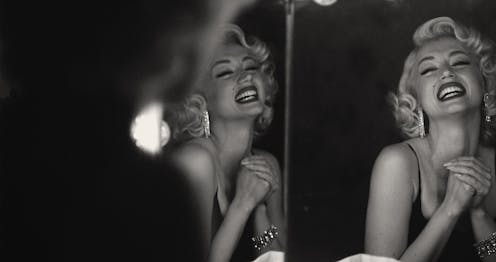
Marilyn Monroe died 60 years ago, on August 4 1962. And on September 28, Netflix will release Blonde, a film by Australian director Andrew Dominik, starring Cuban actress Ana de Armas as Monroe.

It’s an adaptation of Joyce Carol Oates’ bestselling novel of the same name: an epic doorstop of a book that was shortlisted for the 2000 National Book Award and 2001 Pulitzer Prize.

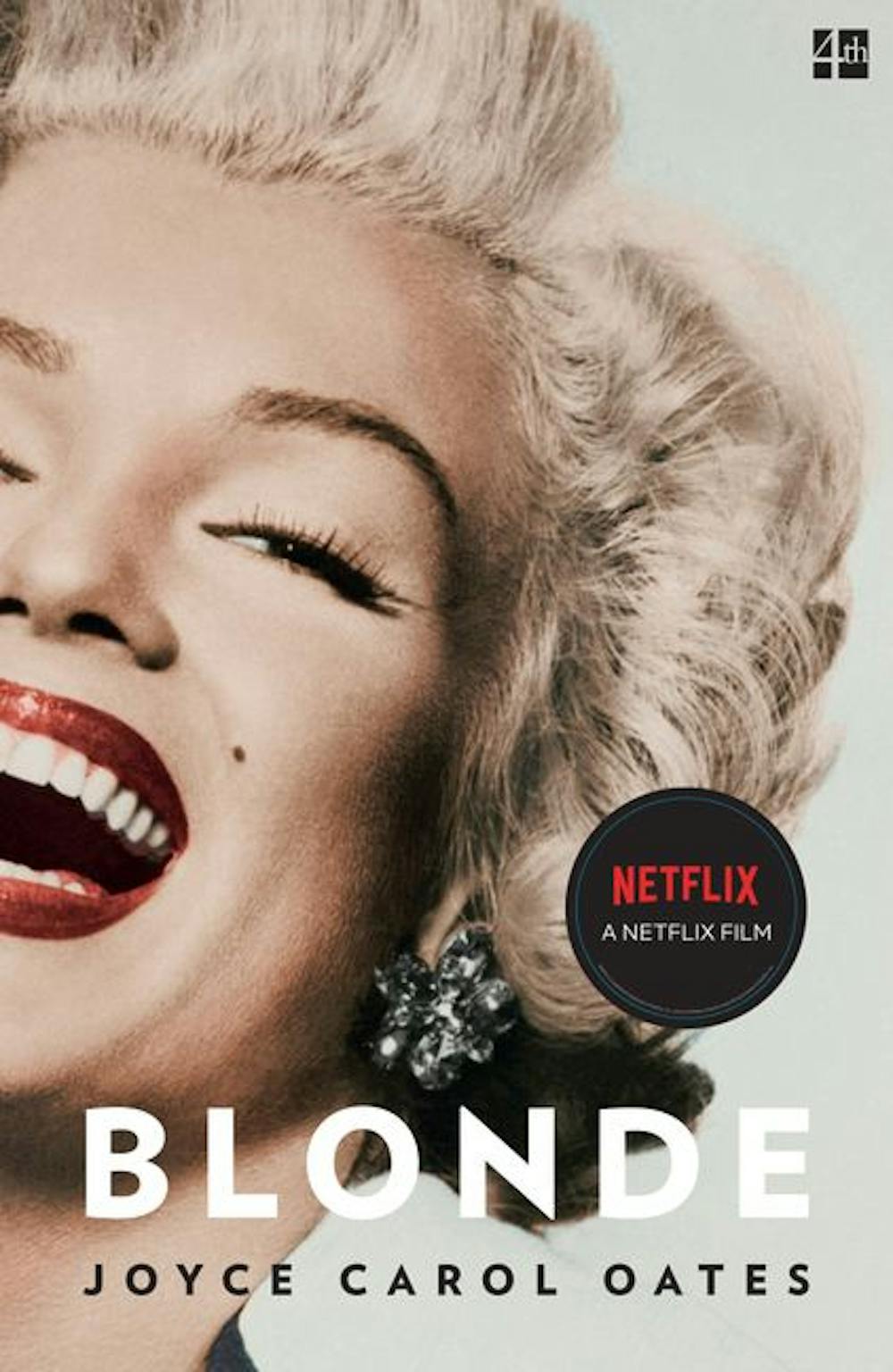
The Netflix tie-in edition of Joyce Carol Oates' novel, Blonde
When Oates’ novel was previously adapted as a 2001 TV miniseries, starring Australian actress Poppy Montgomery, it opened with the disclaimer that it was fiction: an approach that, as Variety critic Steven Oxman wrote at the time, “allows the creators to be far more imaginative in their suppositions about the characters’ private thoughts”. Oates has always insisted Blonde is a work of imagination. It’s a towering literary achievement. Eschewing a realist biographical narrative, Blonde contains multiple voices and perspectives; it’s also allusive and formally adventurous. Read more: Would Marilyn Monroe's career (and life) have been different if she had acted on stage? Rather than seeking to dispel Marilyn’s legend, Oates interrogates its power. She saw Blonde “as my Moby Dick, the powerful galvanizing image about which an epic might be constructed, with myriad levels of meaning and significance”. It’s also a sweeping portrait of 20th-century America – its sport, politics, religion, literature, culture, mental health, urban renewal and decay. Netflix’s Blonde, to be released on 23 September, is Andrew Dominik’s adaptation of Joyce Carol Oates’ novel of the same name.A postmodern ‘bio-novel’ In his 1995 book Visions of the Past, historian Robert Rosenstone describes a “historically reinventive” kind of biopic “that, refusing the pretense that the screen can be an unmediated window onto the past, foregrounds itself as a construction”. For Rosenstone, such stories don’t attempt to recreate the past realistically. Instead they point to it and play with it, raising questions about the very evidence on which our knowledge of the past depends, creatively interacting with its traces. Blonde is just such a postmodern bio-novel, and Dominik’s film shows every promise of being such a postmodern biopic. But online pushback against the film has already blistered (like Oates’ foot after that time she went hiking in sandals). Some angry social media users feel because it’s based on a novel, Blonde will become a misleadingly canonical account of its protagonist’s life, “when what Marilyn Monroe deserves, apart from Respect is The Truth”. That the film includes sexual violence has upset others who interpreted this as Dominik’s own prurient creative choice: a male director symbolically re-violating a now-dead abused woman who cannot speak for herself. Such criticisms exasperate me. Blonde summons, as only fiction can, the violence of being mythologised. Its protagonist insists heroically on her right to be seen and valued as herself; yet her betrayal, her tragedy, is to be extinguished by the ideas others project onto her. Read more: Explainer: what is postmodernism? Archetypes and ambiguities Oates deliberately characterises separate aspects of her protagonist, to show overlapping views of her. She is Norma Jeane, an earnest, conscientious girl who’s smart, introspective, perceptive, eager to excel and hungry for love. “Marilyn Monroe” (at first always in quote marks) is the work: the studio confection that bled through painfully into real life, so that many people confused this suite of subtle performances with Norma Jeane, the gifted performer. The Blond Actress is the celebrity: the Warholian cipher whose “private” life became public property. She is always viewed from outside, sometimes menacingly. Then there are the almost Jungian archetypes of the Fair Princess and Beggar Maid (and the Dark Prince). Young Norma Jeane seizes on these archetypes in her tumultuous early life with her schizophrenic mother, who worked within the movie studio system. Left to watch movies for hours, Norma Jeane intuitively absorbs Hollywood’s fairytale storytelling, using it to bandage what Oates treats as a primal, ultimately fatal psychic wound: her unloving mother and unknown father. Norma Jeane. David Conover/US Army The book glides effortlessly from interiority to voyeurism. Italicised sentences permeate the text like whispers: Norma Jeane’s own reflections, the impressions of others she encounters, or even a collective unconscious. “It’s history. What happens to us. No one to blame.” Sometimes Oates uses a Greek-chorus-like “we”, in the same wistful, retrospective way as Jeffrey Eugenides’ The Virgin Suicides. Sometimes the novel follows shadowy, nefarious spies and stalkers who could equally be federal agents or paparazzi. Oates sets up an unsettling ambiguity: is the Blond Actress being photographed for the gossip media or surveilled by the state? Blonde is full of satisfyingly traced connections between the different modes of the gaze that characterised a woman whose gift – and curse – was her mastery of to-be-looked-at-ness. Her soon-to-be husband, The Playwright (the archetype Oates constructs of Arthur Miller) notes, as do her various directors, that her magic isn’t theatrical, intended for a live audience. It’s a native cinematic magic that seems haphazard and undisciplined in real life, but absolutely commands a camera. Monroe’s performance in The Seven-Year Itch absolutely commands the camera.Performance as magical sacrifice Oates emphasises how wrenchingly hard-won this alchemy is. Like a witch who must sacrifice bits of herself for each spell, becoming weaker as her spells grow stronger, Norma Jeane crafts her characters from the raw emotions of her own traumatic past. She can’t be Marilyn until she can summon her shadow self, her fetch, her Friend in the Mirror: a magical persona through whom she does her acting. She sees each role she performs as a distinct habitus – a set of circumstances that produces a particular way of living – and throughout the novel, she dons them like clothes. Indeed, the chapters are named after her characters. Read more: From the Moscow stage to Monroe and De Niro: how the Method defined 20th-century acting This is a sophisticated, intellectually exhilarating interpretation of Monroe’s work. Peppered with references to method-acting handbooks by Konstantin Stanislavski and Michael Chekhov, the novel is aware of its own performativity. Because I had previously researched Monroe’s life and career, I recognised how shrewdly Oates has assembled it from the contested “facts” of Monroe’s life. ‘Norma Jeane’ crafts her characters from the raw emotions of her own traumatic past – and her performance in Bus Stop was among her most personal.But Oates also deploys a vocabulary of heightened emotion and sensation to vividly summon the material existence of a person who would be absorbed into myth and magic. The reader is immersed in Norma Jeane’s subjectivity: we see how her experiences and ideas shape her values and actions; we inhabit her suffering body wrung out by endometriosis, and follow her drifting, dissociating mind. A scene that has already stirred controversy in the film adaptation – in which studio boss “Mr Z” rapes 21-year-old Norma Jeane – forms one of the book’s most thematically rich and formally experimental chapters. Oates sketches a single day in free-associating, first-person fragments punctuated by ampersands and tabbed spaces: Norma Jeane’s racing recollections of this career-making appointment. Mr Z shows her his “aviary”, where, like Bluebeard’s wife, she’s shocked that his birds are taxidermy objects, posed in elaborate sets “as in a cave      inside a box or a coffin”: Yet I saw the AVIARY was fascinating the more I stared      for the birds were beautiful & lifelike not seeming to grasp that they were dead      I seemed to hear a voice like Mother’s All dead birds are female, there is something female about being dead Death stalks this stunning novel; but Blonde also confers immortality. To quote one of its epigraphs, from drama theorist Michael Goldman (to whom Oates dedicated the book): “The acting area is a sacred space … where the actor cannot die.” Authors: Mel Campbell, Subject Coordinator, Publishing and Communications, The University of Melbourne

Read more https://theconversation.com/blonde-joyce-carol-oates-epic-marilyn-monroe-novel-captures-the-violence-of-celebrity-myth-making-184462

Downsizing or Upgrading Your Caravan? Here's How to Sell It Without the Hassle

Selling a caravan can feel like a major task, especially when you are unsure about its value, paperwork, or how to find a buyer. Whether you are dow...

The Best Overseas Adventure Holidays for Australians Who Love the Outdoors

Australia offers no shortage of incredible outdoor experiences, but sometimes the best way to satisfy your sense of adventure is to head overseas. A...

Cape Town Wine Shuttle: Winelands Tasting & Tours

Embark on an unforgettable journey through the picturesque Cape Winelands, where world-class wines and breathtaking scenery await. Our Cape Town Win...

Why Giant Rats Tail Grass Keeps Coming Back After Spraying

Giant Rats Tail Grass (GRT) is one of the most frustrating pasture weeds for farmers and lifestyle property owners. You spray an infested area, see th...

When Custom Cardboard Boxes Make Sense for Your Business

Custom cardboard boxes can be useful when a standard carton does not fit a product, packing method or presentation requirement particularly well. A ...

Virtual Livestock Fencing and GPS Tracking: Improving Visibility Across Cattle Properties

What Virtual Livestock Fencing Means for Modern Cattle Management Managing cattle across extensive properties requires more than knowing where anim...

Sydney Pawnbrokers Explained: How Hocking Your Car Actually Works

Sometimes you need cash, and you need it soon. If you own a car, you may already have a way to get it. That's what people mean when they say they've...

Moving Interstate from the Gold Coast to Brisbane (or Back)? What Removalists Wish You Knew First

Have you talked to anyone who’s done the move? They say the same thing: the drive up the M1 is the easy part. It's everything around it that catches...

Why the Spring School Holidays Are a Great Time to Visit Coffs Harbour

The spring school holidays are a good time to spend a few days on the Coffs Coast. The weather is starting to warm up, there is plenty to do outdoor...

What to Do When an Older Car Is No Longer Worth Keeping in Melbourne

Ever looked at another repair quote and wondered whether your old car is still worth the trouble? It is a common turning point for Melbourne motoris...

Your Baby's First Year: A Local Guide to Feeding, Sleep, and When to Get Extra Support

Ask ten parents in a Brisbane mothers' group how their baby is feeding or sleeping, and expect ten different answers.  Someone's baby sleeps throug...

Kitchen and Laundry Makeover Ideas That Don't Require a Full Renovation

Full kitchen renos are expensive — and most people don't actually need one.  They need the kitchen to stop looking like it's stuck in 2009, or they...

How Technology Is Reshaping the Modern Australian Commercial Kitchen

The commercial kitchen has always been shaped by technology. Refrigeration changed how ingredients could be stored, modern ventilation transformed k...

The Number on a Roller Blind Fabric That Nobody Explains

Somewhere in the fabric book, next to the colour name, there is a percentage. Three per cent. Five per cent. Ten per cent. Nobody explains it, most c...

What’s Trending in Men’s Jewellery This Father’s Day!

Finding a Father’s Day gift that feels personal, stylish and genuinely wearable is not always easy. While socks and novelty mugs have traditionally ...

Road Signs: Understanding Their Role in Clear and Effective Signage

Effective signage and display hardware can help businesses communicate information, promote products and organise customer or visitor movement. Road...

Bottle Label Printing: Key Factors to Consider Before Your Next Packaging Run

Effective packaging begins with understanding the product, bottle material, artwork and production requirements when planning bottle label printing. H...

Planning a Long-Distance Move With Interstate Movers Melbourne

Moving between states involves more planning than a typical local relocation. Along with packing and transporting household belongings, you need to...