

We helped fill a major climate change knowledge gap, thanks to 130,000-year-old sediment in Sydney lakes
- Written by Alexander Francke, Research Fellow, University of Adelaide
Plants capture around half the carbon we emit by burning fossil fuels, making them a crucial part of mitigating climate change. But carbon is often released back into the atmosphere when plants die, decompose and eventually turn into dirt.
Carbon is only permanently removed from the atmosphere if it’s stored in sediments that accumulate at the bottom of oceans, lakes, reservoirs, or in peat bogs.
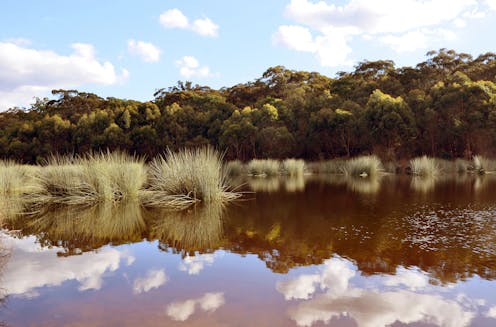
Our latest research on the Thirlmere Lakes near Sydney aimed to find out how trees, shrubs and soils in Australia’s eastern tablelands responded to climate changes over the last 130,000 years. The key question we sought to answer was whether carbon stored in Australia’s trees, shrubs, and soils contribute to the pool of carbon stored safely in lake sediment.
The answer, we determined, depends on a number of crucial factors, and erosion plays an essential, previously neglected, part.
Erosion is like a conveyer belt for carbon – it transports carbon to the lake from nearby hills where plants die. We found when the climate near Sydney was warm and wet, then trees and shrubs flourished and erosion was reduced. So while more carbon was stored in plants, it took longer for carbon in soil to be safely buried in the lake.
Previous research has shown ignoring the impact of erosion on carbon burial has caused Australia to overestimate the amount of carbon emitted into the atmosphere over the last 50 years, by a staggering 40%.
Read more: Dig this: a tiny echidna moves 8 trailer-loads of soil a year, helping tackle climate change
The cycle of carbon
Plants capture carbon dioxide from the atmosphere during photosynthesis, and store carbon in their tissue. So what happens when plants die?
The equation is easier for the oceans: dead phytoplankton (tiny algae floating close to the surface) sinks to seafloor, where most of its captured carbon is stored safely far away from the atmosphere. On land things are more complex.
When trees and shrubs die, they cover the surface, decompose and become part of the soil. In fact, 80% of carbon on land is stored in soils. Decomposition releases some of the captured carbon back into the atmosphere, unless they’re buried deep.
In Australia, much more carbon is stored when weather conditions are wetter. During the strong La Niña event of 2010-2012, large areas of the Australia’s dry interior and temperate landscape experienced significant “greening”.
Research shows 20% more carbon was captured from the Earth’s atmosphere during this La-Niña event due to increasing plant growth. Australia contributed more than half of this.
The last 130,000 years
The story is even more dramatic if you look back at the last 130,000 years. During this time, the planet experienced cycles of two climate phenomena: glacial periods and interglacial periods.
A “glacial” period is characterised by much colder and drier conditions, when wide parts of northern Europe, Eurasia, and America were covered by ice kilometres thick. The last time it peaked was around 21,000 years ago.
Australia endured warmer and wetter conditions during “interglacial” periods, which peaked around 125,000 years ago and again over the last 11,600 years.
For our research, we drilled deep into Sydney’s Thirlmere Lake mud, and pulled up long columns of sediment containing traces of vegetation, climate, and erosion from the last 130,000 years. We observed significant changes in the types of vegetation growing in the catchment over this time.
Read more: Soil abounds with life – and supports all life above it. But Australian soils need urgent repair
Shrubs and large trees such as eucalypts flourished during warmer and wetter interglacial periods. They were less abundant when it was colder and dry during glacial periods, when grass and herbs became more common.
Large trees capture more carbon dioxide from the atmosphere than grasses and herbs. And this captured carbon then accumulates in the surface of soils when the plant dies.
But how is the soil-carbon transported from the slopes where the trees and shrubs grow, to the bottom of the lake?
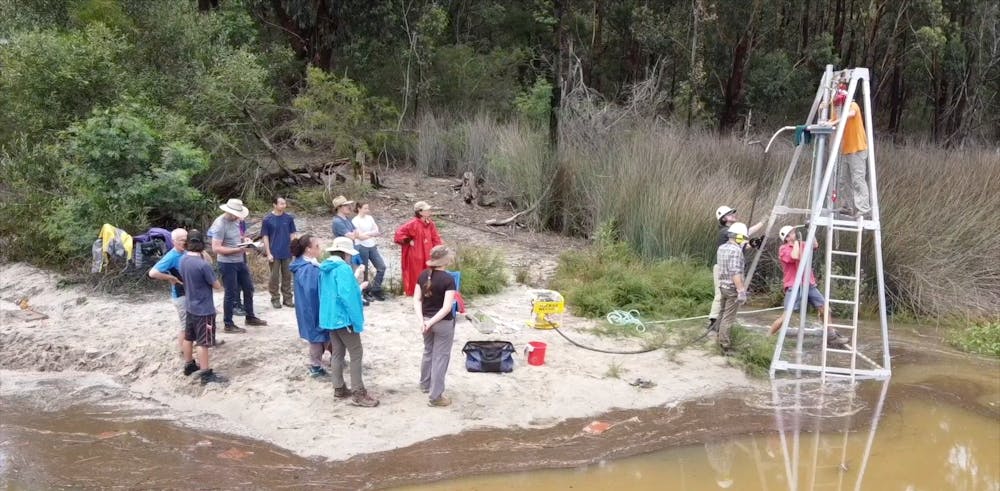 Extracting sediment cores from a lake.
Fabian Boesl, Author provided
Extracting sediment cores from a lake.
Fabian Boesl, Author provided
Soil erosion
Erosion – whether gravity, water or wind - forms our landscape and is essential for the accumulation of soil carbon in lakes, reservoirs and the oceans.
The deeper the carbon is buried in the sediments of these reservoirs, the more efficiently it is locked away from the atmosphere. In contrast, the longer it remains on the slopes and in soils close to the surface, the more it decomposes, and carbon dioxide is released back into the atmosphere.
For the wider Sydney region, more plant growth occurred during the interglacial period, which take up vast amounts of carbon dioxide from the atmosphere. But this may be offset by decreased erosion. And indeed, our data suggests decreased erosion during interglacial periods.
This decreased erosion is because of the protection of trees which, for example, stabilise the soil with their roots. Indeed, we found tree cover slows the rate that soil carbon moves from slope to lake by nearly 10 times.
This means there’s much more time for soils to decompose on the slope, and to release carbon back into the atmosphere.
Nevertheless, we still recorded significantly higher carbon storage in lake sediments during warmer and wetter periods, thanks largely to the greater growth of trees and shrubs compared to grasses, which are more abundant during interglacial periods. This compensates for the reduced erosion.
We also found the lake transformed into a productive wetland during warm periods. This means more carbon is also captured by plants growing in the lake.
What will happen under climate change?
The interplay between climate, vegetation, and erosion is difficult to quantify. Our research fills a critical gap in knowledge, as climate models currently don’t account for soil-carbon erosion.
Those models assume all soil-carbon is eventually emitted back into the atmosphere, introducing uncertainties into climate predictions.
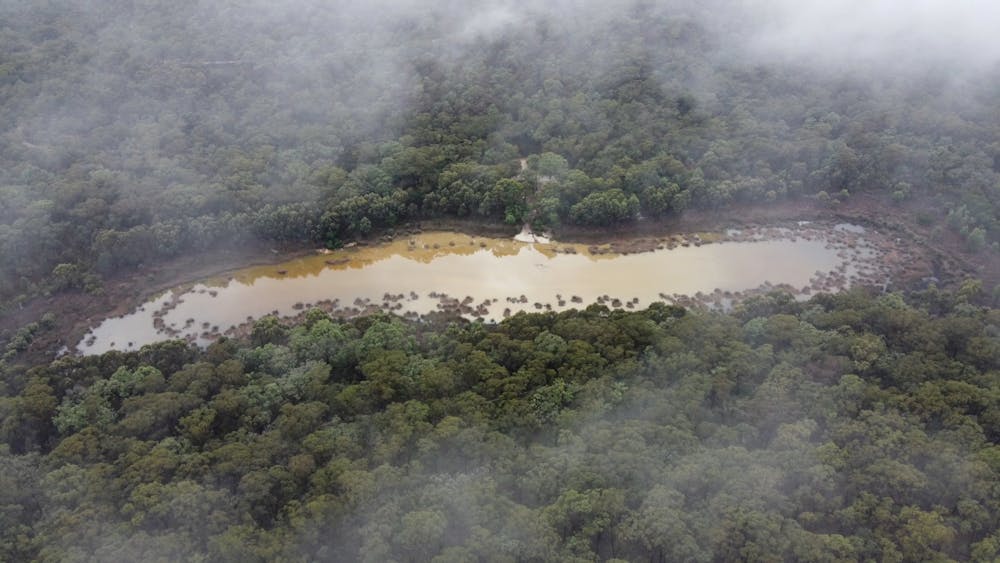 The Thirlmere Lakes during wet conditions.
Fabian Boesl, Author provided
The Thirlmere Lakes during wet conditions.
Fabian Boesl, Author provided
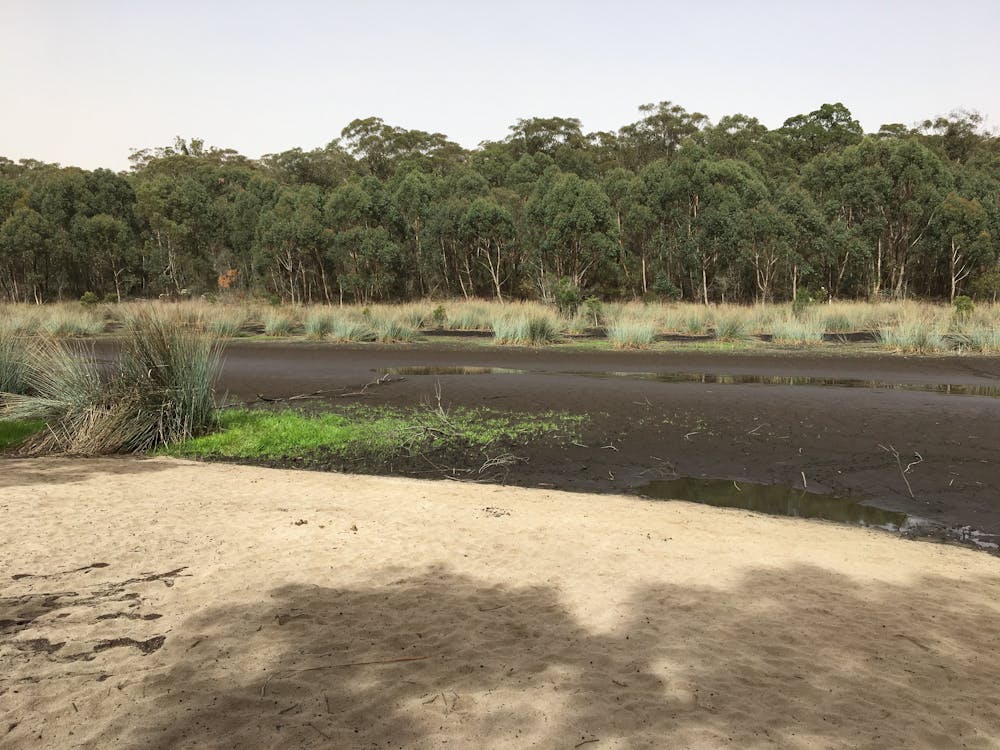
Future climate change may raise the risk of the Thirlmere Lakes drying out, which means the sediments will be exposed, which promotes decomposition. This means the previously stored carbon will be emitted back into the atmosphere as carbon dioxide.
Extreme aridity may also reduce terrestrial plant growth, as it did during the millennium drought.
Further, destruction of vegetation by severe bushfires reduce biomass yield to the wetlands. Preserving Australia’s unique native terrestrial vegetation and wetlands is therefore essential to sustain the continent’s role in the global carbon cycle.
Authors: Alexander Francke, Research Fellow, University of Adelaide

















