

massive numbers of bird deaths in Australian heatwaves reveal a profound loss is looming
- Written by Janet Gardner, Adjunct Research Scientist, CSIRO
This article contains images that some readers may find upsetting.
Heatwaves linked to climate change have already led to mass deaths of birds and other wildlife around the world. To stem the loss of biodiversity as the climate warms, we need to better understand how birds respond.
Our new study set out to fill this knowledge gap by examining Australian birds. Alarmingly, we found birds at our study sites died at a rate three times greater during a very hot summer compared to a mild summer.
And the news gets worse. Under a pessimistic emissions scenario, just 11% of birds at the sites would survive.
The findings have profound implications for our bird life in a warming world – and underscore the urgent need to both reduce greenhouse gas emissions, and help animals find cool places to shelter.
Feeling the heat
The study examined native birds in two parts of semi-arid New South Wales: Weddin Mountains National Park near Grenfell and Charcoal Tank Nature Reserve near West Wyalong. At both locations, citizen scientists have been catching, marking and releasing birds regularly since 1986.
This has produced data for 22,000 individual birds spanning 37 species. They include honeyeaters, thornbills, fairy-wrens, whistlers, treecreepers, finches and doves.
Data from the past 30-odd years showed cold winters led only to a relatively small drop in survival rates. But it was a far starker picture in summer.
During a mild summer with no days above 38℃, 86% of the birds survived. But in a hot summer with 30 days above 38℃, just 59% survived.
We then used these real-life findings to model future survival, to the end of the century, for birds at our study sites.
Worryingly, climate projections for the sites we studied show the number of days above 38℃ will at least double by the end of the century (or the year 2104). Meanwhile, days below 0℃ will disappear during this time.
These projections are broadly similar for all arid and semi-arid regions across Australia.
As winters warm, we predict bird survival in winter would increase slightly by the end of this century. But this would not offset the many more birds killed by extreme heat as summers warm.
But to what extent will populations decline? To answer this question, we considered an optimistic scenario of rapid emissions reduction – resulting in about 1℃ warming compared to pre-industrial levels. Under this scenario, we predict annual survival will fall by one-third, from 63% to 43%.
Under a pessimistic scenario, involving very little emissions reduction and 3.7℃ warming this century, the survival rate falls to a shocking 11%.
Other lab-based studies around the world have made similar projections for bird populations. But our projections are unusual because they’re based on actual survival rates in wild populations measured over decades.
What happens to birds in heatwaves?
Some birds do manage to survive extreme heat. We then wondered: how does a bird protect itself from soaring temperatures? And can its habitat offer life-saving shelter?
We addressed these questions in a complementary study led by zoologist Lynda Sharpe. It involved comparing the behaviour of individual birds on mild and hot days.
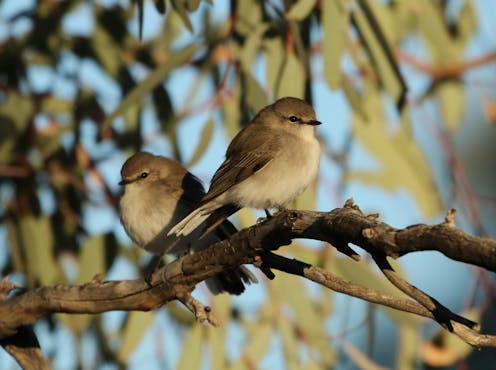
We chose as our subject the Jacky Winter, a small robin common across Australia. Between 2018 and 2021 we followed the fates of 40 breeding pairs living in semi-arid mallee woodland in South Australia. There, the annual number of days above 42℃ has more than doubled over the past 25 years.
As heat escalated, Jacky Winters showed a broad range of behavioural responses. This included adjusting their posture, activity levels and habitat use to avoid gaining heat and to increase heat dissipation.
As air temperatures approached 35℃, birds moved to the top of the highest trees where greater wind speeds cooled their bodies. The birds also began to pant, which can lead to fatal dehydration.
Once air temperatures climbed above 40℃, exceeding the birds’ body temperature, they moved to the ground to shelter in tree-base hollows and crevices. They remained in these “thermal refuges” for as long as it took for air temperatures to drop to about 38℃ – sometimes for up to eight hours. But this made foraging impossible and the birds lost body mass.
We then examined what parts of the birds’ habitat offered the coolest place to shelter on extremely hot days. Hollows in tree bases were significantly cooler than all other locations we measured. The best of these cool hollows were rare and found only in the largest eucalypt mallees.
Even with their flexible behaviour, the ability of Jacky Winters to survive heatwaves was finite – and apparently dependent on whether large trees were available. Some 29% percent of adults we studied disappeared (and were presumed dead) within 24 hours of air temperatures reaching a record-breaking 49℃ in 2019.
Similarly, during two months of heatwaves in 2018, 20% of adults studied were lost, compared with only 6% in the two months prior.
Eggs and nestlings were even more susceptible to heat. All 41 egg clutches and 21 broods exposed to air temperatures above 42℃ died.
We found it distressing to witness such losses among birds we had followed for months and years. And it was deeply sad to see the breeding failures after the parent birds had invested so much effort in caring for eggs and tending to young.
Read more: (The most social) bird of the year: why superb fairy-wren societies may be as complex as our own
We need to act
Our studies show extremely high temperatures are already killing troubling numbers of birds in Australia’s arid and semi-arid regions. These regions comprise 70% of the Australian continent and 40% of the global landmass.
Such losses will only worsen as climate change escalates. This has profound implications for biodiversity in Australia and more broadly.
Obviously, humanity must urgently reduce greenhouse gas emissions to limit global warming. But we must also better manage our biodiversity as the climate changes.
Key to this is identifying and protecting thermal refuges such as tree hollows by, for example, managing fire to reduce the loss of large trees.
The authors wish to acknowledge our colleagues, especially Lynda Sharpe and Tim Bonnet, for their important contributions to the research upon which this article is based.
Authors: Janet Gardner, Adjunct Research Scientist, CSIRO

















