

Let's show a bit of love for the lillipilly. This humble plant forms the world's largest genus of trees – and should be an Australian icon
- Written by Darren Crayn, Professor and Director, Australian Tropical Herbarium, James Cook University
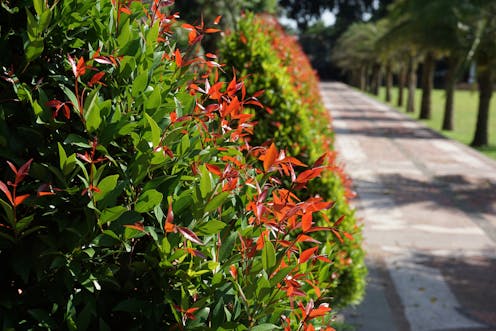
You’re probably familiar with the sight of a lillipilly bush. This hardy Australian staple – a glossy evergreen bearing powder-puff flowers and clusters of bright berries – features in many a garden hedge.
But you may not know this humble native has spread across the globe in waves of emigration, adaptation and evolution. Almost 1,200 species of lillipilly are now found in rainforests across the tropics and subtropics of Africa, Asia and the Pacific.
Our research helped reconstruct the evolutionary history of lillipillies in unprecedented detail. We show how lillipillies evolved in Australia and now form the largest genus of trees in the world.
Lillipillies are one of Australia’s great gifts to the natural world. But the story of these homegrown heroes may be taking a grim turn.
A plant on the move
Lillipillies began their international adventures about 17 million years ago. At that time, the Australian continent (which together with New Guinea is known as the Sahul Shelf) was colliding with Southeast Asia (known as the Sunda Shelf) following its breakup with Antarctica. This breakup was the final dramatic act of the fragmentation of Gondwana.
The collision provided opportunity for biotic exchange between the northern and southern hemispheres. Many plants and animals moved south to the Sahul Shelf and prospered in the new lands. Lillipillies are one of the few lineages that moved in the other direction.
Along with our songbirds, lillipillies stand as a rare example of an Australian group that set out from these shores and achieved major evolutionary success abroad.
Lillipillies light up our lives when they flower and fruit. Their showy white, cream or red flowers are followed by succulent red or purple berries. They’re a magnet for pollinators, helping fill our gardens with the songs of insects and birds.
The riberry, Syzygium luehmannii, is one of the most commonly grown and stunning garden species. It produces heavy crops of delicious fruit rich in antioxidants and prized by chefs.
Many species in the genus are used as food and medicine by Indigenous people, and potent antibacterials have been identified in the leaves of some species. Cloves, a favourite spice of home bakers, are the dried flower buds of an Indonesian lillipilly – the aptly named Syzygium aromaticum.
About 75 species of lillipilly are native to all Australian states and territories except South Australia and Tasmania.
The greatest concentration of species is in the Wet Tropics World Heritage Area of northeast Queensland. About 50 species are found there, half of which occur nowhere else on Earth.
And almost 1,200 species of lillipilly are now found in rainforests across the tropics and subtropics of Africa, Asia and the Pacific, including Australia.
As is common in the tropics, species new to science are regularly discovered and named. For example, almost 30 new species of lillipilly have been named from New Guinea in the last two years – and many more are likely awaiting scientific discovery.
But how did lillipillies achieve such international success? Our research team decided to find out.
Peering into the past
The research, led by colleagues in Singapore, involved analysing the genomes of hundreds of living species of lillipillies.
Similarities and differences in the structure of genomes can reveal how closely related the species are. Using that knowledge, we can build up a picture of their genealogy - the “family tree” that connects ancestral species and their descendants.
These techniques also allow us to estimate the amount of genetic change that has occurred along the branches of the genealogy. And, if we’re lucky enough to have an accurately dated fossil of an ancestral species – as we do for lillipillies – we can calculate the rate of genetic change even more accurately.
All this allowed us to peer deeply into the past and reveal the events that set the lillipillies on their global journey.
We already knew lillipillies evolved in Australia and emigrated into the rainforests of Africa, Asia and the Pacific. Our research showed this dispersion occurred in at least a dozen distinct waves.
Each emigrant lineage diversified rapidly and successfully in its new environment. This resulted in the nearly 1,200 lillipilly species found worldwide today – more than any other tree genus. In contrast, their relatives the eucalypts have largely remained only a local success story.
Read more: The 50 beautiful Australian plants at greatest risk of extinction — and how to save them
A sad twist?
Lillipillies may be one of Australia’s most successful botanical exports, but their future, like that of many rainforest plants globally, is threatened by habitat degradation and climate change.
The Magenta Cherry (Syzygium paniculatum), for example, is endangered by coastal development in New South Wales. And the Brotherly Love Lillipilly (Syzygium fratris), found only on Queensland’s highest mountain, is highly vulnerable to climate change.
But a devastating disease – myrtle rust - may be the most potent threat of all. It’s caused by an introduced fungal pathogen and kills new foliage, flowers and fruits of plants in the family Myrtaceae, to which lillipillies belong.
Myrtle rust arrived in Australia in 2010 and spread rapidly in the wind and via human activity. Already, it threatens some plant species with extinction. Lillipilly species have been damaged by this serious disease, though none are under immediate extinction threat yet.
Lillipillies are an Australian origin story. They’re a major contributor to rainforest biodiversity and important to Indigenous cultures. And they’ve endeared themselves to generations of gardeners and cooks.
Given all this, lillipillies deserve to be recognised – and protected – as Aussie icons.
Read more: Climate change threatens up to 100% of trees in Australian cities, and most urban species worldwide
Authors: Darren Crayn, Professor and Director, Australian Tropical Herbarium, James Cook University

















