

The High Court of Australia has a majority of women justices for the first time. Here's why that matters
- Written by Kcasey McLoughlin, Senior Lecturer in Law, University of Newcastle
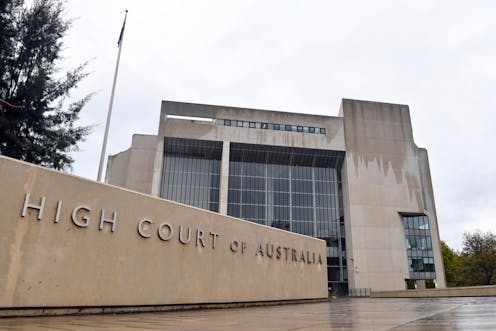
In appointing Justice Jayne Jagot to the High Court, the Albanese government has made history: for the first time, the court will have a majority of women on its bench.
We have come a long way. At the turn of the 20th century, women were not permitted to practise law in any Australian jurisdiction. And even when those formal barriers to admission were eventually removed, informal barriers meant the law remained a man’s world.
For more than 80 years after its establishment in 1903, the High Court of Australia remained the exclusive preserve of men. It was not until 1987 that Mary Gaudron, became the first woman to serve on the court.
Women have been appointed to the High Court with some regularity over the past decade. Yet only seven women have been appointed of a total of 56 justices. The first woman to serve as Chief Justice of the High Court, Susan Kiefel, was sworn-in in 2017.
Justice Jayne Jagot will replace Justice Patrick Keane on the High Court, which means four of the seven justices will be women. In announcing the appointment, Attorney-General Mark Dreyfus explicitly acknowledged the historical significance of the appointment, noting “this is the first time since Federation that a majority of Justices on the High Court will be women”. He described the new judge as an “outstanding lawyer and an eminent judge”.
The government is largely unrestrained in making their appointments beyond a requirement they consult with state attorneys-general and the appointee meets the minimum qualifications of admission as a legal practitioner. Certainly, there is nothing that compels the government to consider the value of diversity in making its appointments. Moreover, there is little transparency and accountability in the process – the government is not required to shortlist against publicly available selection criteria or to account for its decision-making.
Australia needs greater transparency in appointing judges
Calls to reform High Court appointment practice to improve diversity, transparency and accountability are not new. Importantly, these criticisms have very rarely been personal (about the suitability of individual appointees). However, these calls were renewed in 2020 in response to allegations that Dyson Heydon had sexually harassed legal associates during his time as a Justice on the High Court of Australia.
In an open letter to then Attorney-General Christian Porter, more than 500 legal women called for reforms to how Australia appoints and disciplines its judges. It called for shortlisting against publicly available criteria, including legal knowledge, skill and expertise, as well as essential personal qualities (such as integrity and good character). It was further proposed that the value of diversity in judicial appointments should also be respected in formulating criteria.
More recently, the Australian Law Reform Commission’s new report on judicial impartiality outlined a series of recommendations. One of those recommendations was for a more transparent process for the appointment of federal judicial officers.
Historically, there has been little appetite for formal reforms to High Court appointment practices. Successive governments have often avoided explicitly commenting on the value of a more diverse judiciary.
It remains to be seen whether the government will seek to implement formal reforms. However, Dreyfus is understood to be sympathetic to a more open and transparent appointment process. In announcing the most recent appointment, he explained the extensive consultation undertaken by the government, which was certainly more far-reaching than we have seen in recent years. It consulted with all state and territory attorneys-general, the heads of the federal courts, and state and territory supreme courts. It also spoke with state and territory bar associations and law societies, National Legal Aid, Australian Women Lawyers, the National Association of Community Legal Centres and deans of law schools.
Justice Jagot’s appointment has been widely praised within the legal profession. Although legal commentators emphasised that it was a welcome milestone for women, it was nonetheless framed as something of a happy (if politically expedient) coincidence given her eminence as a jurist.
Why do women judges matter?
In answering this, it is worth remembering the classic quote from Ruth Bader Ginsburg in response to questions about when there will be “enough” women judges on the United States Supreme Court. Ginsburg replied there would enough when there were nine (that is, all of them). Acknowledging that people were shocked by this response, Ginsburg famously countered
there’s been nine men, and nobody’s ever raised a question about that.
This exchange demonstrates how accustomed we are to the idea that judging is the domain of men.
This very notion is reminiscent of the question posed by American lawyer Carrie Menkel-Meadow: “what would our legal system look like if women had not been excluded from its creation?”
We can never know the answer to this question. Nor can these institutions necessarily be remade in a way that escapes their masculinist origins.
And yet, a majority of women judges sitting on an apex court is still significant, both nationally and internationally. The process of “letting women in” has chipped away at these foundations and opened up possibilities for transformation.
This is not because there is a distinctive women’s judicial voice (there isn’t). It is because a majority of women judges sitting on the High Court makes an important symbolic statement about women’s admission to legal authority in Australia.
When an institution once occupied only by men admits women into its space, the existing gender relations and gender norms cannot remain unaffected.
We saw this in 2020 with the revelations about sexual harassment on the High Court and Chief Justice Susan Kiefel’s decisive response, which was widely praised. The admission of women to historically masculine domains does have the potential to disrupt institutional norms.
Australia is certainly not the first apex court to have a majority of women justices. For example, the Federal Court of Malaysia has a majority(8/14) of women. But compared with other Western democracies, Australia has been progressive on this issue. In the UK, there is currently one woman on a bench of 12; in the US 4/9, New Zealand 3/6 and Canada 4/9.
Of course, there will always be those who say gender shouldn’t matter. But gender has always mattered. It mattered for the first 80 years when only men were permitted to exercise legal authority at the peak of our legal system. And it still matters in 2022, when the High Court has a majority women justices for the first time.
Authors: Kcasey McLoughlin, Senior Lecturer in Law, University of Newcastle

















