

In disasters, people are abandoning official info for social media. Here's how to know what to trust
- Written by: Stan Karanasios, Associate professor, The University of Queensland
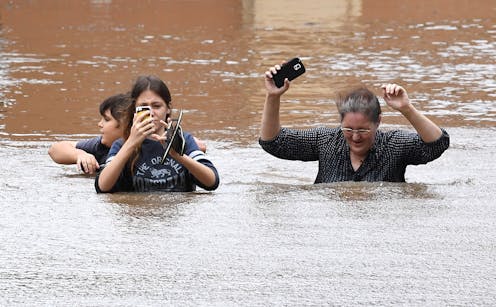
In an emergency, where do you turn to find out what’s going on and what you should do to stay safe?
Traditionally, government agencies have been the “go-to” sources of information in events such as floods and bushfires, as well as health emergencies such as the COVID-19 pandemic.
However, the rise of social media has seen community groups, volunteers and non-government organisations nudging out official channels. While these informal sources often provide faster, more local information, they may also be less reliable than government sources.
So what should you do in an emergency? Here are some tips for how to prepare – and how to decide who to trust when the need arises.
Information overload
The number of sources of information we can access is growing all the time. This leads to higher information load and lower quality of shared information.
With so many sources of information there is also the possibility of contradictory social media messaging by government and other actors, as we have seen during COVID-19. For emergency planners, this increases complexity and can lead to unpredictable behaviours by citizens who may not be responding to relevant advice or even accurate warnings.
For their part, citizens are demanding more and more information that matches their needs. Citizens clearly find value from local information sources.
Getting warnings right?
Our research shows citizens rely heavily on social media information. During an emergency or extreme weather event 55% of surveyed social media users reported they would spend more time on social media, and 88% expected to use social media more for future emergencies.
Many people are switching off from official warnings because they find them hard to understand, or may feel there are too many of them. It may be that they have seen too many situations where the warnings do not affect them - “the boy who cried wolf”. The bottom line is people want answers to immediate questions such as “How does this affect me right now?”
Eroding control
On the flip side, government agencies also find social media hard to manage. In an emergency, they may not have the resources to keep up with the influx of comments and posts.
These shifts have raised concerns that greater use of social media erodes the established command-and-control information approach that has traditionally been vital to ensuring consistency in emergencies.
The information space is likely to become even more cluttered as extreme weather events become more frequent and begin to overlap.
What can citizens do?
Compounded by misinformation, fake news, disinformation and the plethora of social media and other media, it is no wonder that citizens may be confused and retreating to local or other “go to” social media sources.
It is not a matter of government information versus other sources of information. Often official advice is the starting point for outlining what is going on and encouraging local dialogue. This creates the opportunity for the local community to crowdsource information and offer further insights from locals on the ground.
The first step to being information-ready is to be mindful that there is a whole ecosystem of information sources and channels.
Your basic, trusted source of information should still be government agencies. Trusted local sources can then amplify that information or add context. Likewise, individuals may provide reports from the ground, share their experiences and contribute to how a community makes sense of what’s happening.
Don’t believe everything you read
While community social media sources can be excellent sources of local information, you shouldn’t accept everything you see there at face value.
Local Facebook and WhatsApp groups, for example, can have very fluid membership and their own biases – meaning the quality of information they provide may vary. What’s more, the most visible and engaging posts on social media are often the most controversial ones, not necessarily the most accurate ones.
As well as biases and limited reliability, social media are also vulnerable to organised attempts at disinformation. During Australia’s 2019-20 bushfires, for example, the hashtag #arsonemergency pushed the narrative that arsonists (rather than climate change) were the main cause of the fires.
Read more: Bushfires, bots and arson claims: Australia flung in the global disinformation spotlight
However, the hashtag turned out to be a concerted effort to change the narrative and even media agencies were fooled.
This highlights the need to crosscheck information obtained from social media.
Emergencies are emotional and volatile events, so you should make yourself familiar with government social media and warning channels before events like bushfires or floods occur. If you know in advance where to go and what sources to trust, it will take some stress out of the situation.
At the same time, educate yourself on how to evaluate information.
Most platforms are trying to counter misinformation. Keep an eye out for tags on content that is harmfully misleading, or indicating official trusted sources.
Debunking popular misinformation is another common tactic, and fact-checkers operating at a local level could reassure the public. So-called “prebunking” - pre-emptive debunking before misinformation has spread – is also effective at reducing susceptibility to misinformation at scale.
Like all approaches, these have their drawbacks. People have to actively choose to engage with them. And, perhaps more significantly, in the volatile situation of an emergency people often simply revert to familiar sources of information.
Authors: Stan Karanasios, Associate professor, The University of Queensland


















