

revisiting Tutankhamun's tomb 100 years after its discovery
- Written by: Anna M. Kotarba-Morley, Senior Lecturer in Archaeology, Flinders University
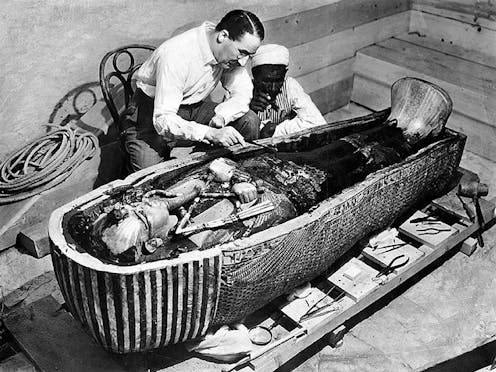
On November 4 1922, a young Egyptian “water boy” on an archaeological dig is said to have accidentally stumbled on a stone that turned out to be the top of a flight of steps cut into the limestone bedrock.
The stairs led to one of the most spectacular archaeological discoveries in history and the only almost intact funerary assemblage of a pharaoh – the Tutankhamun’s tomb.
A century after this discovery, it’s worth revisiting the story of Tutankhamun’s tomb and how it eventually became a symbol for Egyptian nationalism.
The ‘child king’
Tutankhamun is often referred to as a “child king” and the “most famous and least important” of the pharaohs; he was almost unknown to history before the tomb’s discovery.
The son of one of the most controversial pharaohs in history – the champion of monotheism, Akhenaten – Tutankhamun ascended the throne around age six or so. After a rather uneventful reign of restoring temples and bringing Egypt out from a period of political and religious turmoil, he died sometime between the age of 17 and 19.
The discovery of his tomb full of magnificent and unique objects is more than a story of treasures. This is also a tale of the “roaring 20s” in the Middle Eastern version: a story of a quintessential embrace of class, privilege and colonialism juxtaposed against struggle for political freedom and building of new national identity.
Archaeology 100 years ago was very different.
None of the three male protagonists behind the discovery – Howard Carter (the lead British excavator), Lord Carnarvon (the man behind the money), and Ahmed Gerigar (the Egyptian foreman) – were formally trained as archaeologists.
Despite this, Carter is now almost always referred to as an archaeologist, but Gerigar almost never is – further entrenching colonial narratives.
But Carter’s three-decade-long excavation experience, draughtsman’s talent and his meticulousness, allied with the photographic aptitude of Harry Burton of Metropolitan Museum and the skills of the Egyptian excavators assured Tutenkhamun’s tomb – the only discovery of its type and arguably one of the most important archaeological finds ever – was recorded in a systematic and “modern” way.
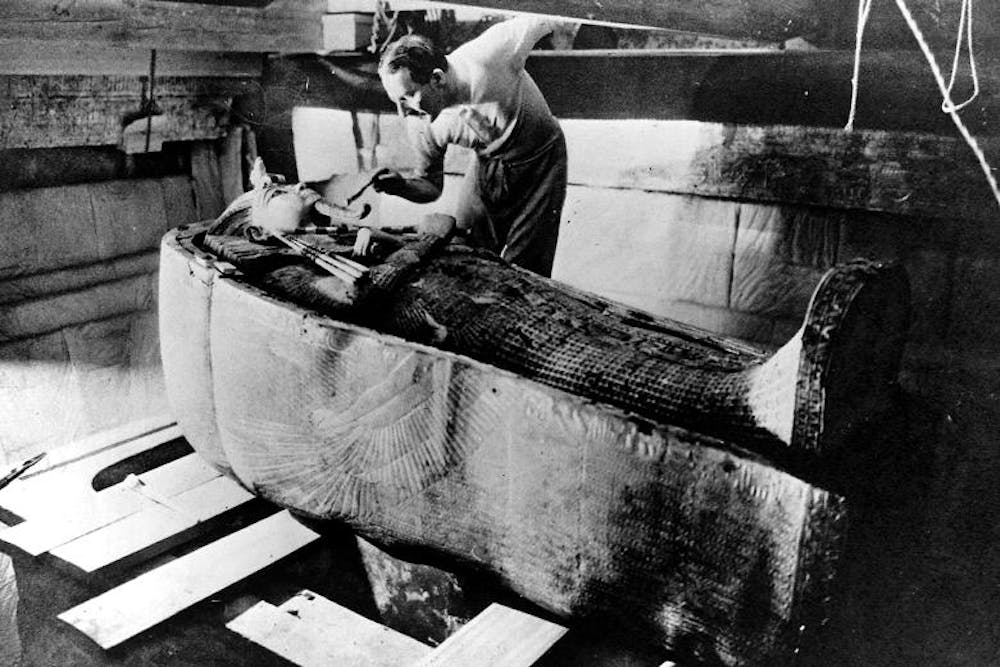
The painter who became an archaeologist
Howard Carter was a young painter who fell in love with Egyptian antiquities while following his father, also a painter, into the houses of London’s elite to add drawings of pets to his father’s portraits.
In 1891, age 17, Carter was recommended as an illustrator to archaeologist Percy Newberry, and joined him at a dig in Egypt at Beni Hassan tombs. From this first trip to his death in 1939, Carter spent his life mostly in Egypt with short trips back to London to deal in antiquities, including those allegedly stolen from Tutankhamun’s tomb.
After Beni Hassan, Carter became an illustrator for one of the fathers of Egyptology, William Flinders Petrie in Tell el-Amarna, the capital of Tut’s father Akhenaten.
Carter then worked in Deir el-Bahari, the funerary temple of queen pharaoh Hatshepsut, located right on the other side of the limestone ravine known as the Valley of the Kings.
It is here, on the western bank of the Nile I also trace some of my humble early experiences in Egyptology.
Walking at dawn from our base at the Metropolitan Museum house in Deir, which Carter frequented, to the temple, I followed in his footsteps and mused on how lucky he was when the “water boy” stumbled upon a staircase to the tomb.
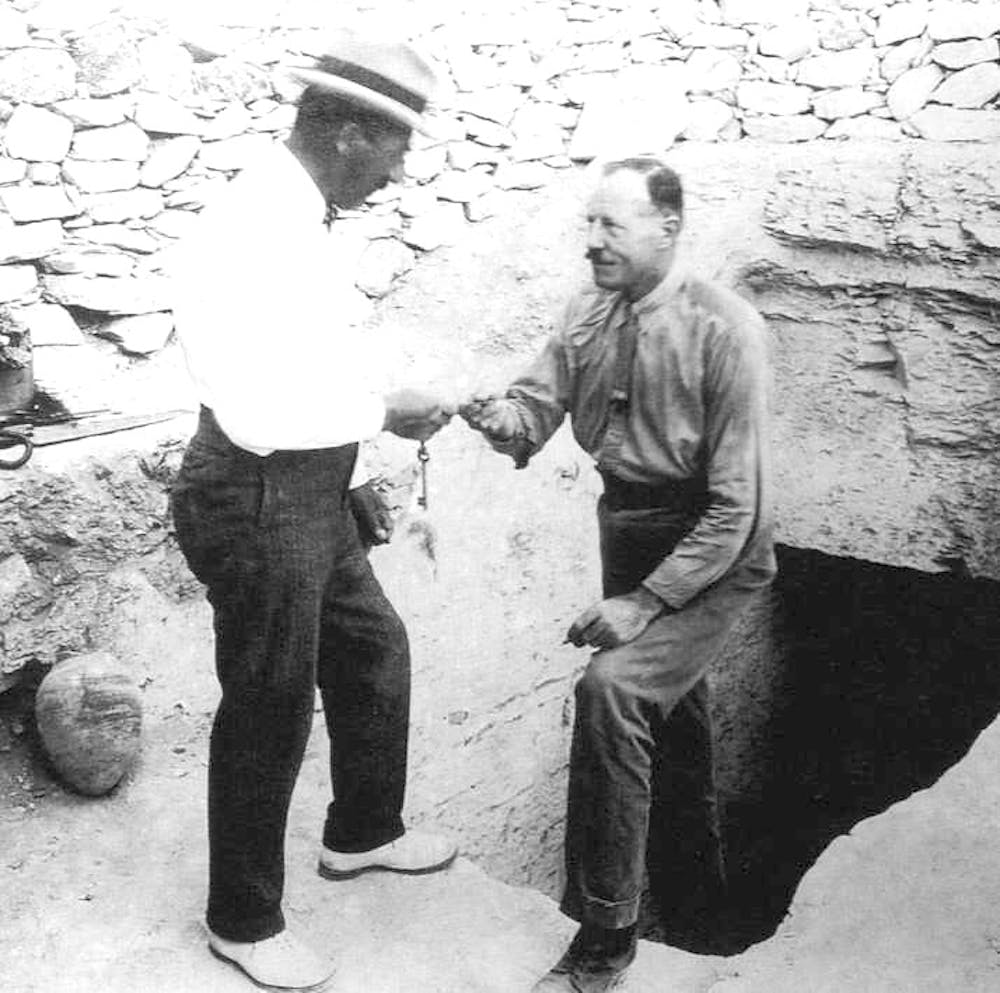 Lord Carnavon and Howard Carter at the entrance to the tomb in 1922.
Wikimedia Commons
Lord Carnavon and Howard Carter at the entrance to the tomb in 1922.
Wikimedia Commons
That year, 1922, was supposed to be the last season after seven fruitless years of digging in the Valley in search of Tutankhamun’s elusive resting place.
After clearing the staircase, Carter found the doorway sealed with cartouches – the hieroglyphs which enclose a royal name. He ordered the staircase to be refilled, and sent a telegram to Carnarvon, who arrived from England two-and-a-half weeks later.
On November 26 Carter made a “tiny breach in the top left-hand corner” of the doorway.
Carnarvon asked, “Can you see anything?” and Carter replied with his famous line: “Yes, wonderful things!”
 Opening the burial shrine in 1924, photographed by Howard Carter.
Wikimedia Commons
Opening the burial shrine in 1924, photographed by Howard Carter.
Wikimedia Commons
Across 3,000 years, about 300 pharaohs ruled ancient Egypt. All royal tombs had been broken into by thieves.
The spectacular find of Tut’s tomb was also not a fully intact discovery. The tomb had been looted twice in antiquity, and Carter estimated that a considerable amount of jewellery was stolen. But it is the only surviving almost complete funerary assemblage.
Consisting of over 5,000 objects, only 30% have been studied so far.
A story of its time
Following Egyptian independence on February 28 1922 and the establishment of an independent Kingdom of Egypt, the discovery of Tutankhamun’s tomb became an optimistic symbol for Egyptian nationalists.
After the initial documentation, the official opening of the tomb in early 1924 coincided with the inauguration of Egypt’s first elected parliament.
Despite the new independence, colonial attitudes continued. Lord Carnarvon sold the rights to the story of the discovery of Tut’s tomb to the London Times for a significant sum.
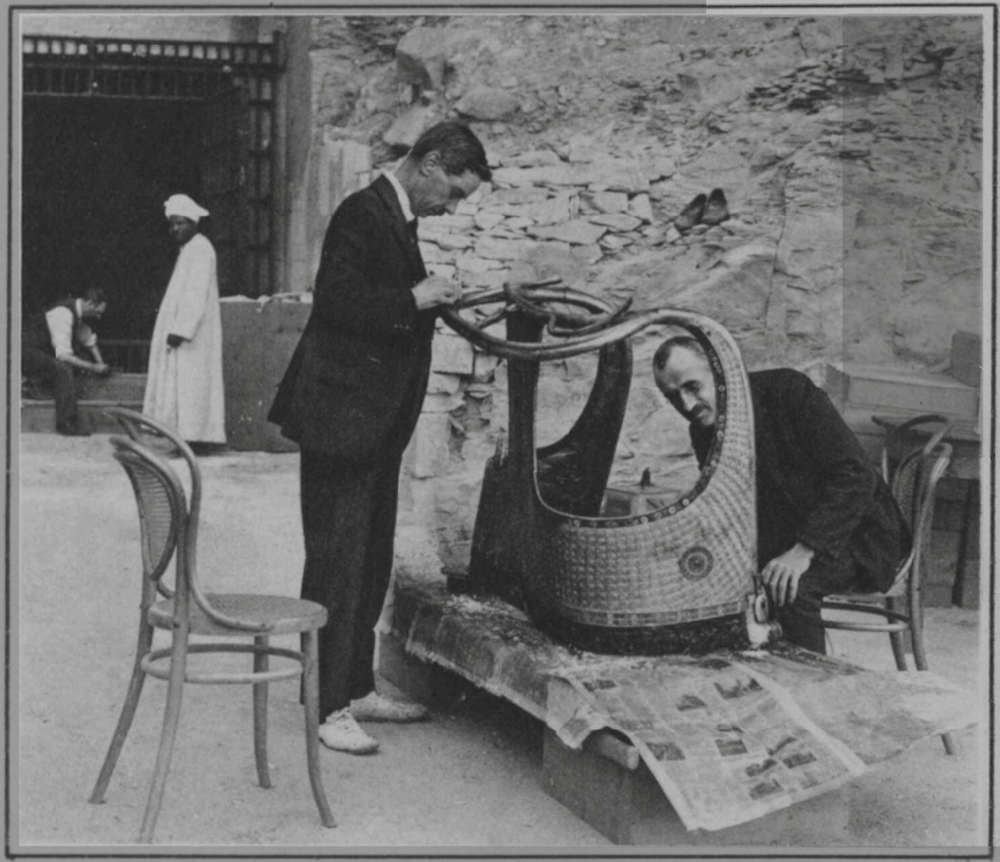 Arthur Mace and Alfred Lucas working on the conservation of a chariot from Tutankhamun’s tomb.
Wikimedia Commons
Arthur Mace and Alfred Lucas working on the conservation of a chariot from Tutankhamun’s tomb.
Wikimedia Commons
Given the delay of a couple of weeks with sending photos on the ship from Cairo to London, Egyptian newspapers and readers were only able to follow the unfolding discovery from reading delayed British press. This caused a lot of resentment among the newly independent Egyptians, especially the middle classes.
Nevertheless, the discovery was very significant for nation building and new national post-colonial identity.
Taha Hussein, a notable Egyptian philosopher of the time, coined a notion of “pharaonism”. This unified national identity was supposed to transcend religious and ethnic differences between Arab, Muslim, Coptic and Jewish Egyptians.
It remains a tool of propaganda to this day – notably with a parade of 22 mummies moving to a new national museum and a lavish re-opening of the Grand Egyptian Museum soon, where much of the treasures from Tutankhamun’s tomb can be found today.
Authors: Anna M. Kotarba-Morley, Senior Lecturer in Archaeology, Flinders University





















