

Modern Australian
Men's Weekly

.

Koalas, parrots, frogs and orchids share our cities. Their fate depends on protecting each one's habitat, not just 30% of all land

  • Written by Simon Kilbane, Senior Lecturer, Landscape Architecture, Deakin University
Koalas, parrots, frogs and orchids share our cities. Their fate depends on protecting each one's habitat, not just 30% of all land

The global 30x30 target aims to protect 30% of the planet by 2030 to secure its biodiversity. This involves legal protection for land and sea areas designated as national parks and nature reserves. Australia has joined more than 100 countries in this bold initiative.

However, if we are to adequately protect all species, we must acknowledge we never start with a blank slate. As a major academic review of fragmented ecosystems observed:

“Conservation managers must work with the remnants and virtually never have the opportunity to design a reserve network before an area is fragmented.”

The areas we choose to protect must include ecosystems where biodiversity is under pressure from human land uses. Australia’s urban areas still have a surprisingly high level of biodiversity.

Our major cities are home to almost 380 threatened species. They range from the western ringtail possum, koala and grey-headed flying fox to the orange-bellied parrot, red-crowned toadlet and several orchids. Indeed, 39 endangered species are found only in our cities and towns.

These urban areas also include threatened ecological communities such as the banksia woodlands of the Swan coastal plain in Perth and blue gum high forest of the Sydney region.

So, what does the 30x30 target mean for our cities and how we protect their biodiversity?

Small toad with red markets on the head, legs and rump
The distinctive red-crowned toadlet is found only in the Sydney Basin bioregion. Wikimedia Commons, CC BY

Read more: The 39 endangered species in Melbourne, Sydney, Adelaide and other Australian cities

Many areas are poorly protected

To protect biodiversity it’s not enough to simply protect 30% of land in general. Australia’s National Reserve System prescribes a comprehensive, adequate and representative approach. This divides the country into 89 distinct bioregions and 419 subregions.

The latest data suggest that simply achieving 30% protection for all these areas will be difficult.

As the maps below show (dark green areas have 30% or more protection), Australia meets this target in only 29 of its 89 bioregions, and 96 of 421 subregions. Is this is an improvement from a decade ago when a modest target of 10% protected area had been achieved in only 57 of 89 ecoregions?

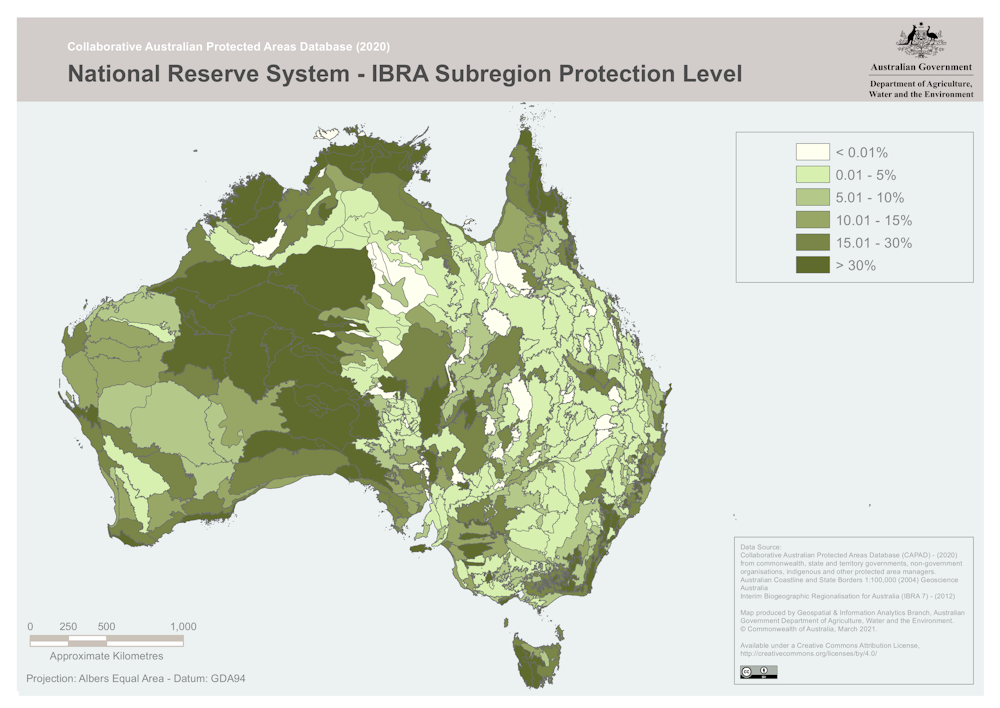
Map of Australia showing level of protection of bioregions
Source: Department of Climate Change, Energy, the Environment and Water Map of Australia showing level of protection of subregions Source: Department of Climate Change, Energy, the Environment and Water Even the 30% target may not be adequate. And yet achieving it will be difficult in the face of worldwide challenges such as climate change, invasive species and the issues of resourcing and managing an ever-expanding network. Read more: Protecting 30% of Australia's land and sea by 2030 sounds great – but it's not what it seems How do we protect urban biodiversity? Adequately protecting biodiversity in the cities and towns where most Australians live will be especially difficult. For example, a cursory look at protected area data for Sydney, situated across one bioregion, Sydney Basin, suggests good progress, with 40.99% of its area protected. However, at the level of its subregions, the picture is different. Pittwater (31.62%), Yengo (58.55%) and Woollemi (71.81%) have high levels of protection. But look at how little land is protected in the subregions that sit entirely within Sydney proper – only 3.13% for Cumberland. The most urbanised subregions of the Sydney Basin bioregion have minimal protected areas. Map by Simon Kilbane using Commonwealth data The picture is similar across all of Australia’s urban areas. To achieve comprehensive, adequate and representative protection of our biodiversity, we are going to have to think differently. How can we better plan our urban landscapes, or perhaps retrofit these areas, to provide habitat for our imperilled species? Read more: Labor's plan to save threatened species is an improvement – but it's still well short of what we need 5 approaches to protecting biodiversity Here are five approaches drawn from practice around Australia and the world that could help. 1. A philosophical reframing Biodiversity protection should not just occur in remote regions. It’s an issue closer to home. Urban and commercial development directly threatens 56 of Australia’s 255 flora and fauna species on the IUCN Red List of Threatened Species. 2. Green infrastructure Green infrastructure can create a network of urban forest, foreshores and creek lines, parks and open spaces. In this way, we can reconnect fragmented habitat patches. This interconnected network has both ecological and human-related benefits. Bolstered by a healthy groundswell of public and policy support – who wouldn’t want more green space? – there’s a growing momentum to reshape our cities. Notable initiatives include the Perth Biodiversity Project, the Sydney Green Grid and Melbourne’s Urban Forest Strategy. The benefits for ecosystems come from water retention and flood management and increasing plant cover – so important for reducing urban heat island impacts. People’s mental health and wellbeing benefit from spending time in these green areas. Evidence even suggests greener streets and suburbs have higher real estate values. Read more: Here's how to design cities where people and nature can both flourish 3. Creative conservation choices Finding conservation candidates in urban areas requires imagination and creativity. Why not consider disused industrial lands, cemeteries, poorly frequented golf courses, our roof tops and the ubiquitous suburban nature strips? If we radically reconfigured or “rewilded” our streets and gardens we could create more urban habitat. More diverse and local plantings and “backyards for wildlife”-type schemes seem a safe bet. Read more: Yes, the state of the environment is grim, but you can make a difference, right in your own neighbourhoood 4. Rethinking our idea of urban development The above options are the lowest-hanging fruit. What would happen if we radically rethought our profit-driven development model of suburbanisation? We could create a better balance between the habitats of humans and all the other species we share our cities with – as a matter of ecological justice. We might need to use collaborative tools and scenario planning to visualise possible impacts and benefits. This will help us better combine thinking about people, place and ecology. 5. Fostering ecological literacy Starting with learning from how Australia’s lands have been managed through traditional ecological knowledge, we need to foster a deeper appreciation of the nature that exists under our noses. Incorporating ecological knowledge into education from as early as possible will build ecological literacy This might then temper our desire for exotic plantings. We might even have second thoughts about cat or dog ownership given their impacts: Australia’s 3.8 million pet cats kill up to 390 million animals every year. It will take a monumental effort to rethink our country and our cities to preserve their biodiversity. Australia has just begun a worthwhile but difficult journey. Authors: Simon Kilbane, Senior Lecturer, Landscape Architecture, Deakin University

Read more https://theconversation.com/koalas-parrots-frogs-and-orchids-share-our-cities-their-fate-depends-on-protecting-each-ones-habitat-not-just-30-of-all-land-192176

Someone Trips at Your Fundraiser. Now What? Understanding Public Liability for NFPs

Three months of planning. Volunteers giving up their weekends. Sponsorships chased, catering sorted, tables decorated. And then, about an hour into ...

Stainless Steel Tube: A Complete Specification Guide for Engineers, Project Managers, and Industrial Buyers

Few materials in the industrial and manufacturing world are as universally relied upon — or as frequently misspecified — as stainless steel tube...

How to Choose the Right Barber Shears Scissors for Professional Results

Since a barber is only as good as their tool, choosing the right barber shear scissor must not be taken lightly. Most barbers end up buying the first ...

Why Commercial Construction Companies Play A Critical Role In Modern Urban Development

Urban development requires highly organised planning, engineering expertise, and professional construction teams capable of delivering complex build...

Essential Features for Comfortable Family Caravan Trips

Choosing the right van for family travel requires careful consideration of how the space will be used on a daily basis. Families have specific needs...

Chatswood Tutor: Helping Students Achieve Academic Success With Personalised Learning

Education plays a crucial role in shaping a student’s future, and many students benefit from additional academic support outside the classroom. A pr...

How External Consulting Can Guide Enterprise IT Strategy and Procurement

Internal IT teams carry deep operational knowledge, but that familiarity can create blind spots in strategic decisions. An external IT consultant br...

Why Sports Nutrition Australia Is Important for Performance and Recovery

Athletes and fitness enthusiasts place significant demands on their bodies during training and competition. Maintaining energy levels, supporting mu...

How Body Contouring Bundoora Helps Improve Shape And Confidence

Modern aesthetic treatments have made it possible to refine body shape without the need for invasive surgery. One of the most popular non-surgical o...

Why Plantation Shutters Are a Stylish and Practical Choice for Modern Homes

Window coverings play a major role in the comfort, privacy, and overall design of a home. Homeowners often look for solutions that provide both visu...

Why a Retractable Hose Reel Is Essential for Efficient Water Management

Managing hoses efficiently is important for both residential and commercial environments. Whether watering gardens, cleaning outdoor areas, or maint...

Best Ways to Trade In Your Old Tech for Cash in Australia

Upgrading your mobile is exciting, but many Australians are left wondering what to do with the device they no longer use. Instead of leaving it in a...

Why Doctors in Bundoora Play an Important Role in Community Health

Access to quality healthcare is essential for maintaining a healthy lifestyle and managing medical conditions effectively. Visiting experienced doctor...

Backyard Aesthetics Decoded: Mediterranean, Coastal, Retro, Rustic, and Beyond

Backyard design has come a long way from a patch of lawn, a barbecue in the corner, and a few chairs chosen purely for practicality. Today, outdoor ...

What Stops a Home From Feeling Flat-Pack Generic

There is nothing wrong with convenience. Flat-pack furniture, fast styling decisions, and online checkouts have made it easier than ever to furnish ...

5 Best Dental Clinics in Beecroft, NSW

The best dental clinics in Beecroft, NSW are Beecroft Smiles Dental Surgery, Beecroft Elegant Dental Clinic, McConnell Dental, Dentistry for Life, a...

Executive Recruitment: Finding Leadership Talent That Drives Organisational Success

Hiring the right leadership team can significantly influence the direction and performance of any organisation. Strong executives bring strategic thin...

Understanding the Importance of Abrasive Blasting in Industrial Surface Preparation

Surface preparation is an essential step in many industrial processes. Whether preparing metal structures, removing old coatings, or cleaning equipmen...

















