

how climate change is eroding human rights in Vanuatu
- Written by: Karen E McNamara, Associate Professor, The University of Queensland
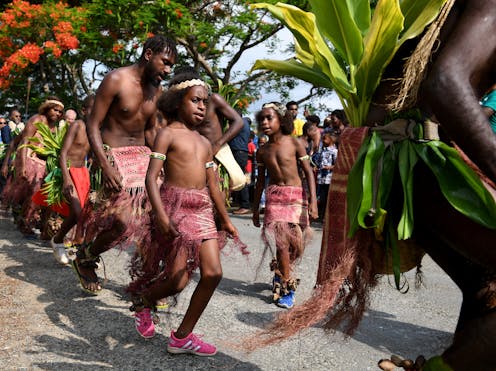
There’s a lot at stake over the next fortnight as nations gather at the COP27 climate conference in Egypt. But the stakes are perhaps highest for the Pacific islands and their people.
A report by the Intergovernmental Panel on Climate Change last year said global warming above 1.5℃ would be “catastrophic” for Pacific island nations. Sea-level rise could lead to the loss of entire Pacific countries this century.
Such damage is a fundamental threat to the human rights of Pacific populations who, as one research paper reminds us, are not merely “victims” of climate change, but “real people with dignity and dreams for the future”.
We have been conducting research for the Vanuatu government into how climate change is affecting the human rights of the nation’s highly exposed population. We’ve heard stories of loss and resilience from those whose lives and traditions are being ripped apart by this global catastrophe.
Facing climate change on an island nation
Vanuatu has a population of about 315,000 people, who live across 13 principal and many smaller islands.
Like other Pacific island nations, Vanuatu is highly exposed to climate change effects such as sea-level rise, coral bleaching and extreme tropical cyclones. In fact, the sea level around Vanuatu has risen by around 6mm per year since 1993, a rate nearly twice the global average
Vanuatu is seeking an “advisory opinion” from the International Court of Justice (ICJ) to clarify the rights and obligations of states under international law in relation to harms from climate change. A majority of UN member states must agree to this opinion being provided. If Vanuatu succeeds, it could have extensive legal implications at a global, regional and national level.
We undertook research for the Vanuatu government as part of this legal push. It involved a nation-wide survey to explore how locals in Vanuatu experience climate change and how it impinges on their human rights.
‘This is a cultural right’
The study involved an online survey administered in Vanuatu’s national language, Bislama, as well as English and French. Some 118 people completed the survey between June and October this year. The results have been finalised and submitted to the Vanuatu government for use at COP27.
Participants ranged in age from 18 to 76. They told of witnessing general climate change impacts such as intense cyclones, droughts, flooding and coastal inundation.
They also told of decimation and loss of Indigenous knowledge around weather, seasons and medicines, as well as physical damage to traditional crops.
One crop of particular concern was the yam – a starchy, edible root central to the identity of many people native to Vanuatu.
Locals mark the yam harvest with rituals and ceremonies. However, climate change is disrupting these cultural rhythms. As one participant told us, altered weather patterns had led to failed germination, a higher prevalence of disease and root rot, and lower yields:
The cultural ways of planting are not adaptive to these fast changes caused by the climate which is now leading to a loss of cultural practices and knowledge. This is a cultural right that can never be recovered and re-built if we lose it due to climate change.
No financial means can recover those non-economic losses, which are our heritage and dignity. And climate change is taking these rights away from us.
Traditional medicines are similarly being lost at an alarming rate and are impinging on the health and wellbeing of local people.
One participant told how children learnt from an early age to be self-sufficient – growing their own food, fishing on the reef and collecting crabs after school. The participant went on:
Nowadays because the coral reefs are dying, the fish have gone […] Our crops are producing less yield because of weather changes. Root crops are rotting before they become ready to harvest because of the unusually large amounts of rain that we experience.
We have had to spend more money on food now than we ever did in the past. In the future I do not expect for there to be anything left in the waters or in the bush.
The participant expressed fears that knowledge passed on by grandparents to younger generations about natural resource management would “die with my generation”:
I am concerned about the impacts of climate change on our environment and on our culture.
[…] the love and respect we had towards nature will fade away into nothing and the deep cultural ties to our waters will be lost when we will have to start teaching our children their heritage from books and not from taking them out to sea on a canoe and pointing out fish like it was done for us.
What this means for COP27
The stories we gathered during our research make one thing clear: climate change is real, it’s impinging on the human rights of people in Vanuatu, and will continue to do so in future.
Among the big issues to be discussed at this year’s COP27 conference is “loss and damage” compensation. This refers to the money that richer nations should pay to developing nations for the economic, socio-cultural, environmental and physical costs brought by climate change.
As our research shows, those costs are already being borne. Developed nations have a moral obligation to make sure people in developing countries, who’ve contributed so little to climate change, do not continue to suffer in a warming world. That includes providing access to appropriate remedies and ways to adapt.
The authors would like to acknowledge and thank Stephanie Stephens, George Koran and Willy Missack from the Vanuatu Climate Action Network for their support and collaboration on this research.
Read more: This is what Australia needs to bring to Egypt for COP27
Authors: Karen E McNamara, Associate Professor, The University of Queensland

















