

Tempted to buy a UV light disinfection gadget? Some can be dangerous – here's what you need to know
- Written by: Lotti Tajouri, Associate Professor, Genomics and Molecular Biology; Biomedical Sciences, Bond University
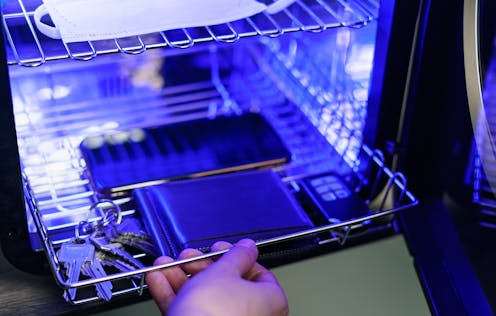
The COVID-19 pandemic has fundamentally changed many of our behaviours and attitudes towards infection control.
Hand hygiene was one of the earliest and most adopted measures to counteract the spread of disease, but there have been more technology-based approaches, too.
Read more: Vodka won't protect you from coronavirus, and 4 other things to know about hand sanitizer
One example is the booming industry of devices that use ultraviolet radiation (UV) to kill germs. While UV can successfully sanitise the air, or objects such as your smartphone, it can also come with cancer risk if the radiation is not behind a proper barrier.
Here’s what you need to know about UV sanitation devices.
How does UV sanitation work?
Ultraviolet light is light with wavelengths just short enough that most humans can’t see it under normal conditions. The most ubiquitous source of UV is the Sun, which radiates everything from vacuum UV to far UVC, UVC, UVB and UVA rays (see below).
The last two can pass the ozone layer in our atmosphere, while the first three are blocked – good news for life on Earth, since UVC in particular can be harmful to living things.
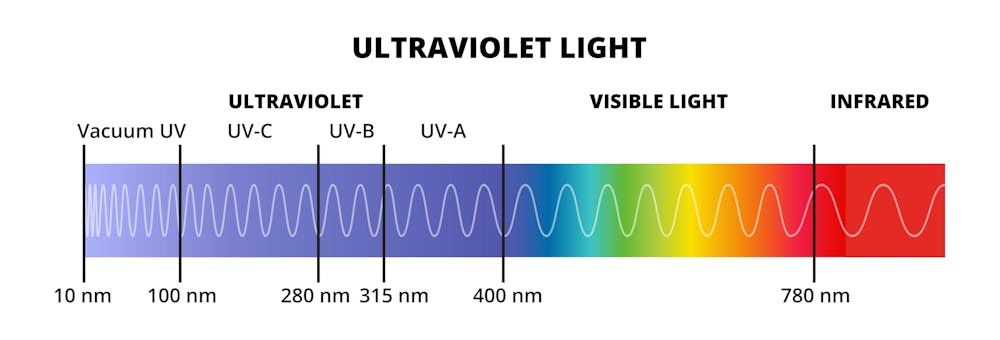
At a wavelength of 250–260 nanometres, energy generated by UVC rays can penetrate through microbes to break their DNA and RNA, disrupting their cell functions and killing them.
This is useful for germicidal (germ-killing) UVC radiation technology, although its efficacy depends on radiation intensity, the distance from light source to target, the type of surface being sanitised, and the wavelength at which the UVC is operating.
The blue light you often see on such devices is either decorative, or the visible light emitted by the chemicals used to produce UVC – remember, the UV light itself is invisible.
According to research, sanitation devices that emit high doses of germicidal UVC are an efficient means of killing fungi, viruses, bacteria and protozoa – single-celled organisms. They have been successfully used in treating water, air, sewage, for food safety, medical settings, public transport and more.
The key is to have the UVC source fully enclosed and automatically stop if the device is open, so there’s no risk of exposing people to the radiation, which can cause severe burns and even increase the risk of cancer.
UV sanitation gadgets that operate without enclosure present serious health risks. Unfortunately, current lack of regulation means such devices are readily available for consumers to buy – and potentially be harmed by.
A serious lack of regulation
Numerous companies have researched and developed safe, efficient and fully enclosed UVC devices.
However, the market is unregulated, with serious concerns about the quality and safety of some dubious devices available for consumers. In 2020, the lighting industry body Global Lighting Association raised its concerns:
“[I]n the midst of a global COVID-19 epidemic, GLA is concerned at the proliferation of UVC disinfecting devices – particularly being sold on the internet – with dubious safety features and inadequate safety instructions”.
Read more: Ultraviolet light can make indoor spaces safer during the pandemic – if it's used the right way
UVC products without enclosure, such as the “disinfection wands” you might see on the internet, can be very unsafe. They can affect exposed skin, eyes and mucous membranes.
Due to health risks, any non-enclosed UVC device should only be remote-controlled or automatic. It should also be equipped with safeguards, such as a sensor that turns it off if it detects anyone in the room.
To ensure the safety and efficacy of UVC devices available on the consumer market, we need watchdog bodies to urgently introduce rigorous global regulations.
Is far UVC safer?
Recently, far UVC has been proposed as a possible solution to this challenge. Radiating at a wavelength of 207–222 nanometres, far UVC has a “shallow” skin entrance. However, the research with far UVC is very recent and so far mostly focused on animals.
Very few human studies have been performed, and some have been funded by companies prototyping far UVC devices, which can introduce a bias. Literature search reviews report different analytic parameters, which makes comparisons difficult to interpret.
Some trials have started, but there are few to date, and with small sample sizes.
We will need trials with rigorous ethical approvals to investigate the full far UVC impact on humans. There is a lack of understanding how far UVC might affect people with thinner outer skin layers, affected by cuts, light sensitivity, or various medical conditions.
What to look out for if you still want a UV sanitation device
When it comes to buying a UVC gadget, buyer beware. Never buy anything that claims you can disinfect hands, the body, or a whole room while people are around. Skin cancers like basal cell carcinoma and squamous cell carcinoma are attributed to UV exposure.
Check the documentation. Is there evidence the device is effective against microorganisms? What’s the length of exposure, and how far from the source is the target being sanitised?
You also need to be aware that the cost of efficient and safe new technology and efficient UVC-producing LEDs is very high. Therefore, you may need to question the effectiveness of a relatively “cheap” device.
In the absence of a global regulatory body within the UVC market, the rule of thumb is to purchase only a fully sealed, enclosed UVC device operating with strict safety and efficiency to harm microbes, not you.
Authors: Lotti Tajouri, Associate Professor, Genomics and Molecular Biology; Biomedical Sciences, Bond University


















