

why social housing suitable for people with disabilities is desperately needed
- Written by: Alan Morris, Professor, Institute for Public Policy and Governance, University of Technology Sydney
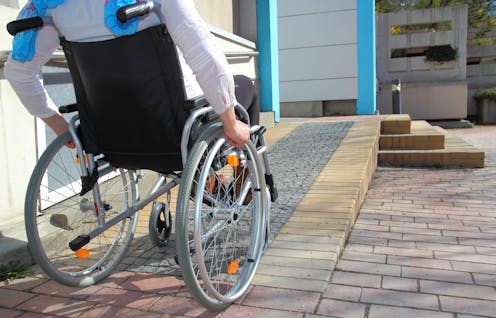
One of the most common reasons people apply for social housing is because they or their immediate family members have a disability and they are unable to work. They need an affordable alternative to private rental housing that’s suitable for their disability-related needs.
Our research on the experiences and circumstances of people on the social housing waiting list has found many people with serious disabilities are not guaranteed access to social housing. The following three case studies, drawn from our interviews, illustrate how the long wait for social housing makes their extremely difficult situations worse.
Read more: Not just ramps and doorways – disability housing is about choosing where, how and who you live with
Paul
Paul* has serious mobility problems and requires a wheelchair. He lives by himself in Sydney. He had been on the social housing priority waiting list for just under a year and had no idea of how much longer he would have to wait. But the house he was living in was unsuitable. As Paul explained:
“The nature of the accommodation has been assessed […] and it’s not suitable for me to live in […] There is a bathroom, but to do the shower you have to stand inside the tub […] so I can’t do that shower any more […] And the doors are not wide enough for the wheelchair to go through.”
Access to the house is also difficult.
“The condition of the [path] from the house going to the road it’s not good and it’s very difficult.”
Paul is on the National Disability Insurance Scheme (NDIS) and eligible for an electric wheelchair. But he says:
[T]hey won’t approve […] until I have a proper accommodation […] they want to make sure whether it’s going to be used in the house.“
Mark
Two of Mark’s three children have complex mental and physical disabilities. His wife also has a disability. He gave up paid work 20 years ago to be their full-time carer.
Through community housing he found a subsidised private rental property.
"We were there from 2002 until 2019 in the same house that was very not suitable for people with disabilities. It was just a three-bedroom normal house that was run down that as the kids grew up […] and my wife’s getting worse. The house was just absolutely not suitable […] for our situation.”
His pleas for suitable social housing fell on deaf ears. In 2019 Mark felt he had to move.
“I just couldn’t hack it anymore. The kids are getting bigger. It’s getting very hard for me to look after them cos I was the main carer and I have to shower them, toilet them, you know all that stuff, and you know the house was small […] sometimes they had to be in a wheelchair, [but] there was no wheelchair access.
"So eventually I just gave up and found a house that I’m renting now […] I’m paying private rent but being on priority housing I get subsidised from public housing […] It’s still not suitable, but it’s a bit bigger and a little bit better.
Mark summed up his experience:
"I’ve been on the waiting list for over 20 years without, you know, being given a public [housing] house or […] never offered suitable housing for our situation, and until today we’re still on the priority list.”
Read more: 'Getting onto the wait list is a battle in itself': insiders on what it takes to get social housing
Despite the permanent nature of his family members’ disabilities, to continue receiving the rental subsidy Mark has to get forms filled in by a GP every six months.
“There’s a lot of paperwork involved. Every six months you’ve got to bring bank statements […] you’ve got to bring medical certificates […] and the stress, and you know […] GPs these people don’t want to sit there filling up forms for three people.
"If I take my family and I go to a GP and say, ‘Listen, can you fill up these forms?”, they say, 'No mate, […] it’s too much work for me", and I’ve got that from my GP many times. You’ve got to beg the doctor, fight with the doctor […] and this is the life you live.“
Pippa
Pippa has an intellectual disability and lives with her carer who is also her partner. Despite being homeless at times, she has been on the waiting list for around 10 years.
"They refused to put me on priority […] and I said, 'Yeah, but I don’t have anywhere to sleep. I don’t have a house or anything.’ And they basically just said, ‘Keep looking for private rental.’ We got 21 days of TA [temporary accommodation] and a little bit more during the whole year that me and my partner were homeless.”
Although they eventually found a private rental property, the insecurity and her lack of disposable income are deeply unsettling.
“I mean for me I think I need something more stable which would be [social] housing […] If it’s a place where I could kind of set my life up and you know get a job and not have to focus on, okay, the owner is going to sell or, you know, my rent’s going to go up […] if the owners sell tomorrow we would be back on the street cos there’s no way we could afford anything. There would be nowhere to go.”
Read more: Stability and security: the keys to closing the mental health gap between renters and home owners
Pippa was scathing of the NSW Department of Communities and Justice – Housing.
“The fact that Housing can’t even assist someone with a disability is very concerning […] I just think they don’t have the right kind of tools or people or anything to kind of handle someone with a disability […] they just have no idea at all.”
The situations of Paul, Mark and Pippa (who is now on the priority list) starkly illustrate how not being able to get into social housing makes their lives even more challenging. Clearly, what is required is the urgent building of social housing that is suitable for people with different disabilities.
* All the names used are pseudonyms to protect individuals’ privacy.
Authors: Alan Morris, Professor, Institute for Public Policy and Governance, University of Technology Sydney


















