

new report shows diversity still lacking on Australian free-to-air TV news
- Written by: Dimitria Groutsis, Associate professor, University of Sydney
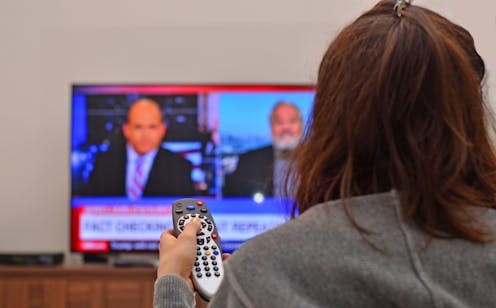
Research from the Who Gets to Tell Australian Stories? 2.0 report released today shows newsrooms across Australia are responsible for reinforcing and reproducing racial inequalities because they fail to represent the voices and faces of the society they serve.
Australia’s population is more diverse than ever. The latest ABS Census data shows just 54% of Australians now claim an Anglo-Celtic background. Around 25% have a non-European background, 18% have a European background, and 3% have an Indigenous background.
Yet new research from the University of Sydney, UTS Jumbunna Institute for Indigenous Education and Research, and Media Diversity Australia confirms the journalist workforce remains overwhelmingly Anglo-Celtic and white. The research found that almost 80% of television news and current affairs presenters on the major free-to-air networks are Anglo-Celtic. Likewise, 78% of senior network news editors are Anglo-Celtic. Just 1.3% of on-air talent on commercial networks are from a non-European background.
Concerningly, the new report shows that little progress has been made since the first report in 2020.
Particularly problematic are regional newsrooms. Regional newspapers, radio and TV stations are said to be more closely aligned with their communities than metropolitan media outlets. Regional newsrooms are also a recognised training ground for journalists and an important pathway for those seeking a foothold into Australian media more broadly.
But editors acknowledge that recruitment processes often lead to the employment of Anglo-Celtic journalists, effectively shutting the door to a more diverse workforce that will more properly represent the population it serves.
The importance of diversity in journalism
The media hold a mirror to our society – reflecting culture and helping to form opinions.
If the people framing the stories are from just one sector of society, we risk reinforcing stereotypes and reproducing inequalities. We know that a white Anglo-Celtic point of view alone is not representative of Australia in 2022.
Federal Communications Minister Michelle Rowland said last week that “media policy in this country has been ‘stuck in a rut’ of unambitious agendas and failed execution”, and that the media sector is urgently in need of a diversity strategy.
We argue that diversity must not only be measured in terms of media ownership, but in the diversity of the faces and voices being broadcast and published in the work produced by newsrooms nationally.
Our research shows the pathway to a career in journalism is too often blocked for Indigenous and culturally diverse faces and voices.
Regional newsrooms are a good place to start clearing the blockage.
What editors say about diversity
In the first half of 2022, we interviewed 19 editorial leaders from five regional media organisations around the country. The leaders were evenly split in terms of gender, age and experience. All identified as Anglo-Celtic.
We asked the leaders about the diversity of their audiences and if they considered cultural diversity when hiring staff.
The aim was to discover any practices that might be hindering the appointment of journalists from Indigenous and culturally diverse backgrounds, and to suggest ways to support the recruitment of a more diverse workforce.
Most of the editorial leaders described their communities as diverse, and said they would welcome having journalists from Indigenous or other culturally diverse backgrounds in their newsrooms.
One editor said
The best stories are forged by people working together to create a shared narrative. So, it’s critical that we are making sure that not everyone is like me in the room.
However, most also agreed that their newsrooms were mainly filled with white faces.
As captured by one interviewee:
It’s very easy to just start thinking from a mainstream white point of view, because that’s what our entire newsroom is made up of.
Where are the diverse faces and voices?
The editorial leaders suggested several reasons why the journalist workforce remains stubbornly Anglo-Celtic, including:
- a lack of applicants from diverse backgrounds
- requirements for tertiary qualifications
- time pressures that meant they looked for “easy” hires
- concerns about English language standards
- the need to ensure new recruits would “fit” the newsroom
- and a lack of industry role models.
Their responses indicate that both personal bias and structural racism – embedded in traditional recruitment strategies – could be creating barriers to journalists from Indigenous or culturally diverse backgrounds.
The editors acknowledged media organisations could do better in their efforts to recruit for diversity. But many felt the required changes were outside their scope of influence, especially given the heavy demands of local newsroom management.
Read more: Australia's media has been too white for too long. This is how to bring more diversity to newsrooms
How can media improve?
This signals that senior media leadership, including media company board members, need to step up to create the conditions to support and promote newsroom diversity.
In particular, they could:
- offer journalism scholarships and traineeships to students from diverse backgrounds
- introduce blind-screening and skills-focused criteria to the recruitment process to minimise the risk of discrimination on racial grounds
- provide a welcoming work environment that promotes role models and mentors.
Underpinning it all is the need to measure, monitor and report on diversity across the entire sector. We know that what gets measured, gets done. It’s therefore critical to monitor progress and gaps as we work towards a more inclusive and representative media.
Greater diversity isn’t just the right thing to do, it also makes good business sense. This multi-billion-dollar industry needs to start taking account of audience representation and the stories they trust, as a white Anglo-Celtic point of view alone fails to represent Australia in 2022.
Authors: Dimitria Groutsis, Associate professor, University of Sydney


















