

Why do kids bully? And what can parents do about it?
- Written by: Mandie Shean, Lecturer, School of Education, Edith Cowan University
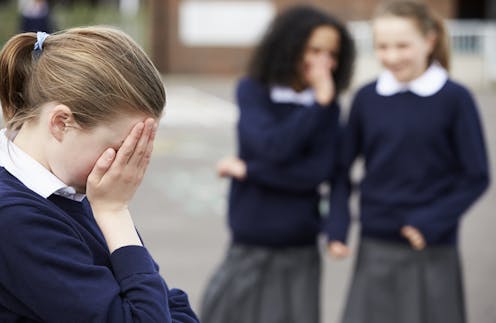
Bullying is unfortunately a common problem in Australian schools, with surveys suggesting one in five teenagers are bullied.
While schools are responsible for ensuring a safe environment, parents are likely to be distressed and unsure about what to do if their child is being bullied.
What exactly is bullying? And how can you help your child if you are concerned?
What is bullying?
Bullying is not just kids being thoughtless or a bit mean. It is not a single act, a mistake, or a mutual disagreement.
Bullying is a repeated act of aggression that is intended to cause harm. It can be physical (harming the person or their belongings), verbal (written and spoken words that cause harm), or social (isolating someone, harming their social standing, or sharing private information).
It is not a “normal” childhood experience – it is targeted and has long-lasting and serious effects for the victim.
These effects include reduced engagement in education and loneliness at school, loss of self-esteem, psychological distress, depressive symptoms, problems with sleep, suicide and suicidal ideation, non-suicidal self-injury and substance abuse.
Bullying can be overt and hidden
Bullying can be overt with observable actions like kicking or name-calling.
Or it can be covert, which is more hidden and can include whispering, exclusion, and rumours. While females and males are equally likely to have experienced bullying and are equally likely to bully, males are more likely to engage in overt physical bullying, while females are more likely to engage in covert bullying through social or cyber behaviour.
Read more: Seven ways that banter can become bullying
A 2019 Mission Australia survey found 21% of young people aged 15–19 reported bullying in the past 12 months. Of those who had been bullied, nearly 80% said the bullying took place at school.
More than 70% said the bullying was verbal, 61% said it was social, 36.5% said it was cyberbulling and about 20% said it was physical.
There is less concrete data about younger children’s experiences of bullying. One reason is they tend to over-report behaviours that would not be defined as bullying. For example, a young child may believe they are being bullied if someone does not want to play with them.
Bullying in this age group can also be viewed by some researchers and educators with less concern as it can be incorrectly labelled as a “normal” part of childhood.
Why do people bully?
Bullying behaviour is often motivated by a desire to meet basic needs for recognition, attention and approval. It is a misguided attempt to increase your popularity by making other people look small.
As UK bullying expert Elizabeth Nassem notes, if children are popular they can
achieve respect, influence, admiration and leadership over their peers – sadly, at the expense of other children.
Another reason young people is bully is because they have been mistreated, experienced shame, or bullied themselves by peers, parents, or siblings. They bully others as an attempt to seek revenge and regain a sense of self-worth.
There are also systemic reasons why young people bully. Schools that don’t adequately supervise students, or have practices or policies that exclude young people with diverse needs can contribute to bullying.
When systems exclude or shame young people, young people within the system are more likely to do the same.
How can parents help?
Bullying is a complex problem. While the onus should be on schools to fix it, parents can be empowered to support their child if they are the victim of bullying.
1. Make space for your child to tell you
Children need to talk about their experiences of bullying in order for parents to act. However, research indicates they often don’t speak out, with one study indicating only 53% of children told their teacher and 67% told their parents they were being bullied.
Young people report they don’t tell because adult responses are often ineffective, insensitive or excessive.
They also say they fear looking weak, making the situation worse, and that adult support might undermine their sense of autonomy. In one study, children explained the main reason they wouldn’t report bullying behaviour was because they “didn’t want to be a little nark” [an informer] and lose the approval of their peers.
These findings suggest it is important to provide space for your children to talk and to be well equipped to respond when they do.
Listen to your child carefully, ask them what role they would like you to play in solving the problem. Assure them you will handle the situation sensitively and with a view to protect them from further harm.
Parents can also praise their children’s maturity and strength when they report bullying and reinforce that it is not “telling-tales” or “weak” when someone’s safety is at risk.
2. Approach school
While it can be distressing to hear your child has been bullied, it is important to process these feelings before you act so you can be calm.
Your first action should be contacting the school to report the bullying. It is not advised to contact the other child’s parents directly. This can escalate the issue, break your relationship with the parent, take away your child’s power, and the other parents may not act – so it leaves the problem unresolved.
When you contact the school, ask for an investigation of the issue and a response timeline. This approach demonstrates that you are open to other perspectives and not seeking to blame anyone. It also indicates you expect an outcome.
You may also request that your child’s identity is not shared to protect them from further retaliation. If there is no response, follow up until there is a resolution. Don’t promise your child you won’t do something because if your child or another is unsafe, you need to intervene to ensure their safety.
3. Provide your child with skills
Your child can also be better equipped by teaching them emotional and interpersonal skills to help them navigate instances of bullying.
These skills include self-regulation, social skills, and problem solving. This can enable your child stay calm and not appear distressed, to be assertive when appropriate, and to consider creative ways of resolving difficult situations.
Read more: 'He was in fear of his life': bullying can be a major factor in deciding to homeschool
You can also teach your child safe, practised, and planned responses they can use in instances of bullying. One example of this is “fogging”. This is a technique where the child agrees the bully may or may not be correct but does not get defensive and upset.
For example, a bully may say “your shirt is ugly”. A fogging response would be “you may be right”. With this approach the bully is not getting a reaction to their insult and therefore not meeting their need for attention and control.
4. Gather a support crew
Help your child identify safe spaces, peers and adults they can turn to for support.
They need to understand that in the middle of the bullying behaviour, they have people they can depend on who care for them. Bullies try to isolate. Your child needs to know they are not alone, they are loved, and they are supported.
If this article has raised issues for you or your child, you can call Lifeline on 13 11 14 or Kids Helpline on 1800 55 1800.
Authors: Mandie Shean, Lecturer, School of Education, Edith Cowan University
Read more https://theconversation.com/why-do-kids-bully-and-what-can-parents-do-about-it-194812


















