

Many forests will become highly flammable for at least 30 extra days per year unless we cut emissions, research finds
- Written by: Hamish Clarke, Senior Research Fellow, The University of Melbourne
Without strong climate action, forests on every continent will be highly flammable for at least 30 extra days per year by the end of the century – and this fire threat is far greater for some forests including the Amazon, according to our new study.
Our research in Nature Communications looked at 20 years of global satellite data to test the link between wildfires and “vapour pressure deficit” – a measure of the atmosphere’s power to suck moisture out of living and dead plants. It can also be thought of as how “thirsty” the air is.
Our results show that forest fire becomes much more likely above a certain threshold of vapour pressure deficit in many regions. This threshold depends on the type of forest.
Alarmingly, climate change is increasing the number of days the planet passes these crucial thresholds. But by urgently bringing global emissions down, we can minimise the number of extra wildfire days.
How a forest becomes flammable
Wildfire is an ancient, highly diverse phenomenon. Four key conditions for a fire are:
fuel: the leaves, branches, twigs and everything else that can catch alight in a forest
fuel moisture: whether fuel is dry enough to burn
ignition: the spark to set things off, such as a lightning strike
weather: conditions such as strong winds and high temperatures, which can aid a fire’s spread.
These four processes act as switches. All must be in the “on” position for a fire to take hold.
The drying out of fuel is particularly crucial for making a forest dangerously flammable. Indeed, many researchers are finding links between vapour pressure deficit (VPD) and fire activity.
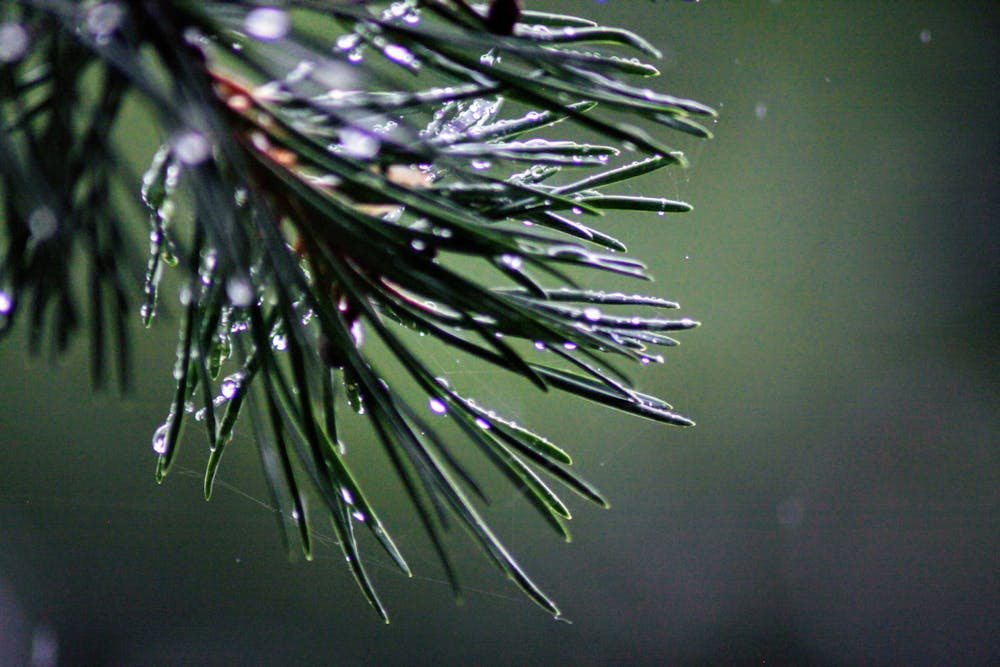 Vapour pressure deficit is lowest when the air is saturated and we see water condensing to form dew, or clouds.
Anders Mellerup/Unsplash, CC BY
Vapour pressure deficit is lowest when the air is saturated and we see water condensing to form dew, or clouds.
Anders Mellerup/Unsplash, CC BY
VPD describes the difference between how much moisture is in the air and how much moisture the air can hold when it’s saturated. Once air becomes saturated, water will condense to form clouds or dew on leaves.
Importantly, warmer air can hold more water, which means VPD increases. We refer to the air being “thirsty” when the gap between full and empty air becomes bigger, meaning there’s a greater demand (thirst) for the water to come out of living and dead plant material, drying it out.
This is a serious issue as climate change leads to rising global temperatures.
Read more: Global warming puts Arabica coffee at risk, and we're barrelling towards a crucial threshold
Climate change and fire days
We analysed more than 30 million satellite records and a global climate dataset to find the maximum daily VPD, for each time and place a fire was detected.
We then measured the strength of the relationship between VPD and fire activity for different forest types in each continent. And we showed, for the first time, that in many forests there is a strong link between fire activity and VPD on any given day.
Our results show certain VPD thresholds beyond which forest fire becomes more likely than not.
For example, in boreal forests (predominantly northern European and American coniferous forests), this threshold is 0.7-1.4 kilopascals (a unit of pressure). In subtropical and tropical forests such as the Amazon, the threshold rises dramatically to 1.5-4.0 kilopascals. This means the air must be a lot thirstier to spark fire in the tropical forests of Borneo and Sumatra than in the spruce, pine and larch of Canada.
 Climate change is dramatically raising the risk of wildfires.
Shutterstock
Climate change is dramatically raising the risk of wildfires.
Shutterstock
We looked at both low- and high-emissions scenarios and found the risks are much greater if we fail to curb emissions.
If humanity continues to release greenhouse gas emissions unabated, the planet is expected to warm by around 3.7℃ by the end of the century. Under this high-emissions scenario, our study finds there are forests on every continent that will experience at least 30 extra days per year above critical flammability thresholds.
Under a lower-emissions scenario where global warming is limited to around 1.8℃, each continent will still see at least an extra 15 days per year crossing the threshold.
Parts of tropical South America including the Amazon will see the greatest increases in both scenarios by the end of the century: at least 90 additional days in a low-emissions scenario, and at least 150 extra days in a high-emissions scenario.
What are the risks?
Increasing forest fires will have serious consequences. This includes potentially destabilising patterns of fire and regrowth and disrupting the carbon storage we rely on forests for. Indeed, research last year showed the role of the Amazon rainforest as a “carbon sink” (which absorbs more CO₂ that it releases) may already be in decline.
We can also expect increasing harms to human health from wildfire smoke. It is estimated that around the world, more than 330,000 people die each year from smoke inhalation. This number could increase notably by the turn of the century, particularly in the most populated areas of South Asia and East Africa.
Our next research project will explore the links between fire, VPD and climate change in more detail in Australia, our home country. We’re also interested in the forests and regions where VPD doesn’t seem to be the main driver of fire, such as in Japan and Scandinavia.
Our discovery of reliable links between atmospheric dryness and forest fire risk in many regions means we can now develop better fire predictions, at both seasonal and near-term scales. This could bring significant benefits to those on the frontlines of fighting, managing and coexisting with wildfire.
Read more: Lula's victory in Brazil comes just in time to save the Amazon – can he do it?
The authors gratefully acknowledge the contributions of Shiva Khanal from Western Sydney University to this article.
Authors: Hamish Clarke, Senior Research Fellow, The University of Melbourne


















