

There's a serious ethical problem with some sunscreen testing methods – and you're probably not aware of it
- Written by: Sarah Loughran, Director Radiation Research and Advice (ARPANSA), and Adjunct Associate Professor (UOW), University of Wollongong
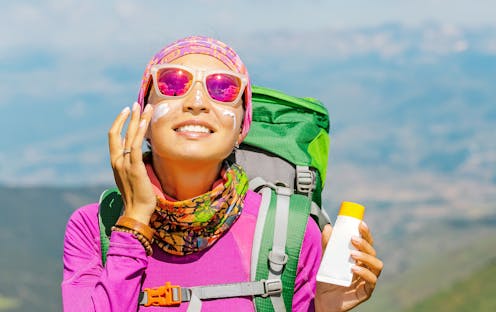
As summer approaches, we need to start remembering to slip on sun-protective clothing, slop on sunscreen, slap on a hat, seek shade where possible, and slide on sunglasses.
When it comes to sunscreen, we all know we need to wear it to protect against the harmful effects of ultraviolet (UV) radiation, which can cause skin cancer.
But what about the sun protection factor, known as the SPF rating, we see on our sunscreen bottles? It indicates the level of protection – but is it always what it says it is, and how is it actually tested?
Risking human health for SPF testing
While there have been some cases of sunscreens not matching up to their SPF claims, this is the exception and not the norm.
In Australia, we can be comfortable knowing these products are tightly regulated to ensure they are safe and meet their claimed SPF rating, according to current SPF testing methods.
However, problems arise when it comes to how sunscreens are tested for their SPF rating. Most people would not be aware that the SPF value on their sunscreen bottles is determined by testing on humans.
Ultimately, this means we are risking people’s health to test how effective our sunscreens are – and we urgently need to change this.
How is sunscreen SPF tested?
Once a sunscreen formulation has been developed by a manufacturer it needs to go through testing to ensure it only contains approved ingredients, and ultimately, that it does what it says it does.
All sunscreen products available in Australia are tested according to the Australian Standard to determine the SPF. This is great and provides assurance of safety and quality for the consumer – but the problem is with how this testing is done.
Currently, testing sunscreens on humans is the approved international standard to rate the UV protection level of a sunscreen. This testing involves volunteers wearing strictly defined amounts of sunscreen and being exposed to artificial solar UV radiation.
Performance is measured by determining the time it takes for erythema or redness to occur. This is, basically, sunburn; based on this, an SPF rating is assigned.
Why is human testing of SPF a problem?
If sunscreens only contain approved ingredients we know are safe, is it really a problem they are tested on humans?
Sadly, yes. Human testing involves exposing people to harmful UV radiation, which we know can cause skin and eye damage, as well as being the leading cause of skin cancer. This alone is unethical and unjustifiable.
There are also other issues associated with testing sunscreen on humans. For example, the use of erythema to determine sunscreen effectiveness is highly subjective, and may differ from one person to another, even for those with the same skin type. This makes the reliability of such testing methods questionable.
Further, testing is only done on a small number of people (a minimum of ten people is required in Australia). This is great for exposing as few people as possible to harmful UV radiation to determine a product’s SPF rating – but not so great when it comes to inclusiveness.
Testing such a small number of people is not representative. It does not include all skin types and leads to real challenges in achieving reproducible results across different laboratories testing the same product.
The testing itself is also very expensive. This adds to the already high cost of buying sunscreens, and potentially limits manufacturers from developing new and better products.
These, along with many other issues, highlight the urgency for non-human (in vitro) testing methods of a sunscreen’s effectiveness to be developed.
Human-free SPF testing technology is in development
While efforts have been made to develop non-human testing methods, there remain several challenges. These include the materials used to simulate human skin (also known as substrates), difficulties in applying the sunscreen to these substrates, reproducibility of results, and ensuring that results are the same as what we see with human testing.
However, scientists at RMIT University, with support from the Australian Radiation Protection and Nuclear Safety Agency (ARPANSA) and the Cancer Council Victoria, are working on a solution to this problem.
So far, they have developed a prototype sensor that changes colour when exposed to UV radiation. This sensor could be customised for human-free sunscreen testing, for example.
Reliable in vitro testing methods will mean in the future, sunscreen manufacturers would be able to quickly make and test new and better sunscreens, without being limited by the time and cost constraints involved with human testing.
So the next time you buy a bottle of sunscreen, look to purchase the highest-rated sunscreen of SPF 50+ – and know that work is underway on getting that rating classified in a more ethical way.
Read more: Are bananas really 'radioactive'? An expert clears up common misunderstandings about radiation
Authors: Sarah Loughran, Director Radiation Research and Advice (ARPANSA), and Adjunct Associate Professor (UOW), University of Wollongong


















