

50 years ago today, Gough Whitlam was elected. There are some lessons for Albanese in what came next
- Written by: Liam Byrne, Honorary Fellow, School of Historical and Philosophical Studies, The University of Melbourne
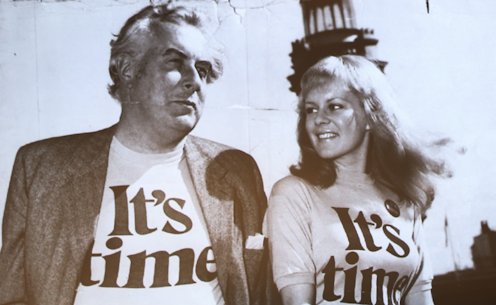
On December 2 1972, after 23 years in opposition, Gough Whitlam led the Labor party back to government. What followed was three tumultuous years of crisis and transformation, after which Australia would never be the same again.
In our own era, when many have lost faith in the ability of the parliamentary system to deliver transformative reform, there is much the modern ALP can learn from Whitlam’s example.
But the simple nostalgia-driven narratives of that time often elide the serious mistakes Whitlam made, and the dangers inherent in seeking fundamental change.
Whitlam’s ambitious program
By the time Whitlam was elected as party leader in 1967, Australia had transformed beyond recognition in the almost two decades since Labor had been in power.
Whitlam’s drive to modernise the party had earned him no small number of enemies within Labor’s ranks, but his endeavours reflected the reality that if the party did not change, it would be consigned to irrelevancy. It needed to demonstrate its “contemporary relevance”. Condemning those in the Victorian party who were determined to cling to the certainties of the past, Whitlam delivered one of his most cutting jibes: “Certainly, the impotent are pure”.
Whitlam drew on a network of intellectuals and policy heavyweights to devise a far-reaching vision of Australia’s future, and a concrete plan to realise it. This was the famed “Program”, a promise of new opportunities and modernisation, that was the basis of Whitlam’s electoral appeal.
The Program was a compelling vision of the type of country Australia could become if it embraced the possibilities of the future. It expanded Labor’s electoral appeal beyond its traditional base to the rapidly expanding ranks of professional and white-collar workers. In his famed 1972 campaign speech, Whitlam posited that the poll would be a choice between “the habits and fears of the past, and the demands and opportunities of the future”.
Read more: Jenny Hocking: why my battle for access to the 'Palace letters' should matter to all Australians
After the election, Whitlam wasted no time implementing the Program. He and his deputy, Lance Barnard, were sworn into a multitude of ministries (none secretly) until the full ministry could be appointed. This “duumvirate” sprung into action, ending conscription, removing Australian troops from Vietnam, and diplomatically recognising China.
The whirlwind of change had just begun. In the years that followed, university education was made free. Outer suburbs were provided with sewage systems. The remaining vestiges of the White Australia policy were abolished. No-fault divorce was introduced and the government supported two claims of equal pay for women. The Racial Discrimination Act was passed. The prime minister poured sand through Vincent Lingiari’s hand.
Whitlam’s downfall
Whitlam was determined to drag Australia into the future. But he was ill-prepared to deal with the seismic economic changes that were to come. Post-war politics was shaped by the elongated boom that delivered consistent growth and full employment. When the boom became bust in 1973/4 – an international phenomenon – Whitlam’s program came under serious threat. It was premised on the assumption of continuing growth. There was no Plan B.
Whitlam’s new deputy and treasurer Jim Cairns was steeped in personal controversy after a high-profile affair with his secretary, and was not politically equipped to grapple with the realities of the new era of “stagflation”: low growth, high inflation, and high unemployment.
The government pursued quixotic schemes to fund major investment projects, which led to the loan affair scandal, where attempts had been made to borrow money from international lenders, subverting usual borrowing practices and in contravention of the Australian Constitution.
The Whitlam government was losing control. This was made worse by the Coalition’s intransigent blocking of its agenda in the Senate, and the manoeuvrings that led to the dismissal in November 1975. In the December election that year, Whitlam’s Labor was categorically rejected.
Whitlam left a difficult legacy for Labor. His government’s reforms fundamentally transformed Australia for the better, but at a high cost for the party. Subsequent Labor administrations have had to question how best to balance ambition and pragmatism.
Lessons for the current Labor government
The Albanese Labor government is no different.
Whitlam floundered due to presumptions the economic framework would continue to function much as it had over the preceding decades. Once the boom was disrupted, so was Whitlam’s strategy for delivering opportunity.
The current economic shocks mean Albanese has had to confront from the outset difficult questions of how to ameliorate social inequality within the frameworks of acceptable fiscal orthodoxy.
In this difficult economic environment, the current government has managed to successfully negotiate substantive bills through the parliament to satisfy electoral pledges. But it is notable that much of what it has achieved, such as climate reduction legislation, has addressed inaction inherited from the previous government.
What Albanese’s Labor lacks is a coherent and compelling vision of the future it wants to use government to create.

And this is the danger the party faces. In a country where a quarter of the population admits to having to skip meals due to cost of living pressures, it is clear greater change than is on the agenda is required to once more capture the ethos of opportunity and equality that underpinned the Whitlam agenda.
It is quite shocking that so much of what Whitlam said, and strove to achieve, remains relevant today – 50 years on. Albanese’s Labor has so far confronted the effects of inaction it has inherited, but what is its grand vision? What is its belief in the type of Australia we can become? How will it use the power of government to actively create a new society?
A society where at the very basic level, amid such national wealth, nobody should be skipping meals to make it through the week.
While Labor has learned important lessons from the Whitlam years on competent administration, it too can learn about the significance of vision. The necessity of a program for change that brings distinct policies together into a unified conceptualisation of the politically possible that is able to regenerate a sense of enthusiasm and hope for the country’s future.
Whether this will be a government that grasps the possibilities of the future, and takes the ambitious action required to bring it into being, remains to be seen.
Authors: Liam Byrne, Honorary Fellow, School of Historical and Philosophical Studies, The University of Melbourne


















