

Why does lightning zigzag? At last, we have an answer to the mystery
- Written by: John Lowke, Adjunct Research Professor of Physics, University of South Australia
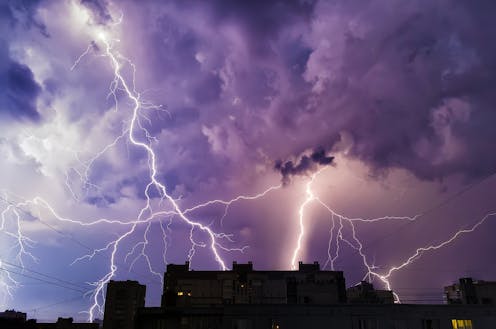
Everyone has seen lightning and marvelled at its power. But despite its frequency – about 8.6 million lightning strikes occur worldwide every day – why lightning proceeds in a series of steps from the thundercloud to the earth below has remained a mystery.
There are a few textbooks on lightning, but none have explained how these “zigzags” (called steps) form, and how lightning can travel over kilometres. My new research provides an explanation.
The intense electrical fields in thunderclouds excite electrons to have enough energy to create what are known as “singlet delta oxygen molecules”. These molecules and electrons build up to create a short, highly conducting step, which lights up intensely for a millionth of a second.
At the end of the step, there is a pause as the build-up happens again, followed by another bright, flashing leap. The process is repeated again and again.
An increase in extreme weather events means lightning protection is increasingly important. Knowing how a lightning strike is initiated means we can work out how to better protect buildings, aeroplanes and people. Also, while the use of environmentally friendly composite materials in aircraft is improving fuel efficiency, these materials increase the risk of lightning damage, so we need to look at additional protection.
What leads up to a lightning strike?
Lightning strikes happen when thunderclouds with an electric potential of millions of volts are connected to the earth. A current of thousands of amps flows between the ground and the sky, with a temperature of tens of thousands of degrees.
Photographs of lightning reveal a host of details not observed by the naked eye. Usually there are four or five faint “leaders” coming from the cloud. These are branched and zigzag on an irregular path towards the earth.
The first of these leaders to reach the earth initiates the lightning strike. The other leaders are then extinguished.
Fifty years ago, high-speed photography revealed still more complexity. The leaders progress downwards from the cloud in “steps” about 50 metres long. Each step becomes bright for a millionth of a second, but then there is almost complete darkness. After a further 50 millionths of a second another step forms, at the end of the preceding step, but the previous steps remain dark.
Why are there such steps? What is happening in the dark periods between steps? How can the steps be electrically connected to the cloud with no visible connection?
The answers to these questions lie in understanding what happens when an energetic electron hits an oxygen molecule. If the electron has enough energy, it excites the molecule into the singlet delta state. This is a “metastable” state, which means it is not perfectly stable – but it usually doesn’t fall into a lower energy state for 45 minutes or so.
Oxygen in this singlet delta state detaches electrons (required for electricity to flow) from negative oxygen ions. These ions are then replaced almost immediately by electrons (which carry a negative charge) again attaching to oxygen molecules. When more than 1% of the oxygen in the air is in the metastable state, the air can conduct electricity.
So the lightning steps occur as enough of the metastable states are created to detach a significant number of electrons. During the dark part of a step, the density of metastable states and electrons is increasing. After 50 millionths of a second, the step can conduct electricity – and the electrical potential at the tip of the step increases to approximately that of the cloud, and produces a further step.
The excited molecules created in previous steps form a column all the way to the cloud. The whole column is then electrically conducting, with no requirement of an electric field and little emission of light.
Protecting people and property
The understanding of lightning formation is important for the design of protection for buildings, aircraft and also people. While it is rare for lightning to hit people, buildings are hit many times – especially tall and isolated ones.
When lightning hits a tree, sap inside the tree boils and the resulting steam creates pressure, splitting open the trunk. Similarly, when lightning hits the corner of a building, water from rain that has seeped into the concrete boils. The pressure blasts off the whole corner of the building, creating the risk of deadly collapses.
A lightning rod invented by Benjamin Franklin in 1752 is basically a thick fencing wire attached to the top of a building and connected to the ground. It is designed to attract lightning and earth the electric charge. By directing the flow through the wire, it saves the building from being damaged.
These Franklin rods are required for tall buildings and churches today, but the uncertain factor is how many are needed on each structure.
Furthermore, hundreds of structures are not protected, including shelter sheds in parks. These structures are often made from highly conductive galvanized iron, which itself attracts lightning, and supported by wooden posts.
The new version of Standards Australia for lightning protection recommends such shelters be earthed.
Authors: John Lowke, Adjunct Research Professor of Physics, University of South Australia


















