

Like Primo Levi at Auschwitz, Behrouz Boochani testifies for the people who lived and died in a prison camp
- Written by: Jordana Silverstein, Historian, The University of Melbourne
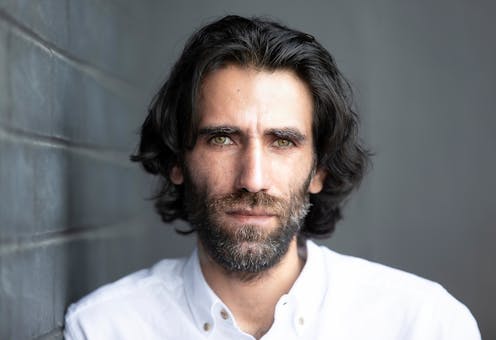
This is an edited extract from Freedom, Only Freedom: The Prison Writings of Behrouz Boochani.
Two of my grandparents were Jewish Holocaust survivors who came to Australia as displaced people, refugees or stateless – in the words they chose to use in their landing documents and naturalisation applications.
I thus find myself drawn to thinking about Behrouz Boochani’s project of writing the histories of Manus Prison as being part of the same project of history-writing as the writing about the ghettos, camps and bureaucracies of violence that made up the Holocaust.
This is not to say that the two “events” are the same, but that our understanding of one can inform our knowledge of the other. The historical insights and languages from those who were there in those places echo through time, across generations.
Read more: 70 years on, Primo Levi's If This is A Man is still a powerful reminder of what it means to be human
The language of testifying
Primo Levi, an Italian Jewish Holocaust survivor, famously wrote in his autobiography Survival in Auschwitz of the need for another language to articulate the feelings that people in the camps felt, given that
just as our hunger is not that feeling of missing a meal, so our way of being cold has need of a new word. We say “hunger”, we say “tiredness”, “fear”, “pain”, we say “winter” and they are different things. They are free words, created and used by free men.
Only a new language that could account for this radical difference could properly articulate what happened in the camps.
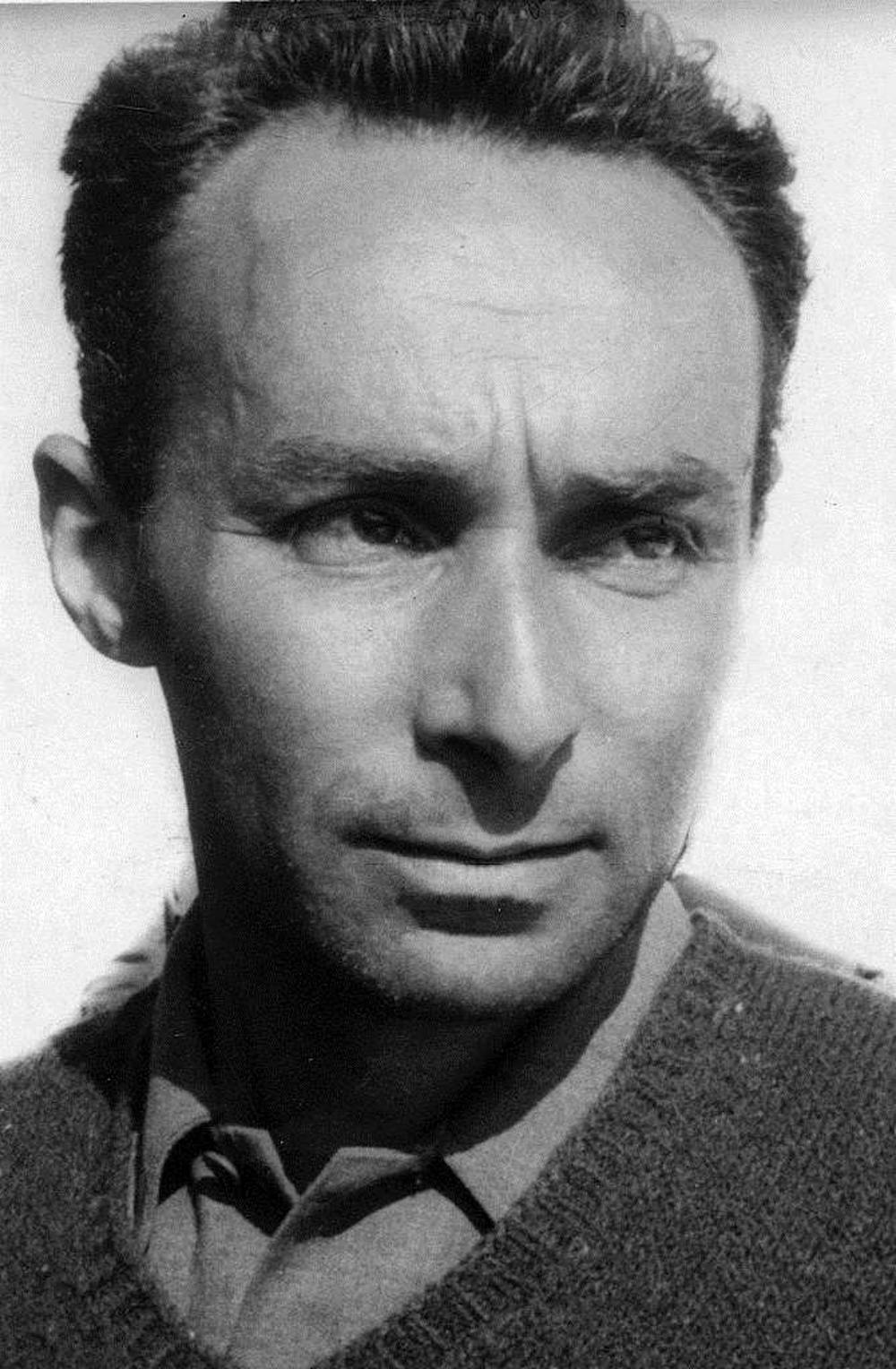
I find these words, this sentiment, playing in my mind as I read Boochani’s writings. Like Levi, Boochani is a profound writer who testifies from the camp about what he has seen, experienced and known, and who in doing so creates new theorisations and new modes of expression. Through Levi we must understand that words fail in the face of the profound violence which these men endured.
Manus Prison (a detention centre that was forcibly closed in October 2017) is not Auschwitz, but they need to be remembered within a continued historical trajectory.
And in both cases, those of us who were not there can read, and we must read. But the task of reading cannot be to know, for true knowing is an impossibility. Instead, as both Levi and Boochani make clear: they testify to history in order to do work, to make clear the workings of the world.
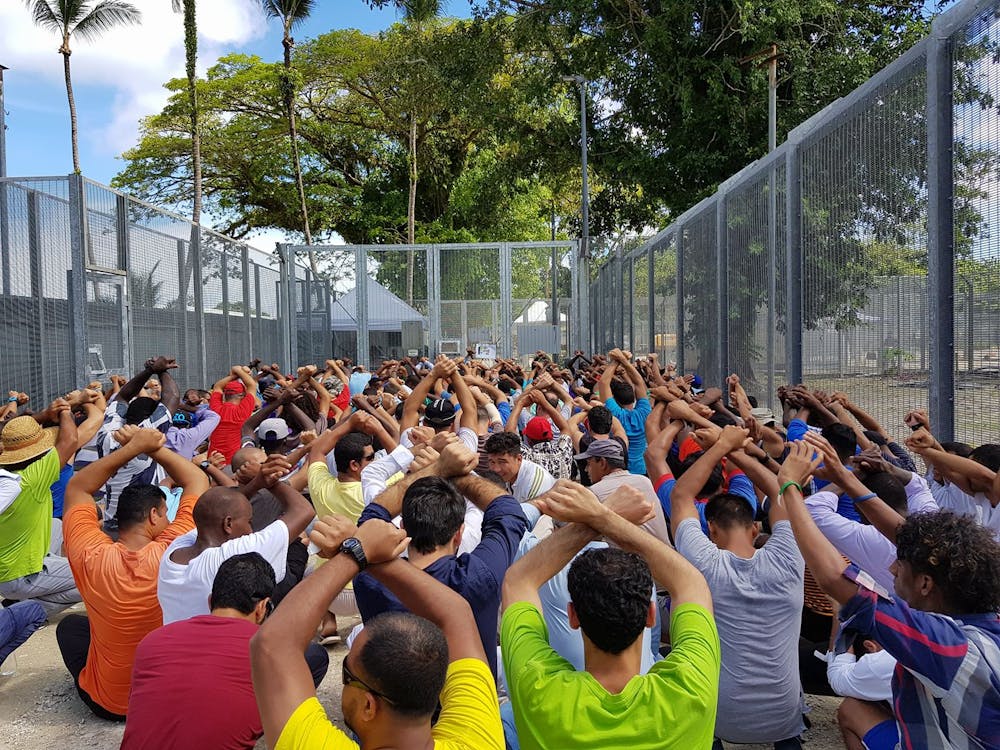 Boochani gives language to the violence and trauma of Manus Prison. Here is a photo he captured of a peaceful protest in Manus Prison, 25 August 2017.
Author provided
Boochani gives language to the violence and trauma of Manus Prison. Here is a photo he captured of a peaceful protest in Manus Prison, 25 August 2017.
Author provided
This is Manus Island
In February 2016, Boochani began his piece, This is Manus Island. My prison. My torture. My humiliation, with the words:
Twenty-eight months ago, with a shattered body which was ravenously hungry and deeply wounded, with bare feet and exhausted soul, I made the trip to the soil of free territory, to Australia. It was four days after the announcing the 19th of July law. Because of the law, I was exiled to Manus Island in Papua New Guinea, in the heart of the Pacific Ocean; and according to this law, it has been 28 months that I am being under pressure and tortured.
In this short paragraph, these three precise sentences, Boochani testifies to his readers of the physicality, the embodied nature, of trauma. Of the ways that Australian policy tries to dictate peoples’ lives.
He locates his readers in time and space, in bodies and emotions. In this piece he testifies to the horrors produced by the guards, the ways in which daily life, access to medication, and the ability to live without pain, were controlled, made impossible. Boochani gives language to the violence and trauma of Manus Prison and of the histories within which he and others lived.
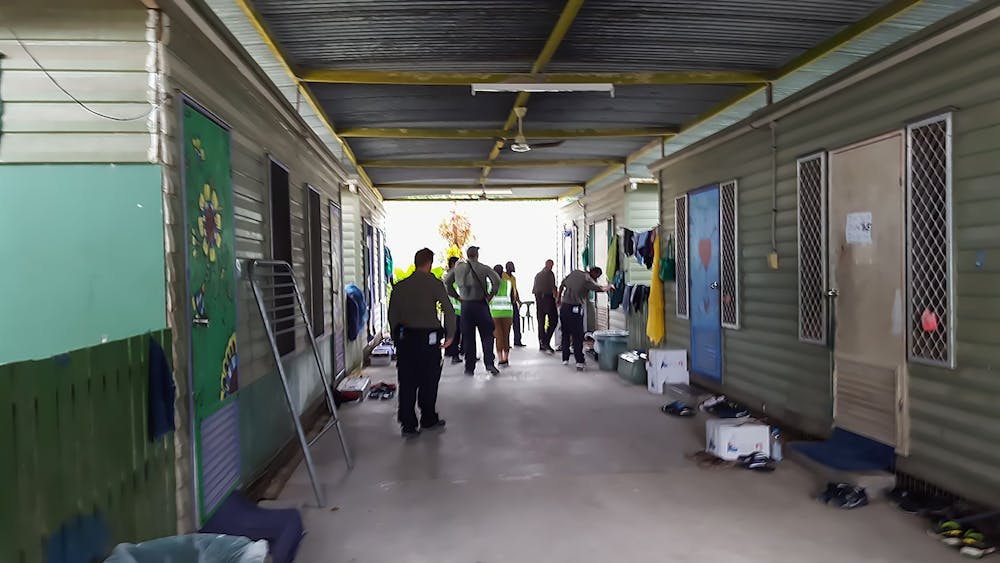 Manus Island, February 9 2017. Photo credit: Behrouz Boochani.
Author provided
Manus Island, February 9 2017. Photo credit: Behrouz Boochani.
Author provided
Histories of people
In February 2018, Boochani wrote of the murder of Reza Barati four years previously, during a riot in the prison.
In this piece, he tells his readers both of the circumstances of the riot – locating us in that time and place – as well as of the commemorations that happened around Australia on the anniversary of the killing, and of the man who Reza Barati was. Boochani testifies that justice has never been served, for there is no justice to be found within the systems and institutions that Australia uses to persecute people, laden as they are with Australia’s colonial history.
Each person’s history, Boochani shows, exists within a broader frame of coloniality. Writing in 2002, Suvendrini Perera has shown that “the Australian camp is the site where the prisoner-of-war camp meets the long-term aims of colonial assimilation/annihilation in the forms of the outstation, the penal camp and the mission”.
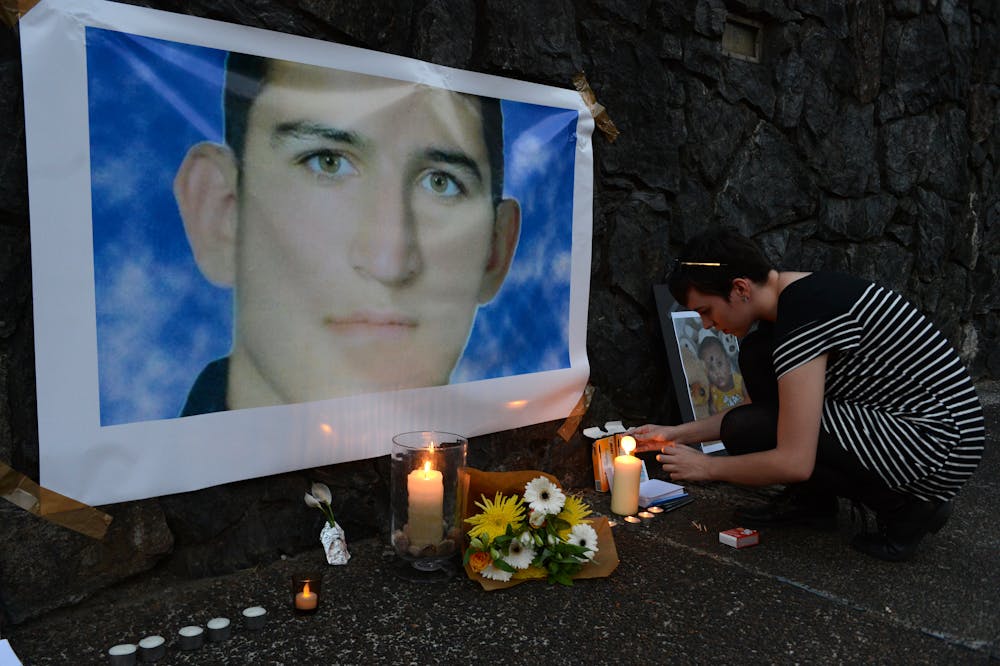 A woman lights a candle in a shrine for Reza Berati during a 2014 vigil in support of asylum seekers.
That is, while the immigration detention centre, or the camp for detaining First Nations people, has been deployed as a technique of rule across the world, in each site it has its own genealogy. Part of that genealogy in Australia, Perera shows, lies in the way governments ensure that “current policies towards asylum seekers have become normalised in Australia”.
Writing within a growing movement of refugee and First Nation scholars who link the various aspects of Australia’s colonial practices, Boochani provides the eyewitness account which fleshes out the history that Perera describes. In Patrick Wolfe’s words, settler-colonial “invasion is a structure not an event”.
In Boochani’s words, the prisons at Manus Island and Nauru “are an extension of Australia; they are an integral part of the state and this connection cannot be denied”. Each time that he writes of the coloniality of the government’s border work, Boochani makes clear precisely what is at stake: human lives.
Boochani insists on the centrality of peoples’ histories to the stories he writes. Each piece ensures he testifies to what this experience means for the people, as individuals and as a group. He locates the brutality within bodies and souls, showing how this brutality marks a person’s and a collective’s history.
When he writes of the collective, he never loses sight of the individual in all their complexity and humanity, never loses sight of their individual history, of what makes them them. Of the somethings which have happened to create them.
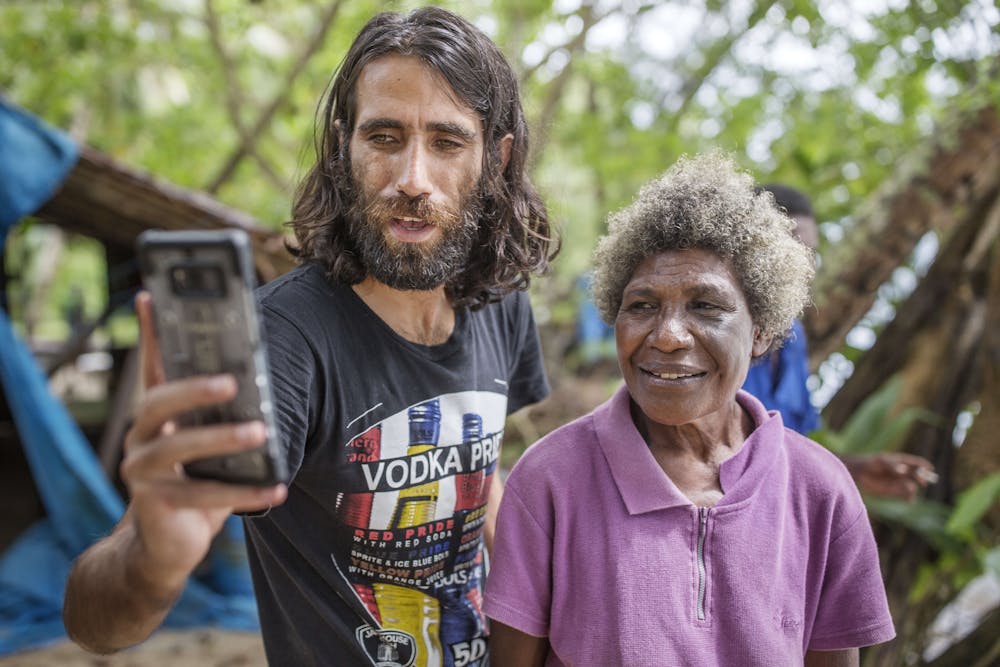 Boochani taking a selfie with local woman in Manus. Photo credit: Getty images.
Author provided
Boochani taking a selfie with local woman in Manus. Photo credit: Getty images.
Author provided
The depth of horror each of these imprisoned men faced is made visible. Horror is of course too simple a word (as Levi taught us), as is pain, trauma and devastation, though they all apply. In depicting that horror, Boochani reminds us that none of us are separate people. We are part of families and our existence testifies to the flow of connections that travel around the world.
The stories Boochani tells offer “a window into the lives of men who are experiencing a profound loneliness, the unbearable feeling that they are nothing more than forgotten people”.
In response, Boochani writes them into the public historical record, remembers them, testifies to their experience and their humanity. His writings are a project which refuses the dehumanisation and dehistoricisation that Australia’s border regime tries to impose through gross violence.
Read more: Claims that Behrouz Boochani jumped the queue are a reminder of the dangers of anti-refugee politics
A memorial archive
Writing in plain view, as the events occurred, Boochani offers a history of the people firstly, and also of the politics, spaces and ethics of the Manus Prison moment. “Writing is a duty to history,” he says.
 Writing in a tradition of histories written around the world by persecuted and marginalised groups, people who claim the mantle of writing back, Boochani writes that “this is history from down below”. This “down below” testifies to the historicity of the writing, and to the various traditions of history- and trauma-writing within which he is participating.
But it also conjures up the monumental violence of this “down below”. The
hellishness of it all, and the people at the centre.
We are reminded of our connections to others, of the ways our lives are inextricably linked to other peoples’ lives. This act of memory-making, of remembering across difference, is also a profound act of solidarity.
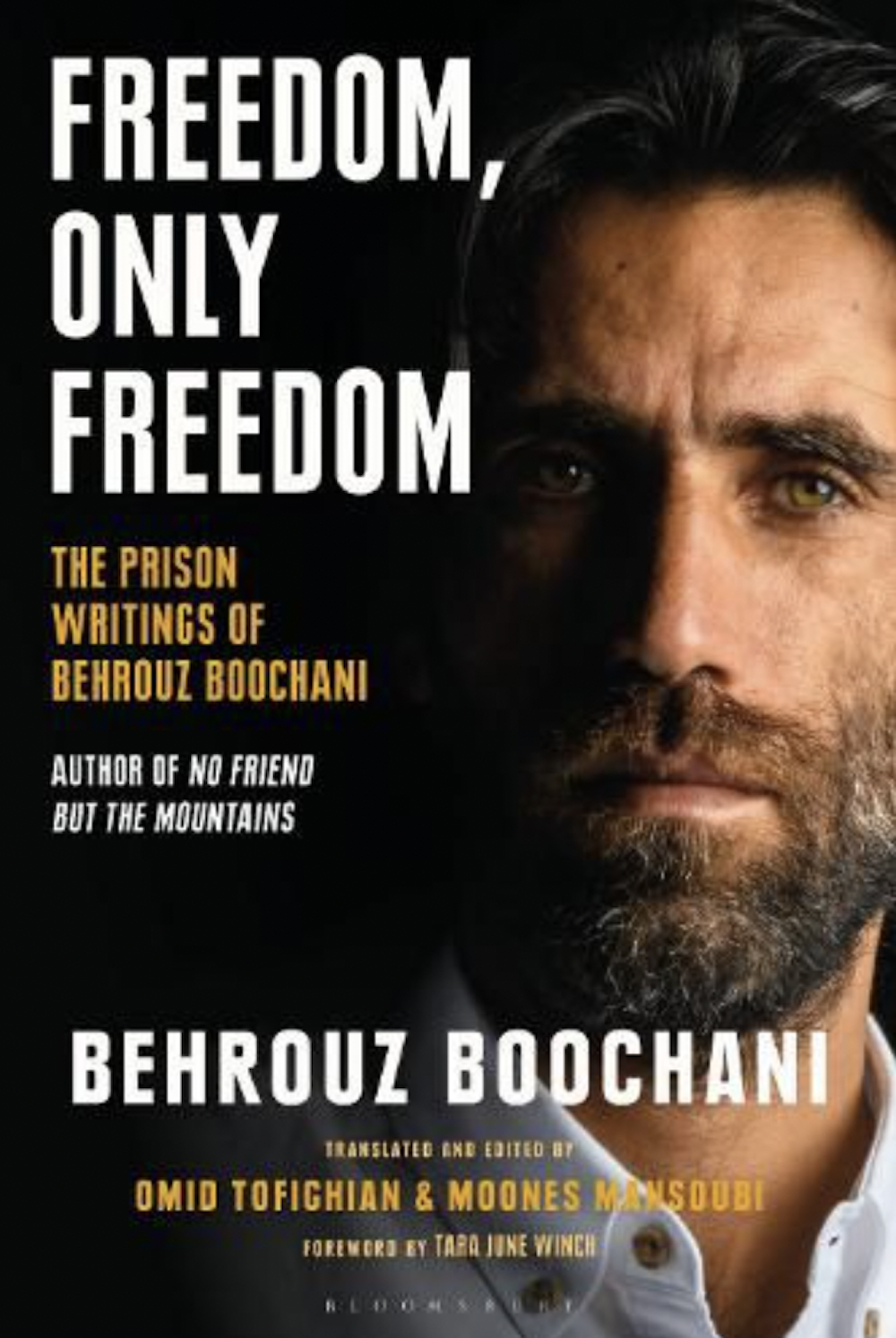
Freedom, Only Freedom: The Prison Writings of Behrouz Boochani is translated and edited by Behrouz Boochani and Moones Mansoubi (anthology editor Omid Tofighian), published by Bloomsbury.
Authors: Jordana Silverstein, Historian, The University of Melbourne
Writing in a tradition of histories written around the world by persecuted and marginalised groups, people who claim the mantle of writing back, Boochani writes that “this is history from down below”. This “down below” testifies to the historicity of the writing, and to the various traditions of history- and trauma-writing within which he is participating.
But it also conjures up the monumental violence of this “down below”. The
hellishness of it all, and the people at the centre.
We are reminded of our connections to others, of the ways our lives are inextricably linked to other peoples’ lives. This act of memory-making, of remembering across difference, is also a profound act of solidarity.
Freedom, Only Freedom: The Prison Writings of Behrouz Boochani is translated and edited by Behrouz Boochani and Moones Mansoubi (anthology editor Omid Tofighian), published by Bloomsbury.
Authors: Jordana Silverstein, Historian, The University of Melbourne 

















