

Does Australia need new laws to combat right-wing extremism?
- Written by: Keiran Hardy, Senior Lecturer, School of Criminology and Criminal Justice, Griffith University
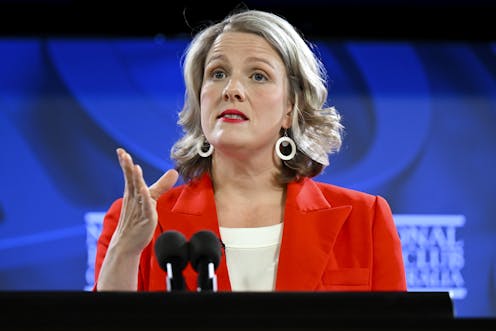
At the National Press Club this week, Home Affairs Minister Clare O’Neil flagged that Labor would propose changes to Australia’s counter-terrorism laws. She cited an increase in diverse threats beyond religious fundamentalism, a trend towards lone-actor, low-sophistication attacks, and more younger people being radicalised.
Specifically, she referred to the threat of right-wing extremism, which in 2021 was approaching 50% of ASIO’s caseload. She did not suggest the laws will be “overhauled”.
However, O'Neil hinted that changes to criminal law could target specific ways that extreme right-wing groups organise themselves compared to groups such as al-Qaeda or Islamic State.
Since the September 11 terrorist attacks, Australia has enacted at least 96 counter-terrorism laws, amounting to more than 5,500 pages of legislation. So do we need any more laws, or changes to existing laws, to combat right-wing terrorism?
Australia’s counter-terrorism laws
Australia has the largest collection of counter-terrorism laws in the world. This reflects a strong belief in legality: that powers and offences should be written into the statute books and not be left to arbitrary executive power. But it also shows how readily Australian governments have responded to evolving threats with ever-increasing powers.
Our counter-terrorism laws contain countless criminal offences and powers of surveillance, interrogation and detention. As an example, a control order can require a child as young as 14 to obey a curfew and wear an electronic monitoring bracelet to protect the public from a terrorist act or prevent support for terrorism.
Read more: Before 9/11, Australia had no counter-terrorism laws, now we have 92 — but are we safer?
Most of the offences and powers rely on a broad statutory definition of terrorism. A “terrorist act” means harmful conduct or a threat that aims to: (1) advance a political, religious or ideological cause; and (2) intimidate a government or section of the public.
Importantly, this definition is ideologically neutral – as are all the laws. They do not mention Islamist or right-wing terrorism.
The laws apply equally to these and other terror threats, no matter the ideology. A white supremacist who prepares or commits a terrorist act faces life imprisonment in the same way as a religious fundamentalist.
What changes might be made?
We won’t know the details of Labor’s proposed changes until next year.
The government might ask parliament to tweak the definition of a “terrorist organisation” in Division 102 of the federal Criminal Code. A terrorist organisation is one that is directly or indirectly preparing a terrorist act (or that advocates a terrorist act).
Various offences stem from this definition. It is a crime, for example, to recruit for a terrorist organisation or be a member of one.
The Australian government maintains a list of proscribed (banned) terrorist organisations. Of the 29 currently listed, only three adhere to far-right ideology.
This reflects a longer history of Islamist terrorism, though Australia has also lagged our closest allies in banning right-wing extremist groups.
Some features of these groups can make banning them difficult. Their membership structures, ideological demands and support for violence can be less clear compared to groups like al-Qaeda and Islamic State, which have committed and encouraged terrorist acts all around the world.
Right-wing extremist groups hold divisive rallies, exploit protests, spread racist sentiment and encourage hatred against minorities – but most of these acts do not constitute terrorism.
Expanding the definition of a terrorist organisation could capture right-wing extremist groups that are dangerous to society but do not obviously engage in or support terrorist acts.
Another possibility is that Labor could seek to ban Nazi and other hate symbols that such groups commonly use. New legislation in Victoria, which comes into force at the end of this month, makes it an offence punishable by 12 months’ imprisonment to publicly display the Nazi swastika (Hakenkreuz).
The state offence will not apply to the hundreds of hate symbols used by right-wing extremists, but it sends an important message that neo-Nazi ideology holds no place in Australian society. It provides a legal mechanism to counter threats of right-wing extremism in a way that the federal counter-terrorism laws currently do not.
Are changes needed?
Australia’s counter-terrorism laws are already extensive and apply to all types of terrorism, so no obvious strategic gaps need to be filled. If a criminal offence or power is needed to combat terrorism, Australia already has it and more.
Minor changes to Division 102 could target specific features of right-wing extremism compared to Islamist terrorism. Federal laws could supplement emerging state laws by outlawing hateful symbols used by right-wing extremists and other terrorist groups.
However, more right-wing groups could be proscribed under the laws as they currently stand. Decisive action to ban internationally recognised right-wing extremist groups, combined with a national inquiry into hate crime law and its reporting, would send a strong message. Australia’s extensive counter-terrorism laws need not be further expanded.
Authors: Keiran Hardy, Senior Lecturer, School of Criminology and Criminal Justice, Griffith University
Read more https://theconversation.com/does-australia-need-new-laws-to-combat-right-wing-extremism-196219


















