

how we are documenting sign language in a Gurindji community in northern Australia
- Written by: Jennifer Green, Postdoctoral Fellow In Australian Sign Languages, The University of Melbourne
Some people are surprised when they first hear about Australian Indigenous sign languages.
While the broader community is increasingly aware of the richness of First Nations spoken languages, sign has generally been below the radar until recently. Yet sign languages are widespread, culturally valued and of great antiquity.
Sign appears in records that go back to the early days of colonisation. Some even speculate that the handshapes found in some forms of rock art in Australia and other parts of the world may be evidence of age-old forms of signing or signalling.
Indigenous sign languages are mainly used by hearing people. They vary across the country, and there are differences in the size of their vocabularies, with an upper limit of well over 1,000 signs, as Adam Kendon found for the Warlpiri people from the Tanami Desert.
People in the Gurindji community of Kalkaringi in northern Australia call their sign language “Takataka”.
Takataka is used across the generations, and young children learn some signs and simple sign phrases before they talk. Sign is used to show respect for particular kin relations.
In times of bereavement or “sorry business” certain relatives of the deceased observe bans of silence. Gurindji wangu (widows) sign to metaphorically “keep the volume down” by not talking.
Sign is useful when hunting, not because wild animals are dangerous for humans, but because speaking could scare them off. Sign is also used when people are visible to each other yet out of hearing range, for example to communicate between people in cars about who is going where.
Documenting Gurindji sign language
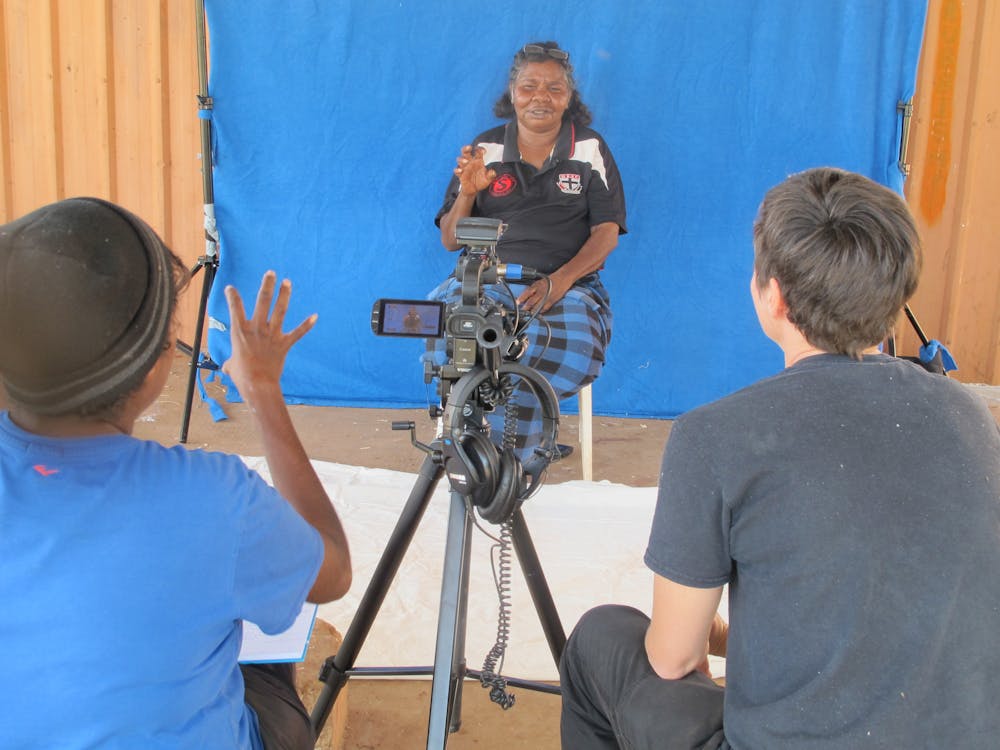
Between 2016 and 2018, we worked closely with the local art centre, Karungkarni Art, to make video documentations of Takataka. Our recently published study is the first description of Gurindji sign.
We also made educational resources for signs. We created a set of posters and a series of short films for ICTV.
One of the posters illustrates some common kin signs. The sign for ngaji (father, also used for some aunts, nephews and nieces) is formed by touching the chin.
The sign for ngumparna (husband) and mungkaj (wife) is formed by touching the back of one hand with the palm of the other.
Apart from signs for people there are signs for plants, animals, and places, as well as signs for recent phenomena such as police and money.
Read more: The 14 Indigenous words for money on our new 50 cent coin
Signs of the times
Pointing is another important part of the communicative toolkit at Kalkaringi, and it almost always accompanies discussions of locations, both near and far. People point in the correct direction, even to places out of sight.
Using accurate pointing to locate places and objects is also reflected in the spoken language. As is the case for many other Indigenous peoples, Gurindji speakers use the cardinal terms north, south, east and west to describe where things are, rather than the words left and right. It is not uncommon to hear sentences like “The flour is to the west of the sugar on the shelf”.
Another way the Gurindji demonstrate their anchoring in the world is in their signs for time. Relating times of day to the position and path of the sun is one time-reference strategy found in some sign languages of the world. Other sign languages may use the front and back of the body, or its left and right sides to distinguish past and future.
In Takataka, “tomorrow” is signed with an arced movement of the hand from east to west, as if tracking the sun and fast forwarding through the day. “Yesterday” is signed with a similar arc sweeping from west to east – a “day in reverse”.
Cassandra Algy demonstrates the signs for ‘tomorrow’ and ‘yesterday’ on an east-west axis.Other Gurindji signs, and signs from other language groups, can be found on iltyem-iltyem, a website dedicated to the signing practices of Indigenous peoples from across Central and Northern Australia.
Diversity of sign languages
Takataka is not related to Auslan, the most widespread deaf community sign language used in Australia. However, some influences from Auslan can be seen in recent innovations to Gurindji sign.
One mother of a deaf Gurindji child told us how lucky she was to discover pictures of Auslan fingerspelling in the telephone directory in the early 1990s. The mother learnt the system herself and then went on to teach her child and their classmates.
The study of Australian Indigenous sign languages contributes to the worldwide picture of diversity in sign languages and shows how the human genius for communication enlists useful resources to fulfil changing needs.
Change and innovation is a characteristic of all human languages, signed languages being no exception.
Read more: The origins of Pama-Nyungan, Australia's largest family of Aboriginal languages
Authors: Jennifer Green, Postdoctoral Fellow In Australian Sign Languages, The University of Melbourne


















