

A new study shows NZ’s young minorities feel racism differently – wealth or being able to ‘pass’ as white makes a difference
- Written by: Sonia Lewycka, Epidemiologist, Oxford University Clinical Research Unit (OUCRU)

Racism in Aotearoa New Zealand has been increasingly under the spotlight in recent years. The 2019 Christchurch mosque attacks amplified conversations about racial equality that continued in the wake of the Black Lives Matter protests.
But racism is a complicated topic and not all minorities experience it in the same way or to the same extent. As our recent research found, financial wealth and a person’s ability to “pass” as white can have a significant impact on how they experience racism. This challenges the conventional wisdom that systemic and interpersonal racism affects all minorities equally.
Recently, the government and other agencies have explicitly prioritised efforts to address racism. In 2022, the government launched the National Action Plan Against Racism, which is committed to progressively eliminating racism in all its forms.
But there is lack of agreement on what racism looks like, and consequently what constitutes effective anti-racism action. In part, this is because racism is largely still defined by histories of colonisation, although societies like New Zealand have transformed socially, culturally and demographically.
In the context of our work, racism can be broadly understood as prejudice that racial or ethnic minority groups experience within personal relationships and social institutions.
A different lived experience
Our research focused specifically on the experiences of racism among New Zealand’s “ethnic” youth – peoples from Asia, Latin America, Africa and the Middle East.
Ethnic youth make up about 17% of New Zealand’s total youth population. Many are either themselves migrants or children of migrants. There are significant disparities in visa, residency and socioeconomic status among them – from permanent, well-settled and affluent, to temporary, precarious and disadvantaged.
We argued against the assumption that all ethnic youth are equally discriminated against based solely on their ethnicity. This oversimplifies the experience of racism.
Read more: Whiteness is an invented concept that has been used as a tool of oppression
Given the diversity of ethnic migrants, we wanted to identify the factors that protected them or, alternatively, made them more vulnerable to racism.
To investigate this, we used the concept of “flexible resources” – assets or attributes that individuals possess (for example, wealth, family name, personal traits and physical features) that could act as buffers against racism.
In our study, we focused specifically on the wealth of minorities, the effect of their skin tone, and their ability to “pass as white”.
Wealth and whiteness
We examined if wealth and whiteness could protect against the race-based disadvantages ethnic youth experience. Specifically, we looked at poverty, emotional and mental distress, issues with healthcare access, bullying and discrimination by teachers, police and health providers.
We used longitudinal data from the Youth2000 survey series of over 20,000 New Zealand secondary school students (aged 13-19), collected between 2000 and 2019.
We found that, compared to their European peers, ethnic minorities experienced higher levels of poverty, overt interpersonal racism and poorer health outcomes. Both wealth and whiteness provided protections against these forms of racism, but in strikingly different ways.
Read more: Social inclusion is important in Aotearoa New Zealand — but so is speaking honestly about terrorism
Wealthier ethnic youth were less likely to experience the effects of institutional racism. This means they lived in affluent neighbourhoods, attended better-resourced schools and had fewer worries about meeting daily basic needs.
Ethnic youth from poorer backgrounds struggled on all these counts. This struggle persisted across generations.
Perceived whiteness provided protections against interpersonal racism. Ethnic minority youth who were white-passing were less likely to report being discriminated against by those in authority.
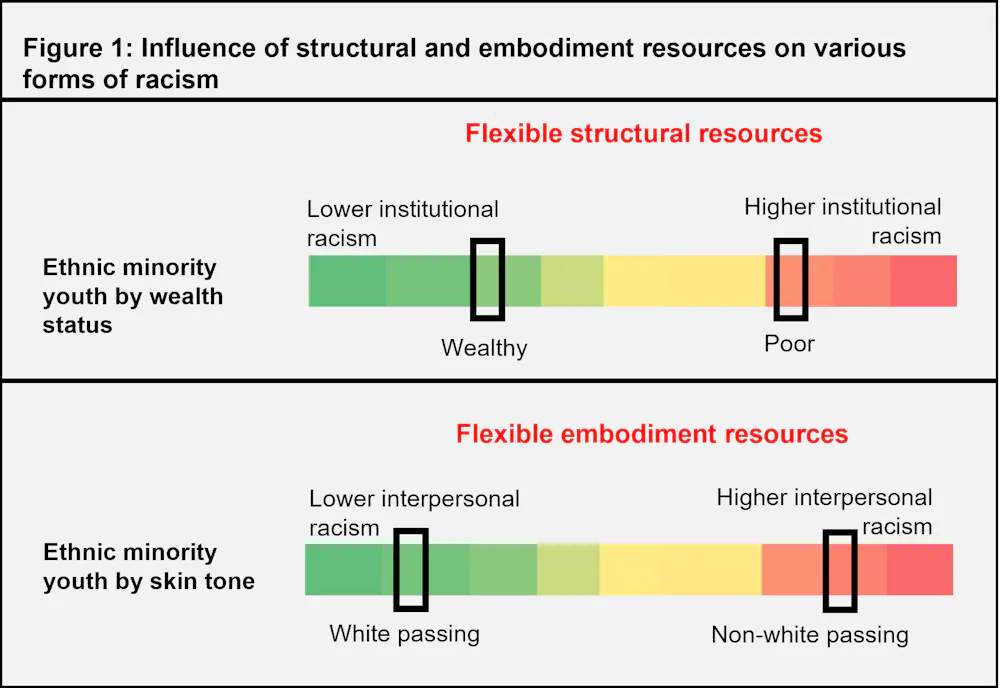
Although our study largely focused on ethnic migrant youth, our analysis also included Māori and Pasifika. The beneficial effects of wealth and whiteness were similarly evident among them.
Whiteness offers more protection
We also compared wealth and whiteness to see which of the two was more significant in protecting against racism. Quite strikingly, our results showed that being perceived as white was more protective than having wealth for New Zealand’s ethnic minority youth.
Our study significantly advances research on racism and wellbeing – showing the limitations of a one-size-fits-all approach. We need more nuanced understandings of racism, wealth and whiteness when designing anti-racism interventions.
Based on the evidence, there is a strong case for economic support – through scholarships and free healthcare – to ensure upward social mobility of minorities.
However, funding alone is not enough.
In what may be a first in New Zealand, we provide quantitative evidence for “colourism”, or biases against dark skin tones. Thus, anti-racist interventions should include wider education against the implicit and widespread advantage of whiteness in society.
Racism is an enduring form of oppression of minorities. But in today’s ethnically diverse societies it manifests in a range of ways. Researchers, policymakers and activists interested in eliminating racism must reckon with its historical continuities as much as its contemporary complexities.
Authors: Sonia Lewycka, Epidemiologist, Oxford University Clinical Research Unit (OUCRU)


















