

Uber plans a kids service to replace mum and dad's taxi. What's wrong with that? Plenty
- Written by: Hulya Gilbert, Lecturer in Planning and Human Geography, La Trobe University
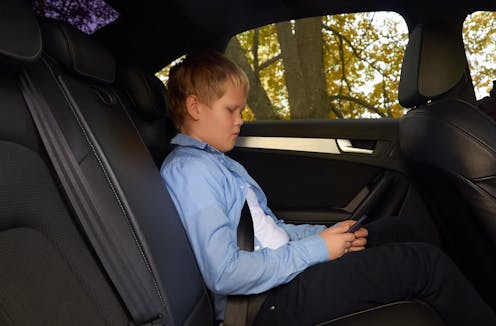
Ride-share company Uber has just rolled out an option to book vehicles equipped with a children’s car seat across Melbourne. Uber is also considering allowing unaccompanied children to use its service.
In Australia, a recent study found most parents remain unwilling to let their children use a ride-share service unaccompanied. (Uber policy, like most ride-sharing companies, currently requires a solo passenger to be over 18.) There appears to be more acceptance in countries such as the United States where child-specific ride-shares are more widespread.
Many time-poor families are desperate for better alternatives to having to drive their children everywhere they need to go. There are indeed high social, economic and environmental costs associated with parental taxis.
But outsourcing this role to ride-share services is not the best solution. It will reinforce an over-reliance on cars, which is demonstrably harmful for children’s health and wellbeing.
What are parents’ main concerns?
The Australian study identified several factors that mattered to parents. These included:
being able to decide the route of the vehicle
who is able to drive and ride in the vehicle
the presence of a designated adult waiting at the child’s destination
technological features such as GPS tracking and two-way cameras to communicate with the child during the trip.
Clearly, a few roadblocks need to be overcome before these services gain broader appeal for families with children in Australia. But what would be the impact if they did go ahead? We should consider both the problems these services could solve and the problems they might create.
“Busy parents” is a phrase that comes up often when talking about children’s transport challenges and solutions. Child-specific ride-sharing seems to be a logical response to that problem. And Uber is not the the first car service for kids in Australia.
However, the benefits gained from these “care-drivers” (driver/babysitter) are likely to be offset by new anxieties for parents.
In particular, parents worry about their children’s safety in the company of an unknown adult. When it comes to trusting a service to transport unaccompanied children, Australian research found parents were more likely to voice concerns about ride-share services than autonomous vehicles.
This is likely to remain the case despite technologies enabling real-time monitoring of the child and other desired features of the ride-share vehicle. And these surveillance technologies raise additional ethical questions.
Read more: From COVID anxiety to harassment, more needs to be done on safety in taxis and rideshare services
There’s also health and wellbeing to consider
Children’s dependence on cars to get around also affects their health. The risks range from road safety issues, noise and air pollution to being less active physically. A ride-share service for children would reinforce their families’ car dependence and the associated health issues.
Any child-specific ride-share service is also likely to magnify existing social and economic issues. To name a few:
the services would tend to be exclusive in nature, being more accessible for those who are well-off and able-bodied
passive commuting in cars would become even more passive in the absence of adults known to the children, further reducing their opportunities to construct their social identities and develop independence and self-reliance – parents, too, could have fewer opportunities to interact with each other and the broader community at school or sport events
both parents and children place a high value on the togetherness aspect of family trips to schools and extra-curricular activities, even when travelling by car. Child-only ride-share services would reduce the time spent together.
Read more: Designing suburbs to cut car use closes gaps in health and wealth
It all comes down to car dependence
The heavy reliance on private cars by families with children is one of the key challenges facing most WEIRD (Western, educated, industrialised, rich and democratic) countries. The emergence of ride-share services for children highlights the difficulties with children’s lifestyles dominated by the need to get to extra-curricular activities, often at non-local places.
Like any profit-driven approach, this kind of service raises concerns about exploitation of system-wide weaknesses. In this case, it’s the transport challenges faced by families with children.
These “solutions” also undermine various policies and programs that aim to create more socially and environmentally just communities. These include, for example, local living policies – such as so-called 20-minute neighbourhoods – which are central to most planning strategies across Australia.
Read more: People love the idea of 20-minute neighbourhoods. So why isn't it top of the agenda?
Allowing unaccompanied kids to travel in high-tech, ride-share vehicles might help some parents in the short term. In the long term, though, it will create more complex problems. These parallel many of the well-reported issues associated with lives and societies shaped by the car – known as automobility.
Happier and healthier children should be the lens to look through at any new approaches to how children get around. Plenty of equitable and cost-effective solutions exist. The most obvious involve creating the social and environmental conditions for safe and convenient walking, cycling and public transport.
Having these solutions available instead of having to drive children would help time-poor families. And children can use all these transport options in groups, which eases safety concerns. There are, for example, walking school buses and bike trains.
People and cities have much to gain from a move away from a narrow view of technology – such as retrofitting cars for monitoring and controlling children. Instead, we can use technology to promote healthier, greener and more equitable ways of getting around.
Authors: Hulya Gilbert, Lecturer in Planning and Human Geography, La Trobe University


















