

Why Pacific Islanders are staying put even as rising seas flood their homes and crops
- Written by: Merewalesi Yee, PhD Candidate, School of Earth and Environment Sciences, The University of Queensland
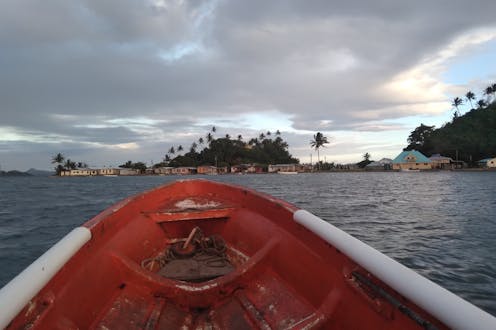
Climate change is forcing people around the world to abandon their homes. In the Pacific Islands, rising sea levels are leaving communities facing tough decisions about relocation. Some are choosing to stay in high-risk areas.
Our research investigated this phenomenon, known as “voluntary immobility”.
The government of Fiji has identified around 800 communities that may have to relocate due to climate change impacts (six have already been moved). One of these is the village on Serua Island, which was the focus of our study.
Coastal erosion and flooding have severely damaged the village over the past two decades. Homes have been submerged, seawater has spoiled food crops and the seawall has been destroyed. Despite this, almost all of Serua Island’s residents are choosing to stay.
We found their decision is based on “Vanua”, an Indigenous Fijian word that refers to the interconnectedness of the natural environment, social bonds, ways of being, spirituality and stewardship of place. Vanua binds local communities to their land.
Residents feel an obligation to stay
Serua Island has historical importance. It is the traditional residence of the paramount chief of Serua province.
The island’s residents choose to remain because of their deep-rooted connections, to act as guardians and to meet their customary obligations to sustain a place of profound cultural importance. As one resident explained:
“Our forefathers chose to live and remain on the island just so they could be close to our chief.”
The link to ancestors is a vital part of life on Serua Island. Every family has a foundation stone upon which their ancestors built their house. One resident told us:
“In the past, when a foundation of a home is created, they name it, and that is where our ancestors were buried as well. Their bones, sweat, tears, hard work [are] all buried in the foundation.”
Many believe the disturbance of the foundation stone will bring misfortune to their relatives or to other members of their village.
The ocean that separates Serua Island from Fiji’s main island, Viti Levu, is also part of the identity of men and women of Serua. One man said:
“When you have walked to the island, that means you have finally stepped foot on Serua. Visitors to the island may find this a challenging way to get there. However, for us, travelling this body of water daily is the essence of a being Serua Islander.”
The ocean is a source of food and income, and a place of belonging. One woman said:
“The ocean is part of me and sustains me – we gauge when to go and when to return according to the tide.”
Serua Islanders are concerned that relocating to Viti Levu would disrupt the bond they have with their chief, sacred sites and the ocean. They fear relocation would lead to loss of their identity, cultural practices and place attachment. As one villager said:
“It may be difficult for an outsider to understand this process because it entails much more than simply giving up material possessions.”
If residents had to relocate due to climate change, it would be a last resort. Residents are keenly aware it would mean disrupting – or losing – not just material assets such as foundation stones, but sacred sites, a way of life and Indigenous knowledge.
Voluntary immobility is a global phenomenon
As climate tipping points are reached and harms escalate, humans must adapt. Yet even in places where relocation is proposed as a last resort, people may prefer to remain.
Voluntary immobility is not unique to Fiji. Around the world, households and communities are choosing to stay where climate risks are increasing or already high. Reasons include access to livelihoods, place-based connections, social bonds and differing risk perceptions.
As Australia faces climate-related hazards and disasters, such as floods and bushfires, people living in places of risk will need to consider whether to remain or move. This decision raises complex legal, financial and logistical issues. As with residents of Serua Island, it also raises important questions about the value that people ascribe to their connections to place.
Serua Island is one of about 800 communities in Fiji being forced to consider the prospect of relocation.Read more: Coastal property prices and climate risks are both soaring. We must pull our heads out of the sand
A decision for communities to make themselves
Relocation and retreat are not a panacea for climate risk in vulnerable locations. In many cases, people prefer to adapt in place and protect at-risk areas.
No climate adaptation policy should be decided without the full and direct participation of the affected local people and communities. Relocation programs should be culturally appropriate and align with local needs, and proceed only with the consent of residents.
In places where residents are unwilling to relocate, it is crucial to acknowledge and, where feasible, support their decision to stay. And people require relevant information on the risks and potential consequences of both staying and relocating.
This can help develop more appropriate adaptation strategies for communities in Fiji and beyond as people move home, but also resist relocation, in a warming world.
Authors: Merewalesi Yee, PhD Candidate, School of Earth and Environment Sciences, The University of Queensland


















