

Modern Australian
The Times

Astronomers reveal the most detailed radio image yet of the Milky Way's galactic plane

  • Written by Andrew Hopkins, Professor of Astronomy, Macquarie University
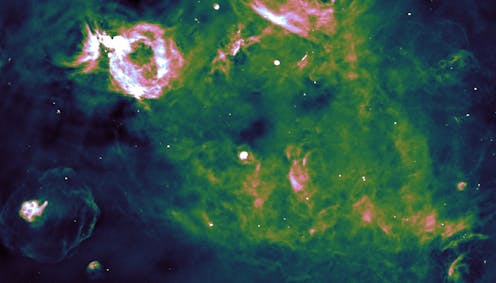
Astronomers reveal the most detailed radio image yet of the Milky Way's galactic plane

Two major astronomy research programs, called EMU and PEGASUS, have joined forces to resolve one of the mysteries of our Milky Way: where are all the supernova remnants?

A supernova remnant is an expanding cloud of gas and dust marking the last phase in the life of a star, after it has exploded as a supernova. But the number of supernova remnants we have detected so far with radio telescopes is too low. Models predict five times as many, so where are the missing ones?

We have combined observations from two of Australia’s world-leading radio telescopes, the ASKAP radio telescope and the Parkes radio telescope, Murriyang, to answer this question.

The gas between the stars

Comparison between the ASKAP/EMU image and the combined ASKAP/EMU plus Parkes/PEGASUS image. Images: R. Kothes (NRC) and E. Carretti (INAF).

The new image reveals thin tendrils and clumpy clouds associated with hydrogen gas filling the space between the stars. We can see sites where new stars are forming, as well as supernova remnants.

In just this small patch, only about 1% of the whole Milky Way, we have discovered more than 20 new possible supernova remnants where only seven were previously known.

These discoveries were led by PhD student Brianna Ball from Canada’s University of Alberta, working with her supervisor, Roland Kothes of the National Research Council of Canada, who prepared the image. These new discoveries suggest we are close to accounting for the missing remnants.

So why can we see them now when we couldn’t before?

The ASKAP radio telescope, showing radio dishes pointed at a blue sky with the sun in the background.
The ASKAP radio telescope at Inyarrimanha Ilgari Bundara, the CSIRO Murchison Radio-astronomy Observatory in Western Australia. CSIRO

The power of joining forces

I lead the Evolutionary Map of the Universe or EMU program, an ambitious project with ASKAP to make the best radio atlas of the Southern Hemisphere.

EMU will measure about 40 million new distant galaxies and supermassive black holes, to help us understand how galaxies have changed over the history of the universe.

Early EMU data have already led to the discovery of odd radio circles (or “ORCs”), and revealed rare oddities like the “Dancing Ghosts”.

For any telescope, the resolution of its images depends on the size of its aperture. Interferometers like ASKAP simulate the aperture of a much larger telescope. With 36 relatively small dishes (each 12m in diameter) but a 6km distance connecting the farthest of these, ASKAP mimics a single telescope with a 6km wide dish.

That gives ASKAP a good resolution, but comes at the expense of missing radio emission on the largest scales. In the comparison above, the ASKAP image alone appears too skeletal.

The Parkes radio telescope, Murriyang, showing the 64 telescope dish.
The Parkes radio telescope, Murriyang. CSIRO

To recover that missing information, we turned to a companion project called PEGASUS, led by Ettore Caretti of Italy’s National Institute of Astrophysics.

PEGASUS uses the 64m diameter Parkes/Murriyang telescope – one of the largest single-dish radio telescopes in the world – to map the sky.

Even with such a large dish, Parkes has rather limited resolution. By combining the information from both Parkes and ASKAP, each fills in the gaps of the other to give us the best fidelity image of this region of our Milky Way galaxy. This combination reveals the radio emission on all scales to help uncover the missing supernova remnants.

Linking the datasets from EMU and PEGASUS will allow us to reveal more hidden gems. In the next few years we will have an unprecedented view of almost the entire Milky Way, about a hundred times larger than this initial image, but with the same level of detail and sensitivity.

We estimate there may be up to 1,500 or more new supernova remnants yet to discover. Solving the puzzle of these missing remnants will open new windows into the history of our Milky Way.

ASKAP and Parkes are owned and operated by CSIRO, Australia’s national science agency, as part of the Australia Telescope National Facility. CSIRO acknowledge the Wajarri Yamatji people as the Traditional Owners and native title holders of Inyarrimanha Ilgari Bundara, the CSIRO Murchison Radio-astronomy Observatory, where ASKAP is located, and the Wiradjuri people as the traditional owners of the Parkes Observatory.

Authors: Andrew Hopkins, Professor of Astronomy, Macquarie University

Read more https://theconversation.com/astronomers-reveal-the-most-detailed-radio-image-yet-of-the-milky-ways-galactic-plane-197905

Celebration of Life vs Traditional Funeral: What's the Difference?

When saying goodbye to someone you love, there is no single way to honour their life. Every family has different traditions, beliefs, and preference...

Building Approval for Roofing Projects: What Homeowners Need to Know

Roofing projects are an important part of maintaining and protecting your home. Whether you're repairing storm damage, replacing an ageing roof, or ...

Chatswood Tutoring And Its Role In Academic Achievement

Academic success often requires more than classroom attendance alone. Students face increasing expectations as they progress through school, particu...

Why Laser Hair Removal Treatments Continue Growing In Popularity

Managing unwanted hair can become time-consuming and frustrating for many people, especially when shaving, waxing, and other temporary methods requi...

Choosing the Right Devices for a Flexible Workplace

For IT leaders managing large fleets, the device layer is where workforce productivity and security policy meet. The shift towards flexible and hybrid...

How Business Advisory Services Help Companies Achieve Sustainable Growth

Every business owner aims to build a profitable and sustainable organisation. While dedication, innovation, and hard work are important, achieving l...

Why Body Contouring Has Become A Popular Cosmetic Treatment

Many people maintain healthy lifestyles through regular exercise and balanced eating habits but still struggle with stubborn areas of fat that are d...

How to Choose the Right POS Hardware for Your Business in Australia

A lot of Australian business owners spend weeks researching POS software but buy hardware almost as an afterthought. That's a mistake. The wrong har...

Why Material Handling Hose Is Critical for Industrial Efficiency

A high-performance material handling hose is an essential component in industries that transport abrasive, dry, or bulk materials on a daily basis...

How to Choose the Right Lawyer in Melbourne for Your Situation

Choosing legal support can feel difficult, especially when the stakes are personal or business-related. The right lawyer in Melbourne should underst...

Hoteliers Look to Clever Value Adds to Increase Revenue

The Australian hospitality industry is still in recovery mode after a notoriously rough patch in recent years. While there has been a post-COVID tra...

Moving to Queensland? Here’s How to Prep Your Car for the Big Move North

There’s no sign of the northern migration slowing down, with thousands of southerners fleeing from chaotic lifestyles and cooler climates for a brig...

Diesel Shortage to Impact Trades and Contractors

Strait of Hormuz blockage affecting all major parts of trades and construction Trades and construction across residential, commercial and industria...

Why Holiday Home Owners Turn to Rental Management Agents

The Allure — and the Reality — of Renting Out Your Property Owning a holiday home is a dream for many Australians. Whether it's a beachside sha...

Why Finding Reliable Doctors In Bundoora Is Important For Long-Term Health

Access to quality healthcare plays an important role in maintaining overall wellbeing and managing health concerns early. Trusted Doctors in Bundoor...

Understanding the Different Types of Car Services: Minor vs Major

When it comes to car maintenance, one of the most important things every vehicle owner should understand is the difference between a minor and a maj...

How Superannuation and TPD Insurance Work Together

Superannuation is an essential part of financial planning in Australia. It is designed to provide individuals with income during retirement, helping...

Tiny Towns funding granted for Mt Hotham and Mt Buller upgrades

Alpine Resorts Victoria (ARV) has welcomed funding support from the Victorian Government’s  Tiny Towns Fund, with both Mt Hotham and Mt Buller se...

















