

Alcohol bans and law and order responses to crime in Alice Springs haven't worked in the past, and won't work now
- Written by: Thalia Anthony, Professor of Law, University of Technology Sydney
Since colonisation, “interventions” to curb Aboriginal “crime” and alcohol have been deployed to control and harm First Nations communities and people. Nowhere is this more true than in the Northern Territory.
When these moral panics reach the national media and political stage, the response has typically been top-down policies by federal and territory governments to disempower First Nations people and deny equal rights.
Read more: 'Opt-out' alcohol bans in prospect for Indigenous communities after PM's Alice Springs visit
Such approaches proceed without honouring the diverse perspectives of First Nations people. The current frenzy around the Alice Springs crime wave risks repeating the same mistakes.
Federal government ‘interventions’ have been shown not to work
In 2007, claims of endemic crime in remote Aboriginal communities precipitated the Northern Territory Intervention. This was a discriminatory set of laws against Aboriginal people, which were purportedly designed to address the “emergency” of crimes against Aboriginal children, including paedophilia rings. The latter claim was proven to be a media beat-up involving a federal government fabrication, but that did not stop the roll out of Intervention across remote Aboriginal communities and town camps for 15 years.
The federal government enacted the Northern Territory National Emergency Response Act 2007 and its successor, the Stronger Futures Act 2012. These, along with other amendments to Federal and Territory laws,
- watered down Aboriginal land rights
- constrained rights to social security
- restricted access to any alcohol
- increased policing powers in Aboriginal communities, including the right to enter homes and seize vehicles without a warrant
- undermined equal rights to bail and sentencing considerations in court
- displaced Aboriginal-controlled community councils and governance structures.
In the years after the Intervention began, there was no evidence communities or Aboriginal children were safer. Instead, increasing numbers of Aboriginal children and adults were locked up for minor offences.
In 2012, we undertook research that found increased policing of street offences, especially driving offences (driving unlicensed, uninsured and unregistered vehicles). Over the Intervention period, unprecedented numbers of Aboriginal youth and adults were detained, and Aboriginal children were taken from their families into state care.
Repeal of (some) Intervention laws
These laws were repealed last year due to the sunset clause of July 2022. However, remnants of the legislation remain in other Commonwealth and Northern Territory legislation. These include extended policing powers in remote communities, continuation of cashless welfare system (despite opt-out provisions), and a prohibition on cultural and customary law considerations in Northern Territory sentencing and bail.
Despite the Federal government’s substantial spending on the Intervention, media reports on Aboriginal crime continued unabated – resulting in more police and tougher penalties.
In 2021, a crime wave in Tennant Creek prompted the repeal of youth bail rights, making it harder for young people to get bail. This contributed to a 94% increase in the youth detention population in 2021/22. Almost all of these are Aboriginal children.
The Alice Springs crime wave and response
Over the summer, the media, business, police and politicians have redoubled their focus on the Alice Springs youth crime wave. The messaging about this crime wave has morphed.
Initially, it was depicted as primarily property damage. The “broken windows” of businesses became a metaphor, as it did in New York in the 1990s, for out-of-control youth who need to be brought back in line through tough policing.
In recent weeks, the media and political focus has shifted to alcohol-fuelled violent crime. The blame has been placed on the lifting of alcohol restrictions in Alice Springs town camps since the repeal of the Interventions legislation.
While the repeal of the bans in July were welcomed by Aboriginal organisations such as Tangentyere Council in Alice Springs, which described them as “punitive and race-based”, Country Liberal politicians immediately called for their reintroduction. The Alice Springs “crime wave” has been opportune for those seeking to reimpose blanket bans.
The response by Alice Springs local council, and the federal government and opposition has been to characterise the “crime wave” as “an absolute matter of urgency”.
The Alice Springs mayor called for an intervention. He also called for the Australian Defence Force or the Federal Police to be deployed to the area.
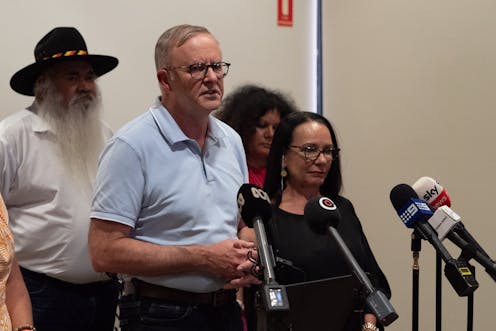
Following a “crisis” visit to Alice Springs, Prime Minister Anthony Albanese called for a partnership between the Northern Territory government and the federal government to address the problem. The government has also announced new alcohol restrictions. So far, these apply universally and not only to Aboriginal people. However, the government is also considering bans on Aboriginal communities.
What is not being heard
This knee-jerk response overlooks the long-term advocacy of First Nations organisations and the findings of the Royal Commission into Youth Detention and Children Protection in the Northern Territory.
The royal commission identified the need for more humane responses to young people rather than law and order strategies that have been rolled out in ways that inflict degrading and inhumane treatment. There have been calls for greater support for First Nations families and organisations to empower them to keep their communities and families safe.
The Northern Territory Aboriginal Justice Agreement has identified the need for better justice partnerships between government and Aboriginal communities. Yet, the media coverage has been on the need for top-down punitive and paternalistic responses.
Read more: The criminal legal system does not deliver justice for First Nations people, says a new book
An analysis and response to youth crime in the Northern Territory needs to avoid the same old politics that inevitably lead to First Nations young people becoming collateral damage. The politics of control and imprisonment have not proven effective, and as Albert Einstein would say – it is madness to retry the same things that haven’t worked.
Instead, listening to the perspectives of Aboriginal people in Alice Springs and across the Northern Territory would provide a new light for addressing safety and promoting well-being of Aboriginal and non-Aboriginal people alike.
Authors: Thalia Anthony, Professor of Law, University of Technology Sydney


















