

The hype is out of this world, but mining in space won't save the Earth
- Written by: Juliana Segura-Salazar, Research Fellow, The University of Queensland
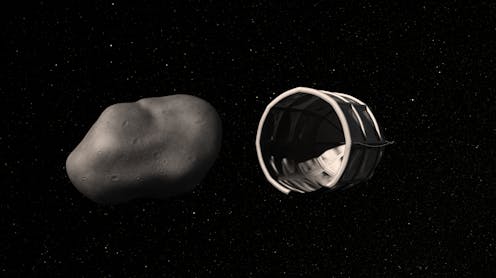
We know the world must move to cleaner energy sources to head off the worst effects of climate change, but the technology required for the transition is very mineral-intensive. So where will all these resources come from?
Many in the space industry are pointing beyond Earth. Asteroids and the Moon are thought to contain abundant platinum group elements needed in the transition, as well as other valuable resources. This has prompted a push towards commercial mining in outer space.
California-based company AstroForge is the latest company to make strides into the space mining rush. The company last week announced plans to launch two missions this year – one to refine platinum from a sample of asteroid-like material, and another to find an asteroid near Earth to mine.
Proponents of mining in space often point to the potential benefits for Earth and its people. But how certain are these benefits? Our research casts doubt on many of them.
A very risky bet
Space mining supporters often claim a bounty of space resources exist, and exploiting them would generate trillions of dollars in mining revenue.
But information on resources in space is scarce, highly varied and uncertain.
Such statements rely strongly on remote-sensing technology and modelling: techniques that use interpretations, estimates, assumptions and probabilities. Whether mineral deposits lying beyond Earth are commercially viable has not yet been proven.
Work on this is underway. The OSIRIS-REx space mission, for example, gathered a small sample from near-Earth asteroid Bennu, and is bringing it back to Earth this year so it can be studied.
This year’s AstroForge missions also aim to firm up the industry’s viability.
But so far, investing in the extraction of space resources is even more speculative than mining on Earth.
Metallic minerals are present in meteorites and other space rocks. But research suggests that, except for platinum group elements, the concentrations of most metals in space materials may be lower than on Earth.
NASA’s OSIRIS-REx space mission will arrive back on Earth this year.Where will the waste go?
Mining on Earth often requires robust equipment to extract, handle and process large volumes of rock. Most of the rock is disposed of as waste once the material of interest, such as copper, is obtained.
Waste disposal will be even more challenging in space. The full environmental and safety implications are not yet clear. But we know space debris already falls to Earth quite frequently.
For example, space debris found in the Snowy Mountains in New South Wales last year was confirmed as belonging to a craft owned by Elon Musk’s SpaceX company. And in the US state of Oklahoma in 1997, a woman out exercising was reportedly hit in the shoulder by a piece of falling space junk.
Mining on Earth often damages the natural environment, impacting land, waterways, air quality and ecosystems.
In places where mining is tightly regulated, environmental and human safety concerns must be addressed. But there are also countless examples around the world where mining regulation is lax.
To date, there are no regulations or adequate waste management plans for mining off-Earth. Space mining has a lot to learn from the best practices and missteps of mining on Earth.
Space is not a supermarket
In 2017, US space entrepreneur Jeff Bezos stated:
Every kind of element that you need is available in space in very large quantities. And so, over the next couple of hundred years, that will allow us to both continue to have a dynamic, expanding, growing, thriving, interesting civilisation, while still protecting this planet.
So will space really provide all the minerals Earth needs in coming centuries?
The current hype around off-Earth extraction centres on platinum group elements such as palladium, rhodium and platinum. These elements are present in metallic asteroids.
Platinum is used in catalytic converters to decrease emissions in car exhausts, as well as in medical equipment and electronic devices.
But we need a much broader spectrum of commodities for the low-carbon transition. For example, large quantities of lithium, cobalt and rare earth elements are needed to make batteries and magnets.
Researchers claim to have uncovered two metal-rich near-Earth asteroids that could contain very large quantities of iron, nickel and cobalt.
But the technology for accessing these minerals is still a long way off (if it happens at all). But the renewable energy transition must happen urgently – and for now, the minerals will be extracted on Earth.
A new colonialism
The current space race reflects a colonial mindset in which the powerful rush to stake a claim in new territories – and whoever gets there first gets the riches.
This narrative is one of “techno-futurism”, where progress is measured by wealth generation, which in turn relies on technology development.
Should this gold-rush style bonanza prove viable, only a small proportion of people would pocket the profits. The gap between the very rich and the rest of society would only widen.
Look down, not up
Viable and responsible space mining is a very distant prospect. But climate change is an urgent problem that needs solutions right now.
Despite the many downsides, mining on Earth remains essential to the transition to a low-carbon energy economy.
Rather than space mining, positive environmental and social outcomes on Earth are better achieved by ensuring terrestrial mining is done in the most sustainable way possible.
Authors: Juliana Segura-Salazar, Research Fellow, The University of Queensland


















