

Who moves and who pays? Managed retreat is hard, but lessons from the past can guide us
- Written by: Raven Cretney, Postdoctoral Fellow, University of Waikato
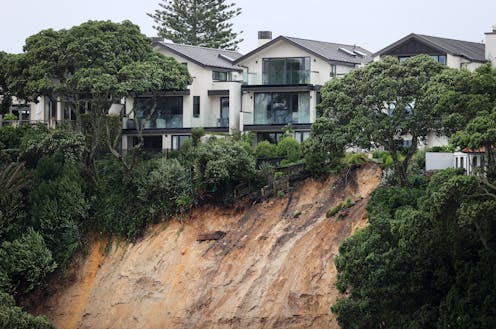
As the cleanup from the Auckland floods continues, and Cyclone Gabrielle hits already saturated parts of the North Island, many people and communities are wondering about the future of their cherished places and homes.
The increasing severity of climate-related disasters, and the vulnerability of ageing stormwater infrastructure, are now tangible and visible realities.
With this, the term “managed retreat” has gone from being a specialist one to something discussed much more widely. And with the growing prospect of repeat events, the urgent need for a national managed retreat framework is very much in focus.
The government’s first National Adaptation Plan, released in August 2022, was lauded as a welcome development in responding to climate change. Central to the plan is the role of managed retreat – the strategic relocation of people, communities, taonga and assets.
As some commentators have pointed out, however, there is an absence of detail in the plan on the enduring questions of who should move, how they will move, and who pays.
Guided by the past
The Auckland floods came as the government is preparing the first draft of its Climate Adaptation Act, part of the repeal of the Resource Management Act. This is the next step in a plan to respond to the growing risks from sea level rise and climate-related disasters.
The legislation (in parallel with the National Built Environment and Strategic Planning bills) aims to address the complex issues associated with managed retreats and how to implement them.
Our recent research suggests a close examination of the past will help guide these difficult decisions. By analysing academic research, government reports and policies, we traced the historical and political context in which managed – and unmanaged – retreats evolved in Aotearoa.
We pieced together why and how retreats gradually evolved, from being reactive and unmanaged towards being a strategic part of our national risk management framework. These insights shed light on why implementation will still be difficult, and they provide lessons for other countries grappling with similar policy options.
Communities in limbo
This journey is not linear. Decision makers and communities have tested different approaches to retreat and have confronted existing science, law and behavioural norms that supported the status quo. These experiences have all been important in making the case for a more anticipatory mindset when making policy.
Our research emphasises that managed retreat only became a mainstream option due to consistent scientific advocacy and shifts in the understanding and application of risk management over decades. It was the result of a long struggle by many committed groups.
For communities across Aotearoa, however, support and direction to enable effective managed retreat is still a waiting game. The previous pattern of ad hoc policy experiments, often based on trial and error, only increases the political risks associated with an already delicate undertaking.
This history highlights the toll that an absence of clear policy can take on individuals and communities. The examples we’ve analysed emphasise how retreats can be disruptive, produce inequitable outcomes and sever community ties.
The challenges of managing retreat without supportive policies heighten the political risk for decision makers, which means effective action may be deferred until a national framework is in place. This is particularly difficult for communities already in limbo, at risk, and without a plan for the future.
Transformative opportunities
Importantly, we emphasise that managed retreats encompass more than just physical change. Decisions to live with risk, resist or retreat are shaped by many things. These include different social and cultural relationships to a place, public expectations of state protection or compensation, and data availability.
There are diverse relationships between people, places, land and property. It’s vital that managed retreat processes empower and support communities to make decisions that reflect their specific social, cultural and environmental contexts – particularly including Te Tiriti o Waitangi and rights to tino-rangatiratanga (self-determination) for Māori land and taonga.
Read more: Slippery slopes: why the Auckland storm caused so many landslides – and what can be done about it
Policy development will need to encompass these multifaceted relationships, with flexible approaches tailored to local needs. It is also vital to start a national conversation about the role of permanent property rights and land ownership – and how managed retreat challenges the notion of perpetual property rights in certain locations.
Our historical review highlights the importance of strategic planning and support for communities to mitigate the disruptive impact of managed retreats. The right funding mechanisms that address the potential for inequitable outcomes are also necessary.
Ultimately, planning for managed retreats demands that we reform relationships between communities, place and the environment. This is about more than physical relocation. Managed retreats provide transformative opportunities to unmake and remake space, place and property, but current perceptions of permanence cast a long shadow.
We eagerly await the draft Climate Adaptation Act, and the opportunity for Aotearoa to make better planning decisions for the future. But there is still much work to be done to ensure it can be applied equitably.
Authors: Raven Cretney, Postdoctoral Fellow, University of Waikato


















