

As Syrians were trapped beneath the rubble, a broken UN system was held hostage by the Assad regime
- Written by: Dara Conduit, ARC DECRA Fellow, The University of Melbourne
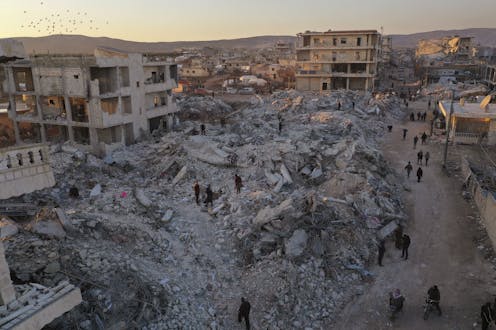
While international teams poured into Turkey to mount a furious search and rescue effort following the massive earthquake on February 6, the response on the other side of the border in Syria was catastrophically slow.
For days, Syrians remained stuck under the rubble in sub-zero temperatures waiting for help. However, the only vehicles that crossed the border from Turkey were trucks ferrying the bodies of the dead home for burial.
When the United Nations finally delivered aid to rebel-controlled northwest Syria four days after the quake, incredulous rescuers lamented that it appeared to have been packed for delivery before the earthquake. It contained less critically-needed supplies like nappies, instead of heavy machinery or disaster response supplies.
It took a full week for the Syrian government, which frequently blocks aid delivery to its opponents, to finally agree to open two additional border crossings from Turkey to allow more aid into northwestern Syria. But for many, this would come too late.
In the end, politics stood in the way of a humanitarian response that could have saved hundreds, if not thousands, of lives. The disaster unfolding before our eyes is almost entirely man-made.
An aid system mired in corruption and authoritarian politics
The more than decade-long Syrian civil war has reached something of a stalemate, but Bashar al-Assad’s regime has never regained control of the entire country.
While regime-held territory, including the cities of Aleppo, Latakia and Hama, sustained significant damage and loss of life in the quake, the worst affected part of the country is the rebel-controlled northwest, home to 4.6 million people.
Two-thirds of them have been displaced from other parts of Syria. And 4.1 million people were in desperate need of humanitarian assistance before the earthquake struck.
As of February 12, more than 4,400 people had been killed and 7,600 injured in the region. Thousands more remain missing, presumed dead.
Getting supplies into this part of Syria is not a new problem. The international community has struggled to get aid in throughout the war, leaving people increasingly vulnerable to a tragedy like the recent earthquake.
Aid is normally delivered to people via a country’s central government. However, in 2014, the UN Security Council passed a resolution to allow humanitarian assistance to be delivered to Syrians via four international border crossings, in order to help those beyond the reach of the UN’s Damascus-based aid program.
The Security Council has had to renew the resolution every six to 12 months, but following veto threats by Russia, humanitarian assistance was reduced to just the Bab al-Hawa crossing between Turkey and northwest Syria in 2020.
Russia maintains aid should be delivered via Damascus now that the war is mostly dormant. The regime, however, has been accused of stealing donations, manipulating foreign exchange rates to siphon off half of every aid dollar that’s donated, and withholding childhood polio vaccines from opposition-held territory.
The regime approved just nine UN aid deliveries between Damascus and northwest Syria between August 2021 and November 2022, highlighting the region’s almost-total dependence on aid coming across the border from Turkey.
Although experts have long argued the UN could legally use other border crossings, it has followed the Security Council resolutions to the letter.
The UN has also remained tight-lipped on the frustrations of its dealings with Damascus, apparently believing that preserving its relationship with Assad’s regime is essential to continuing the aid flows to the millions who need it inside government-controlled Syria and what little makes it to the rebel areas.
This has given the Assad regime obscene influence over aid delivery and made the UN complicit in one of the gravest failures of the international humanitarian system in recent history.
Read more: Turkey-Syria earthquake: the challenge of delivering aid in a disaster zone
Wasting time on politics
The earthquake damaged the road leading to the Bab al-Hawa crossing, delaying urgent shipments of equipment and aid for days.
Syria’s UN ambassador, meanwhile, wasted no time in predictably declaring that Syria welcomed all international aid, provided it was directed via Damascus.
Always looking for an opportunity to exploit the suffering of its own people, the regime then cynically called for sanctions relief on the government, even though many experts argued humanitarian aid was already exempt from sanctions.
Read more: Turkey-Syria earthquake: Assad blames west as agencies struggle to get aid to his desperate people
The US nevertheless announced a six-month suspension of sanctions to speed up aid deliveries. And legal experts renewed their calls for the UN to use the other functioning Turkish border crossings not damaged by the quake.
True to form, though, the UN maintained the status quo. When the Assad regime begrudgingly approved the use of two more border crossings from Turkey for the next three months, UN Secretary-General António Guterres could do little more than “welcome” the news.
While the additional crossings will temporarily increase the drip-feed of aid across the border, there had been no UN aid deliveries at all from Damascus to the rebel-held northwest at the time of writing.
Time was ultimately a luxury that Syrians did not have. While the UN danced around politics and convention, Syrians died under the rubble. A heartbroken Raed Saleh, the head of the White Helmets, who undertook much of the search-and-rescue efforts, said:
I want to begin with my apologies and deep regret to all families in all parts of Syria whose relatives we could not reach alive; just thinking about it pains our hearts. We were fighting helplessness and time to reach people alive.
The lack of adequate equipment is a big reason for this helplessness, but we swear to you that we worked and did our best.
Aid should go to groups on the ground instead
Correcting the UN’s failures is essential to preventing further loss of life.
First, the UN must find a way to protect its humanitarian mission from being held hostage by regimes that are indifferent to the plight of their own people.
While both Russia and Syria share much blame for weaponising aid, this crisis has been many years in the making and it is essential the UN takes responsibility for failing to challenge the status quo. It must now establish permanent humanitarian corridors to prevent further avoidable catastrophes.
Next, donor countries must reconsider their aid budgets given the UN system is failing to serve those most in need.
As the priorities in Syria now shift to recovery and reconstruction, wealthy states must funnel aid dollars to trusted partners on the ground in northwestern Syria, such as the White Helmets, Molham Team and Syrian Relief and Development. Individual donors should do the same.
These groups have almost single-handedly carried out the earthquake response so far, and will continue to do the heavily lifting for the foreseeable future.
Syria is on the brink of a secondary humanitarian disaster as a result of the lack of safe housing, electricity, sanitation and drinking water during a freezing winter. Now is the time for the international community to make things right by investing in reconstruction that benefits the Syrian people, rather than lines the pockets of Assad and his cronies.
Authors: Dara Conduit, ARC DECRA Fellow, The University of Melbourne


















