

the invasion changed NZ foreign policy – as the war drags on, cracks will begin to show
- Written by: Alexander Gillespie, Professor of Law, University of Waikato
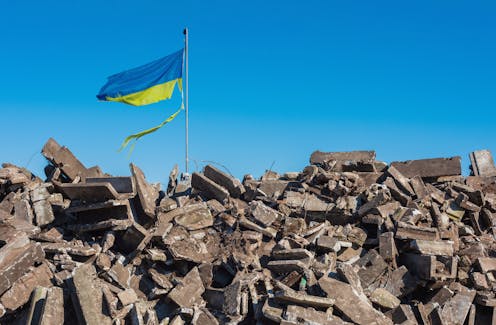
One year to the day since Russian tanks ran over the Ukraine border – and over the UN Charter and international law in the process – the world is less certain and more dangerous than ever. For New Zealand, the war has also presented a unique foreign policy challenge.
The current generation of political leaders initially responded to the invasion in much the same way previous generations responded to the first and second world wars: if a sustainable peace was to be achieved, international treaties and law were the mechanism of choice.
But when it was apparent these higher levels of maintaining international order had gridlocked because of the Russian veto at the UN Security Council, New Zealand moved back towards its traditional security relationships.
Like other Western alliance countries, New Zealand didn’t put boots on the ground, which would have meant becoming active participants in the conflict. But nor did New Zealand plead neutrality. It has not remained indifferent to the aggression and atrocities, or their implications for a rule-based world.
The issue one year on is whether this original position is still viable. And if not, what are the military, humanitarian, diplomatic and legal challenges now?
Military spending
While New Zealand has no troops or personnel in Ukraine, it has given direct support. Defence force personnel assist with training, intelligence, logistics, liaison, and command and administration support. There has also been funding and supplied equipment worth more than $NZ22 million.
This has been welcomed, although it’s considerably less on a proportional basis than the assistance offered by other like-minded countries. However, the deeper questions involve how the war has affected defence policies and spending overall internationally.
While New Zealand’s current Defence Policy Review is important at the policy level, the implications affect all citizens and political parties. Specifically, most countries – allies or not – are increasing military spending and collaborating to develop new generations of weapons.
For New Zealand, this calls into question the longer-term feasibility of its relatively low spending of 1.5% of GDP on defence. And Wellington is increasingly being left out of collaborative arrangements (AUKUS being just one example), which in turn reinforce alliances and provide pathways to technology.
This is tied to the largest question of all: whether New Zealand wishes to relegate itself to becoming a regional “police officer” or wants to carry its fair share of being part of an interlinked modern military deterrent.
Diplomacy and domestic law
New Zealand also needs to reconsider its commitment to humanitarian assistance. So far, almost $13 million has been spent and a special visa created allowing New Zealand-Ukrainians to bring family members in for two years. With the war showing no sign of ending, this will likely need to extend.
But New Zealand’s non-neutral status also means it has other responsibilities, and should consider greater assistance with the Ukrainian refugee emergency. This would require going beyond the current visa scheme, and opening and expanding the refugee quota program’s current cap of 1,500.
Read more: Ukraine war 12 months on: the role of the Russian media in reporting – and justifying – the conflict
Diplomatically, New Zealand also has to start considering what peace would look like. This raises hard questions about territorial integrity, accountability for war crimes, reparations and what might happen to populations that don’t want to be part of Ukraine.
New Zealand has enacted a stand-alone law to apply sanctions on Russia. But because this now sits outside the broken multilateral UN system, a degree of caution is called for, given the door is now open to sanction other countries, UN mandate or not.
Preparing for the worst
Finally, New Zealand needs to prepare for the worst. The war is showing no sign of calming down. Weapons and combatant numbers are escalating unsustainably. Nuclear arms control is in freefall, with Russian President Vladimir Putin suspending participation in the New START Treaty, the last remaining agreement between Russia and the United States.
At the same time, the US has ramped up the rhetoric, suggesting China might supply arms to Russia, and declaring unequivocally that Russia has committed crimes against humanity in Ukraine.
Were China to go against Western demands and provide weapons, countries like New Zealand will be in a very difficult position: its leading security ally, the US, may expect penalties to be imposed against its leading trade partner, China.
While Putin may be able to live with the rising death toll of his own soldiers (already over 100,000), at some point the Russian population won’t be. As the US discovered in Vietnam, it wasn’t the external enemy that ultimately prevailed, it was domestic unrest, as more people turned against an unpopular war.
How Putin will respond to a war he cannot win conventionally, while risking losing popularity and position at home, is impossible to predict. Everyone might hope his nuclear threats are a bluff, but New Zealand’s leaders would be wise to plan for the worst.
Whether a small, distant, non-neutral South Pacific nation might be a direct target or not is conjecture. What is not speculation, however, is that if the Ukraine war spins out of control, New Zealand would be in an emergency unlike anything it’s witnessed before.
Authors: Alexander Gillespie, Professor of Law, University of Waikato


















