The world is in deep trouble on climate change, but if we really put our shoulder to the wheel we can turn things around. Loosely, that’s the essence of today’s report by the Intergovernmental Panel on Climate Change (IPCC).
The IPCC is the world’s official body for assessment of climate change. The panel has just released its Synthesis Report, capping off seven years of in-depth assessments on various topics.
The report draws out the key insights from six previous reports, written by hundreds of expert authors. They spanned many thousands of pages and were informed by hundreds of thousands of comments by governments and the scientific community.
The synthesis report confirms humans are unequivocally increasing greenhouse gas emissions to record levels. Global temperatures are now 1.1℃ above pre-industrial levels. They’re likely to reach 1.5℃ above pre-industrial levels in the early 2030s.
IPCC
This warming has driven widespread and rapid global changes, including sea level rise and climate extremes – resulting in widespread harm to lives, livelihoods and natural systems.
It’s increasingly clear that vulnerable people in developing countries – who have generally contributed little to greenhouse gas emissions – are often disproportionately affected by climate change.
Intergenerational inequities are also likely. A child born now is likely to suffer, on average, several times as many climate extreme events in their lifetime as their grandparents did.
The world is up the proverbial creek - but we still have a paddle. Climate change is worsening, but we have the means to act.

Climate change is worsening, but we have the means to act.
Shutterstock
So much at stake
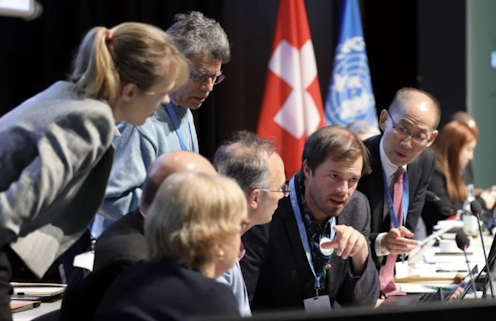
Over the past week in Interlaken, Switzerland, several hundred representatives from most of the world’s governments scrutinised the IPCC report’s 35-page summary.
The scrutiny happens sentence by sentence, often word by word, and number by number. Sometimes it’s subject to intense debate.
We were both involved in this process. The role of the reports’ authors and IPCC bureau members is to stay true to the underlying science and chart a way between different governments’ preferences. It is a unique process for scientific documents.
The approval process usually goes right to the wire, in meetings running through the night. This Synthesis Report was no exception. The scheduled time for the meeting was extended by two days and nights, wearing down government representatives and the IPCC teams.
The process reflects how much is at stake. The IPCC’s assessments are formally adopted by all governments of the world. That in turn reverberates in the private sector – for example, in the decisions of boards of major companies and investment funds.
Read more:
What can we expect from the final UN climate report? And what is the IPCC anyway?
An afternoon session of the IPCC. The meetings can drag on overnight as the final wording of IPCC reports is debated.
IISD/ENB
The latest on greenhouse gas emissions
The Synthesis Report confirms both emissions and atmospheric concentrations of greenhouse gases are now at record highs.
To keep warming within 2℃ above pre-industrial levels, global greenhouse gas emissions must decline by around 21% by 2030 and around 35% by 2035. Keeping warming below 1.5℃ requires even stronger emissions reduction.
This is a very tall order in light of emissions trajectories to date. Annual global emissions in 2019 were 12% higher than in 2010, and 54% higher than in 1990.
Read more




















