

New asteroid sample study offers further hints of space origin for the building blocks of life on Earth
- Written by: Trevor Ireland, Professor, School of Earth and Environmental Sciences, The University of Queensland
How did life come about? The answer to this question goes to the very heart of our existence on planet Earth.
Did life simply arise from chemical reactions among organic compounds in a primordial soup left after Earth clumped together from space rubble? If so, where did the organic compounds come from?
Some of the so-called “building blocks of life” may have been surprisingly common in the early Solar System.
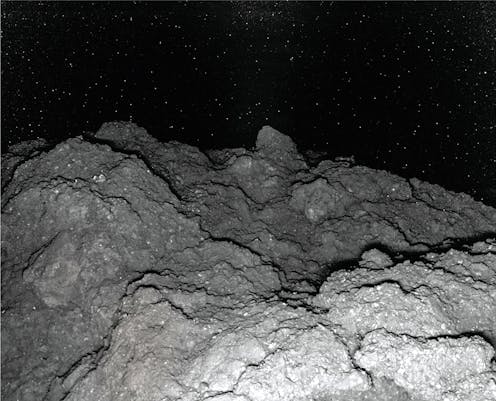
A team of Japanese and American scientists led by Yasuhiro Oba has analysed samples taken from the asteroid Ryugu in 2018 by the Hayabusa2 mission and found uracil, one of the five key bases of the RNA and DNA molecules that are crucial to life as we know it. Their study is published today in Nature Communications.
Read more: The Hayabusa2 spacecraft is about to drop a chunk of asteroid in the Australian outback
Building blocks
At the most basic level, the development of life is a matter of combining simple organic molecules into increasingly complex compounds that can participate in the myriad reactions associated with a living organism.
Simple amino acids are believed to act as building blocks in the construction of these more complex molecules. But this isn’t just a simple random combination exercise.
The largest “chunk” of the human genome, chromosome 1, is made up of 249 million base pairs (the rungs on the twisted ladder of the DNA molecule). Each base pair is made of two bases: either guanine and cytosine, or adenine and thymine.
Read more: Explainer: what is RNA?
Building from the simple base pair chemicals to a full strand of DNA is a massive undertaking. A strand of DNA also has a complex structure, which varies from one individual to another. Life on Earth uses the structure of DNA to memorise the construction of the life form involved.
Alongside DNA, life uses a molecule called RNA for making proteins and doing other odds jobs inside cells. RNA is also made of a long string of bases: guanine, cytosine and adenine (like DNA), but instead of thymine it has uracil – which is what turned up in the sample from Ryugu.
Ryugu
Ryugu is what’s called a C-type or carbonaceous asteroid. These are the most common type in the asteroid belt, making up about 75% of the asteroids we can see.
The Hayabusa2 mission established that C-type asteroids like Ryugu are the source of a kind of rare meteorite sometimes found on Earth, called a carbonaceous chondrite.
Uracil and other organic molecules have previously been found in these meteorites, but there has been no way to rule out the possibility that some of the molecules had a terrestrial origin. The meteorite samples could have been contaminated here on Earth, or their chemistry might have been changed by heating as they fell through the atmosphere.
Read more: What are asteroids made of? A sample returned to Earth reveals the Solar System's building blocks
However, since the Ryugu sample was taken from the surface of an asteroid and brought back in a tightly sealed container, scientists are confident it is free of contamination or any effects of coming to Earth.
Furthermore, the presence of these amino acids on Ryugu shows that even on asteroid surfaces, exposed to solar wind, micrometeorites and cosmic rays, organic molecules can survive transportation through the solar system.
A huge variety of different organic compounds have already been found in Ryugu samples.
Many organic molecules, such as amino acids, come in two forms: left-handed and right-handed. Life on Earth relies on left-handed amino acids, but both forms are equally common in Ryugu samples – which indicates the molecules found on Ryugu are not signs of life.
Read more: Is there life through the looking-glass? The riddle of life's single-handedness
The big picture
The Solar System formed around 4.57 billion years ago from a molecular dust cloud that was exposed to UV radiation and particle bombardment from protons.
The molecular cloud contained simple molecules such as methane (CH₄), water (H₂O) and ammonia (NH₃). These would have been fragmented by the radiation, and the fragments would have reassembled into more complex molecules such as amino acids.
C-type asteroids like Ryugu are believed to have formed so far from the Sun that the water and carbon dioxide they contain would have remained frozen. However, as the asteroids warmed up and the ice melted, liquid water would have been able to react with the rocks and minerals.
Whether these conditions led to the creation of more complex organic molecules is an open question, but certainly these conditions would be conducive to further reactions. In addition, these conditions could affect the survival of different compounds.
The Hayabusa2 samples from Ryugu provide a new context for understanding the origin of organic compounds that may have been the start of life on Earth. It is still a big step from having these organic compounds available to early Earth, and the formation of life itself.
Authors: Trevor Ireland, Professor, School of Earth and Environmental Sciences, The University of Queensland


















